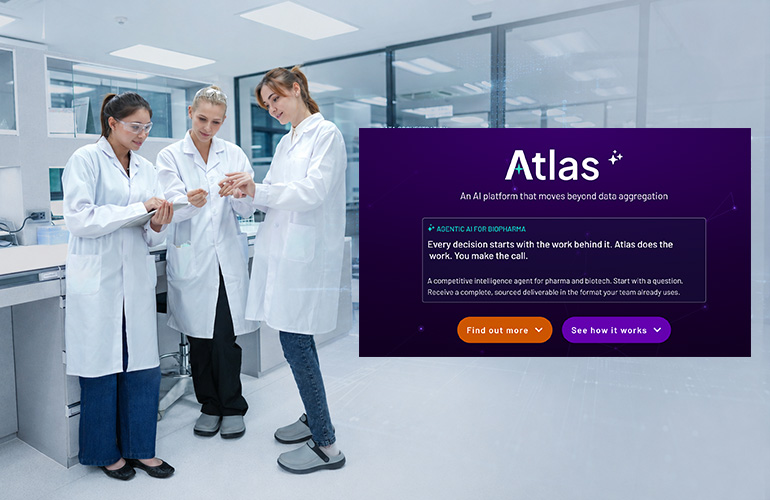
Norstella Atlas combines the company’s proprietary biopharma data with AI agents designed for specific workflows. Background image: Adobe Stock. Atlas image: Norstella.
Enterprise software in drug development tends to arrive slowly. Laboratory information management systems, quality platforms and the enterprise resource planning software they connect to typically take months to deploy. In Panorama Consulting Group’s 2026 ERP report, based on 170 organizations across industries surveyed between January 2025 and January 2026, the median project ran nine months, and almost a quarter came in over schedule. Clinical trial software can be similarly cumbersome to deploy, with study systems requiring coordination among sponsors, sites and vendors, along with contracting, technical integration and end-to-end validation before they go live. FDA guidance finalized in October 2024 sets out what sponsors and investigators are expected to do for electronic systems and records in clinical investigations to be considered trustworthy and reliable.
The pharma data and intelligence firm Norstella has launched an agentic platform, Atlas, with a much lighter onboarding model. Asked what getting started looks like, Suzanne Caruso, Norstella’s president of strategic intelligence and clinical and regulatory, said in an interview at Ai4 that the product can guide users itself: “Atlas can train you. You ask it how you want to work with it and it will give you some feedback.”
The company sells training services alongside its other products, she said, but the beta worked differently. “On the beta, we literally turn it on, confirm it’s on for beta testing, and then they go and figure it out.”

Suzanne Caruso
That experience borrows from the leading general-purpose AI systems from companies such as OpenAI and Anthropic, which users increasingly direct through ordinary language to perform tasks ranging from data analysis to software work. Atlas is “very interactive in the same way as a frontier model,” Caruso said, while being purpose-built around specific pharma workflows and Norstella’s proprietary data.
Atlas launched August 4, drawing on Norstella data ranging from clinical trials and drug pipelines to market access to real-world patient data. The data comes from Norstella’s Citeline, Evaluate, MMIT and Panalgo brands. Atlas CI, the platform’s first persona-specific agent, focuses on competitive intelligence. It can assemble competitive landscapes, drug profiles, catalyst timelines and leadership briefings, work Norstella says Atlas can deliver in minutes instead of days or weeks.
Away from ‘pockets of pilots’
Despite widespread interest in genAI, mature projects are considerably rarer than proof-of-concept projects. In a McKinsey survey of more than 100 pharma and medtech leaders published in January 2025, every respondent said their organization had experimented with genAI and 32% had taken steps to scale it. Only 5% said they had realized genAI as a competitive differentiator generating consistent and significant financial value. More recent numbers point the same way. In KPMG’s Global AI Pulse, which surveyed 2,145 senior leaders across 20 markets in May, only 7% said they had established ROI, a measure KPMG treats separately from reporting business value because it requires that the outcomes justify the investment. Frontier models have made it relatively easy to build promising pilots, but turning those pilots into dependable, domain-specific systems remains harder, Norstella notes.
Caruso described adoption at large pharma companies as fragmented across individual functions, with smaller companies applying the technology more broadly. A large organization might use AI in feasibility without the protocol design or patient recruitment teams doing the same. “That’s what we’re seeing very much on the clinical side, which is that they’re in these silos, what we call pockets of pilots,” she said.

Kris Kaneta
Kris Kaneta, Norstella’s chief product and innovation officer, said he sees a similar pattern internally. “Everyone’s got a pilot, a pet project,” he said. “The question now is, can it scale?” He put most prototype failures down to three causes: the pilot does not scale technologically, it does not fit the workflow of whoever sits upstream and downstream of the decision, or the data context is too thin to act on the conclusion. Norstella hit all three building Atlas, he said.
From general-purpose AI to pharma workflows
Against that backdrop, Atlas is Norstella’s pitch to package much of the work required to turn general-purpose AI into a production-ready pharma application. It combines Norstella’s linked data with domain expertise, agent orchestration and workflow-specific agents.
Among the challenges is giving a general-purpose model enough domain and workflow context to perform precise, repeatable work. That context layer “has to be pulled through all the way, end to end,” Kaneta said. “So when we’re building these pilots in silos, we’re losing that connected thread of, oh, that data didn’t come from me, I didn’t sign off on this data.” Norstella positions Atlas CI around that problem. “The subject matter expertise that we built into training this model means that as a user in a competitive intelligence setting, you’re engaging with a peer who in many respects understands the question you’re asking, the context in which you’re asking it, and the output you’re looking to create as you go about your job,” said Kaneta. “So we’re finding that it’s become very intuitive, because we trained it to be that peer, that sidecar companion for a competitive intelligence [workflow].”
Asked whether Atlas runs on off-the-shelf agents or ones Norstella built, Kaneta described a mix. “Our agents are going to be a mix of leveraging what’s in the frontier world, plus our domain expertise, plus our model training, plus small language models to complement it. So it’s going to be a hybrid based on the use case.” Caruso added: “We’re not really taking anything off the shelf,” she said. “Every single thing that we have internally is customized.”
The Clarity Test
Norstella says every Atlas output is evaluated against its Clarity Test, an internal benchmark requiring answers to be cited, consistent, contextual and consequential. Kaneta said consistency was a particular challenge early in development. “So if I ask it to complete the same task or answer the same question five times, is it consistent? That’s a real big one, and we struggled with that early on.”
The final criterion asks whether a subject-matter expert would act on Atlas output. “At the end of the day, I’ve got to put my name on this and say, this is my recommendation,” Kaneta said. “I’m not going to make a $3 billion molecule acquisition decision at 70 percent confidence.”
Bringing the customer’s own data in
Atlas sits atop a Norstella data estate that Kaneta said contains more than 10 trillion raw data points, distilled into a smaller set of actionable data. The context available to Atlas can also include a customer’s own information. Caruso said the platform allows users to incorporate their own files, a capability added after early testers wanted to combine Norstella’s data with material from consultancies and their own sales organizations. “We kept getting feedback in early testing that people wanted to bring their consultancies’ data in, their own sales data in, for the context of their experience,” she said
Atlas has to ingest different file types, interpret them and bring their contents into the context of the user’s ongoing work, Caruso said. “It was actually challenging.” Kaneta agreed that “the technological gap was not easy for us to overcome.”
Taking a position first
Caruso said the agent picks its own data sources. “We found in early development that it was actually better when I let the tooling decide,” she said. Caruso contrasted that with models that hand a question back to the user. “Some models are set up so that you ask a question and you get asked a question back. You ask another question, you get an answer. It’s really annoying to people,” she said. Atlas was built to take a position first and offer follow-up questions afterward. Kaneta described the design as a response to what he called the paradox of choice in AI adoption.
Asked how he counsels customers deciding whether to build, buy or partner, Kaneta reframed the question. “Don’t build for AI, build for a decision,” he said. “So often we have this hammer and we’re looking for the right nail. But what’s the question? What’s the decision we’re trying to get to?”