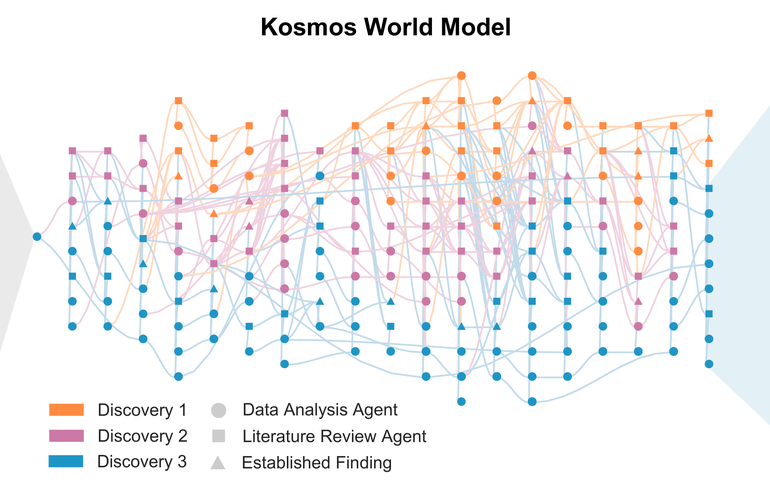
Kosmos coordinates data-analysis and literature-review agents through a shared world model; each colored path traces one discovery. Credit: Mitchener et al., arXiv 2511.02824, Fig. 1a (CC BY 4.0)
An AI scientist that ties each claim to the code it ran, the data it analyzed or the page it read is slated to work on Pfizer’s internal drug-development data in oncology, internal medicine, immunology and other areas. Edison Scientific, the San Francisco company spun out of the nonprofit research lab FutureHouse in 2025, announced on Oct. 29 an agreement to deploy the Edison AI Platform and Kosmos, its AI scientist, across Pfizer’s biopharmaceutical R&D pipeline.
In written responses to R&D World, Sam Rodriques, Edison’s CEO, said the company’s platform works “across the full R&D life cycle from target identification through clinical development and filing.” In the Pfizer collaboration, Kosmos “will develop integrated R&D world models by combining access to publicly available and proprietary data sources from Pfizer’s internal drug development efforts,” Rodriques said. Edison’s forward-deployed scientists and engineers will work with Pfizer research teams to build Kosmos into specific workflows, according to the announcement.

Sam Rodriques, Ph.D., Edison’s CEO
“Pfizer has spent decades generating data about what works and what doesn’t work in human biology,” Rodriques said in the announcement. “That experience serves as the foundation for Kosmos, ensuring lessons from each program are maximized to inform other programs, with every experiment and clinical readout strengthening the entire system.”
How Kosmos shows its work
In the Kosmos paper posted to arXiv in November 2025, independent scientists judged 79.4% of the statements in Kosmos reports to be accurate. Accuracy varied by statement type: 85.5% of data-analysis statements were reproducible, 82.1% of literature-review statements held up against primary sources and 57.9% of synthesis statements were accurate. Each run lasted up to 12 hours, executed an average of 42,000 lines of code and read 1,500 papers, according to the paper.
Asked how partner scientists can distinguish findings supported by data analysis from those involving interpretation, Rodriques pointed to Kosmos’s citation system. “What separates Kosmos is that all statements are cited back to executed code, source data, or literature, even including specific pages and figures associated with the claim,” he wrote. “Our goal is to equip scientists to see provenance and iterate on interpretations.” Rodriques added that the paper’s results “were published one year ago” and that “LLM capabilities have advanced dramatically in the last few months.”
Rodriques said Edison co-builds agents around each biopharma partner’s tasks. At Population Health Partners (PHP), a New York investment firm that creates companies and develops drugs, Edison built agents that produce IND drafts using PHP’s established rubrics, along with an agent that collaborates with experts in Microsoft Word through comments and tracked changes, “the research environment where subject matter experts are often most comfortable.”
Where the 75% and $99 million come from
Edison’s Sept. 30 case study on PHP projects a roughly 75% cut in the team time needed to prepare an IND and about $99 million in recovered peak sales per program. Rodriques said the 75% figure “is the projected time compression PHP expects in its second program with Kosmos,” based on drafting and review speedups in the first stage of the engagement, measured against a four-month baseline from PHP’s own experience.
That first stage involved a PHP program preparing for a Phase 2b study, according to the case study. Kosmos produced a first acceptable draft of a Nonclinical Overview in 4.2 hours, against roughly 100 hours of expert time, and found 98% of the source-data errors Edison planted in a draft document. Kosmos also drafted roughly 70% of the Pre-IND Briefing Meeting Request that PHP edited and submitted to FDA.
In Edison’s Sept. 30 case study, Rodriques and his co-authors break the $99 million into three potential gains per program: $42 million from cutting IND preparation from four months to one, $32 million from cutting protocol amendment turnaround from 12 weeks to three, and $25 million from reducing the probability of amendments by roughly half and nearly eliminating clinical holds.
Edison announced a similar deployment with Incyte on May 19. Incyte said it would embed Kosmos across its discovery and development work, starting with target discovery and validation and translational biology. Spark Capital, Triatomic Capital and other investors have put $70 million into Edison.

Tell Us What You Think!
You must be logged in to post a comment.