Research & Development World

  • R&D World Home
  • Topics
    • Aerospace
    • Automotive
    • Biotech
    • Careers
    • Chemistry
    • Environment
    • Energy
    • Life Science
    • Material Science
    • R&D Management
    • Physics
  • Technology
    • 3D Printing
    • A.I./Robotics
    • Software
    • Battery Technology
    • Controlled Environments
      • Cleanrooms
      • Graphene
      • Lasers
      • Regulations/Standards
      • Sensors
    • Imaging
    • Nanotechnology
    • Scientific Computing
      • Big Data
      • HPC/Supercomputing
      • Informatics
      • Security
    • Semiconductors
  • R&D Market Pulse
  • R&D 100
    • 2026 R&D 100 Award Winners
    • 2026 Professional Award Winners
    • 2026 Special Recognition Winners
    • R&D 100 Awards Event
    • R&D 100 Submissions
    • Winner Archive
  • Resources
    • Research Reports
    • Digital Issues
    • Educational Assets
    • Subscribe
    • Video
    • Webinars
    • PharmSci360
    • Content submission guidelines for R&D World
  • Global Funding Forecast
  • Top Labs
  • Advertise
  • SUBSCRIBE

10x ships a Claude agent for the single-cell analysis it left unfinished last year, on the platform it opened with NVIDIA

By Brian Buntz | November 4, 2026

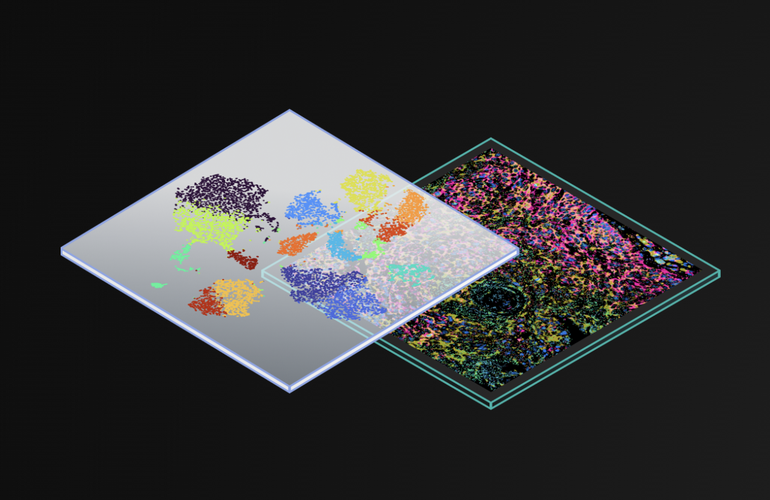
Illustration from 10x Genomics of a single-cell cluster plot on a glass panel, layered over a spatial image of tissue.

Credit: 10x Genomics

Which cell types responded most to a treatment? For a biologist with single-cell data from treated and untreated samples, answering that question often means waiting for a bioinformatician to write the code to compare them. With Sentira Single Cell, a cloud application 10x Genomics launched Nov. 2, researchers using the company’s Chromium single-cell platform can ask the question in plain English and skip writing custom code with Seurat, an R package, or Scanpy, a Python library, or waiting for a bioinformatician to write it. Inside the application, an AI agent based on Anthropic’s Claude proposes a plan, runs the analysis and gives the researcher the code behind the result, written in Python with packages such as Scanpy.

The custom coding workflows are examples of the “last mile” problem in single-cell analysis that 10x described last year in introducing Anthropic’s Claude into its cloud analysis stack. Its software could already group cells by similarities in their gene expression.

“Now, with the capabilities emerging with LLMs, it’s actually possible to automate that last mile in an agentic workflow,” Michael Schnall-Levin, chief technology officer at 10x Genomics, told R&D World on Nov. 4. “It means people who don’t write Python or R can analyze their own data and have a lot more direct access to it.”

Researchers can bring their own hypothesis or ask Sentira to suggest one from their data. They can revise the plan before the agent runs it and ask follow-up questions once they see the results. Each run produces an editable notebook that records the methods and code. The analyses run on 10x Cloud, where a lab can pursue several questions in parallel.
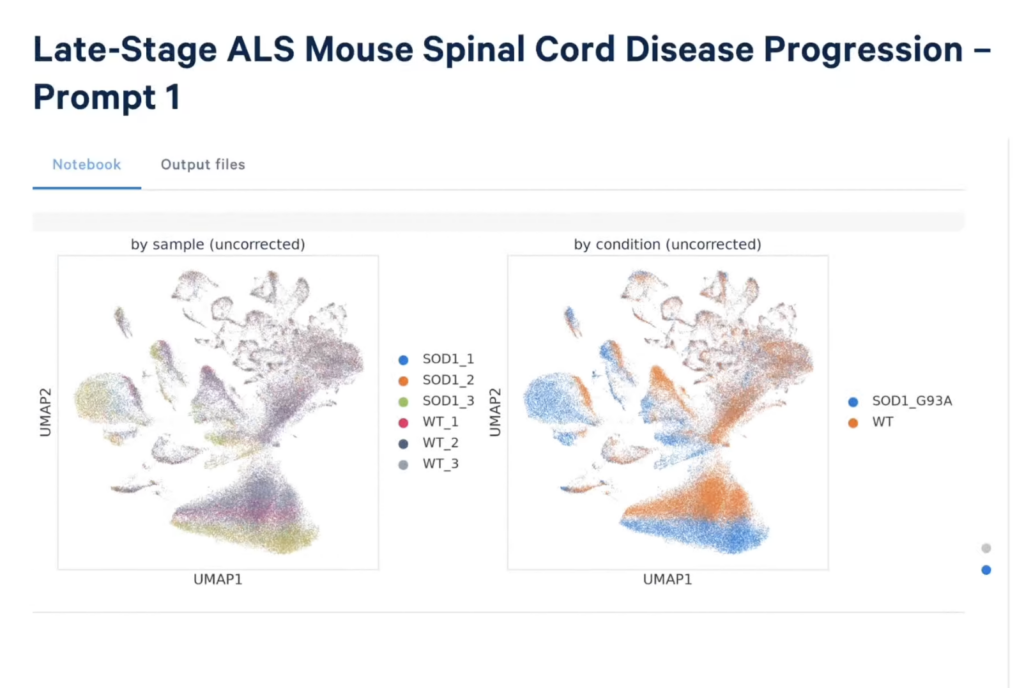
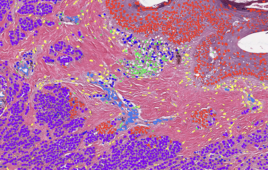
A Sentira Single Cell analysis of spinal cord cells from ALS model mice and wild-type mice. Credit: 10x Genomics

A Sentira Single Cell analysis of spinal cord cells from ALS model mice and wild-type mice. Credit: 10x Genomics

Henry Long, a scientific director at Dana-Farber Cancer Institute, pointed to speed in the launch announcement. “What stands out to me is how easily Sentira Single Cell lets us ask questions of our data directly and get answers quickly,” Long said. “The questions themselves aren’t new, but being able to ask them in natural language changes how fast we can get answers.”

To check those answers, 10x tested the agent on datasets a computational biologist had already analyzed by hand. The team then compared Sentira’s results to the biologist’s on questions with known answers. As of Nov. 4, 10x had yet to publish accuracy figures. Schnall-Levin said the company plans to publish results from those tests and the framework behind them, “so people can see what we have evaluated, what we haven’t, and the accuracy level we’ve had.”

10x prices Sentira Single Cell by consumption and offers promotional credits to get users started. A companion application, Sentira Spatial, has been in free early access since Sept. 29 for researchers using 10x’s Xenium and Atera instruments. It runs on NVIDIA GPUs with rapids-singlecell, a package that scverse, the group behind Scanpy, developed with NVIDIA. 10x says the GPUs can cut analysis cycles from hours to minutes, and it expects a paid launch in early 2027.
Tell Us What You Think! Cancel reply

You must be logged in to post a comment.

Related Articles Read More >

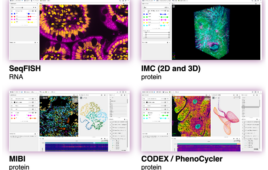
Screenshots of HuBMAP Data Portal visualizations of seqFISH, imaging mass cytometry, MIBI and CODEX/PhenoCycler data, showing fluorescent tissue images and cell clusters.
Harvard-led team says NIH-funded healthy-tissue atlas is AI-ready, but its paper warns it’s not fully representative
Agilent completes $240 million Proscia acquisition, taking ownership of the pathology software it distributed
NIH awarded more new grants in fiscal 2026, even as total awards fell
Illustration of a folded protein with three amino acid substitutions labeled: leucine to glycine, cysteine to aspartate and serine to phenylalanine.
Twist adds cell-free antibody screening for AI-designed candidates
rd newsletter
EXPAND YOUR KNOWLEDGE AND STAY CONNECTED
Get the latest info on technologies, trends, and strategies in Research & Development.

R&D World Digital Issues

Fall 2026 issue

Browse the most current issue of R&D World and back issues in an easy to use high quality format. Clip, share and download with the leading R&D magazine today.

R&D 100 Awards
Research & Development World
  • Subscribe to R&D World Magazine
  • Sign up for R&D World’s newsletter
  • Contact Us
  • About Us
  • Drug Discovery & Development
  • Pharmaceutical Processing
  • Global Funding Forecast

Copyright © 2026 Arrowfly LLC. All Rights Reserved. The material on this site may not be reproduced, distributed, transmitted, cached or otherwise used, except with the prior written permission of Arrowfly
Privacy Policy | Advertising | About Us

Search R&D World

  • R&D World Home
  • Topics
    • Aerospace
    • Automotive
    • Biotech
    • Careers
    • Chemistry
    • Environment
    • Energy
    • Life Science
    • Material Science
    • R&D Management
    • Physics
  • Technology
    • 3D Printing
    • A.I./Robotics
    • Software
    • Battery Technology
    • Controlled Environments
      • Cleanrooms
      • Graphene
      • Lasers
      • Regulations/Standards
      • Sensors
    • Imaging
    • Nanotechnology
    • Scientific Computing
      • Big Data
      • HPC/Supercomputing
      • Informatics
      • Security
    • Semiconductors
  • R&D Market Pulse
  • R&D 100
    • 2026 R&D 100 Award Winners
    • 2026 Professional Award Winners
    • 2026 Special Recognition Winners
    • R&D 100 Awards Event
    • R&D 100 Submissions
    • Winner Archive
  • Resources
    • Research Reports
    • Digital Issues
    • Educational Assets
    • Subscribe
    • Video
    • Webinars
    • PharmSci360
    • Content submission guidelines for R&D World
  • Global Funding Forecast
  • Top Labs
  • Advertise
  • SUBSCRIBE