The National Institutes of Health (NIH) made 13,686 new awards in fiscal 2026, more than it awarded in fiscal 2025 and within 2% of the 13,943 it made in fiscal 2024. Total grants still fell, mostly because of fewer annual payments on grants already underway.
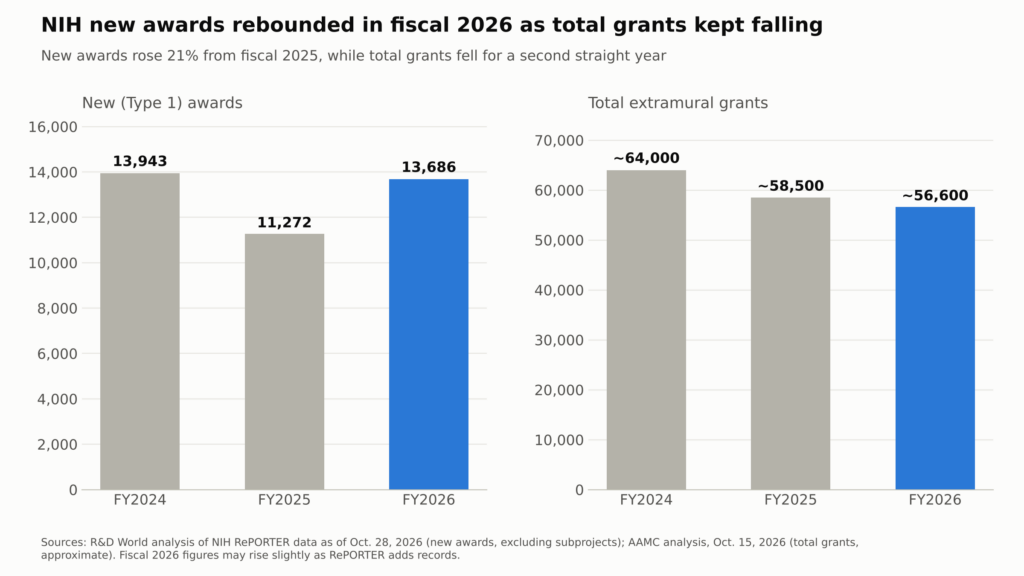
That figure comes from an R&D World analysis of data from NIH’s Research Portfolio Online Reporting Tools (RePORTER) as of Oct. 28. It counts new (Type 1) NIH-funded extramural awards, or grants to universities and other outside institutions, in fiscal 2026, which ended Sept. 30. The count excludes subprojects within larger grants and awards from other agencies listed in RePORTER, such as the VA and FDA. It is up 21% from 11,272 in fiscal 2025.
A smaller gap than projected
Credit: Tada Images – stock.adobe.com
In June, Science reported that new and renewal grants in fiscal 2026 could fall about 2,800 awards below the 2021-24 average. Science’s year-end count, which includes subprojects, came in 2,259 short of that average, at 17,543 new and renewal grants, or 11% below. By R&D World’s count, which excludes subprojects, NIH awarded 15,733 new and renewal grants, about 1,000, or 6%, short of the 16,764 average.
Roll Call reported in August 2025 that forward funding, or paying multiyear grants up front, would mean fewer NIH grants in fiscal 2026 even if Congress approved a proposed budget increase, and STAT reported in March that, as of March 3, competitive awards were running 74% below the 2021-24 average for the same point in the year, according to a Johns Hopkins analysis. That early-year pace did not last. New awards rose 21% from fiscal 2025, though new and renewal grants remained below the 2021-24 average.
RePORTER is still adding fiscal 2026 records, and NIH has not yet released official full-year counts, so the final figures may rise slightly.
Total grants still fell. NIH awarded about 56,600 extramural grants in fiscal 2026, down from just under 58,500 in fiscal 2025 and about 64,000 in fiscal 2024, according to an Oct. 15 analysis by the Association of American Medical Colleges (AAMC).
NIH’s fiscal 2026 budget was $47.5 billion in program-level funding, a 1% increase from the previous year, according to NIH’s fiscal 2026 policy notice. However, the Consolidated Appropriations Act, 2026, signed Feb. 3, 2026, capped the amount NIH could obligate for multiyear awards at the fiscal 2025 level.
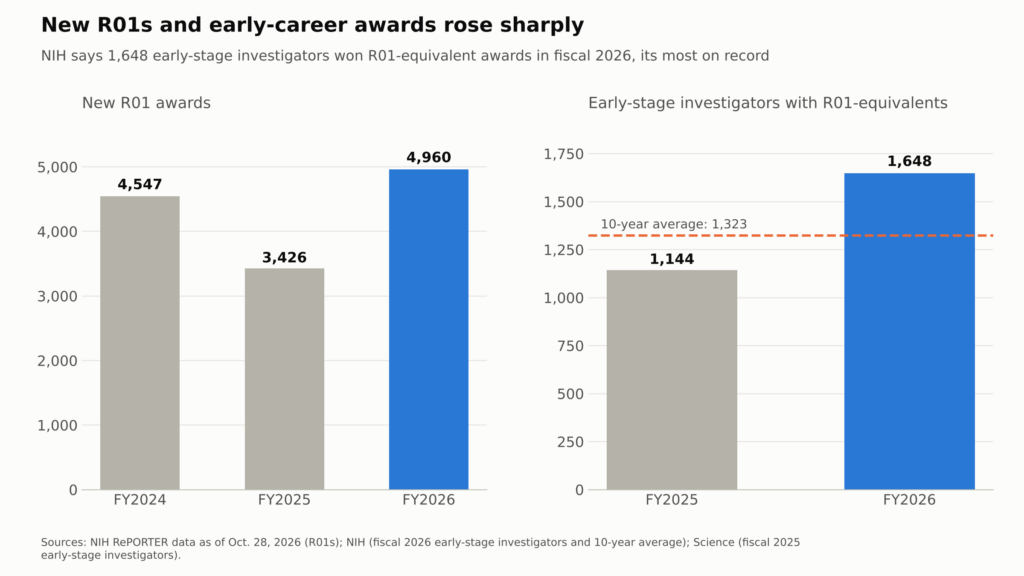
NIH awarded 4,960 new R01s, NIH’s standard grant for independent research projects, compared to 3,426 in fiscal 2025 and 4,547 in fiscal 2024. Competing research project grants (RPGs) also rose, with 11,519 this year compared to 9,103 in fiscal 2025, according to RePORTER data.
NIH says that 1,648 early-stage investigators, researchers within 10 years of finishing their graduate degree or clinical training who are seeking their first major NIH grant, received R01-equivalent awards in fiscal 2026. That is 25% above the 10-year average of 1,323 and the most NIH has recorded. Science reported that 1,144 early-stage investigators received those awards in fiscal 2025.
The National Institute of Allergy and Infectious Diseases (NIAID) made 2,106 new awards, up from 1,567, while the National Heart, Lung, and Blood Institute (NHLBI) made 1,193, down from 1,285. The National Institute of Mental Health’s (NIMH) count rose to 650 from 468 but remained below 845 in fiscal 2024.
Why totals and new awards diverge
New awards count the projects NIH funded for the first time. The total number of grants also includes noncompeting continuations, the yearly payments on grants already in progress, which fell 10% from 39,642 to 35,506, according to RePORTER data. Competing renewals of existing grants rose from 1,822 to 2,047. RePORTER and the AAMC count total grants differently, so these RePORTER figures do not sum to the AAMC totals.
Grants NIH funds up front don’t generate annual continuation payments in later years.
According to the AAMC analysis, multiyear-funded competitive RPGs received $1.9 billion in fiscal 2026, compared to $2.1 billion in fiscal 2025 and $964 million in fiscal 2024. They made up about 22% of competitive RPGs, down from 25% in fiscal 2025 and up from about 10% in fiscal 2024.
As there were fewer new grants in fiscal 2025, there are likely fewer second-year payments in fiscal 2026.
In total, NIH committed $7.6 billion to new awards in fiscal 2026, compared to $6.6 billion in fiscal 2025. Those totals include future years’ funding on grants paid up front.
The 43-day government shutdown, which ran from Oct. 1 to Nov. 12, 2025, affected these counts, with no new NIH awards in October or November that year. August and September accounted for 6,018 of fiscal 2026’s new awards, or 44%.
Overall, the number of new grants recovered from the 2025 lag, but the average dollar amount per new award fell from about $587,000 to about $556,000 and total grant numbers still trail 2024.



Tell Us What You Think!
You must be logged in to post a comment.