Credit: R&D World chart; data from ACS and ACS CAN analysis, Annals of Internal Medicine
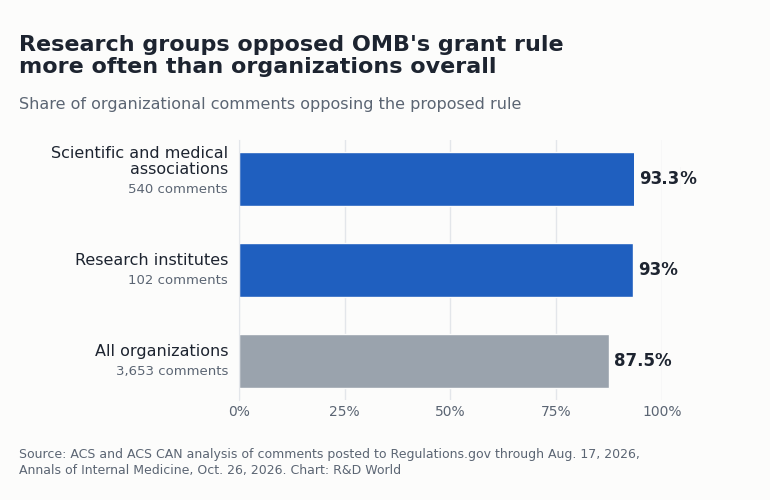
Scientific and medical associations and research institutes were among the most opposed of 3,557 organizations that commented on the White House Office of Management and Budget’s proposed rewrite of federal grant rules. The finding comes from an analysis released Monday in Annals of Internal Medicine, a peer-reviewed journal published by the American College of Physicians. Overall, 87.5% of comments from organizations opposed the rule changes.
The study covers the roughly 165,000 comments OMB had posted by Aug. 17, out of about 497,000 submitted.
The proposal would require political-appointee review of discretionary awards, revise agencies’ authority to terminate grants when priorities change and impose new restrictions on federally funded international research. The changes would cover federal grants and cooperative agreements across about 40 agencies. The stopgap spending law bars OMB from issuing or finalizing the rule, or a substantially similar rule, through Dec. 11, 2026.
OMB has said the rule is meant to improve oversight of federal spending. In an email to R&D World in June, an OMB spokesperson wrote that the proposed rule “will ensure spending is aligned with current law, Executive Orders, and agency priorities,” and added:
“This change will dramatically improve the ability of agencies to identify and respond to fraud, waste, and abuse.”
The new study’s authors, from the American Cancer Society (ACS) and its advocacy affiliate, the American Cancer Society Cancer Action Network (ACS CAN), used an AI model to classify the comments. ACS and ACS CAN jointly filed comments opposing the rule.
Research groups among the most opposed
The analysis reviewed 3,653 organizational comments, including 540 from 526 scientific and medical professional associations. Approximately 93% of those comments opposed the changes. It also found 102 comments from 100 research institutes, 93% of which were opposed.
The associations’ and institutes’ concerns ranged from research funding and continuity to publication and open access. About 83% of the associations’ comments and 84% of the research institutes’ comments raised concerns about scientific integrity and peer review. Across all organizations, the top concerns included administrative burden, due process, termination authority and research funding stability.
Only 14 of 3,557 commenting organizations were life sciences companies or health plans. The Biotechnology Innovation Organization (BIO) strongly opposed the rule and urged OMB to withdraw or substantially revise it, while the Pharmaceutical Research and Manufacturers of America (PhRMA) and AdvaMed, the medical technology trade group, raised concerns and urged OMB to revise it or delay finalizing it, according to letters posted on Regulations.gov. The Council of State Bioscience Associations, a coalition of regional bio groups, opposed the proposal and urged OMB to withdraw or revise it. Individual companies that posted were mostly small biotechs, and all those identified opposed. No large drugmakers appear among the published comments.
A small, mixed group of supporters
In the analysis, about 1.4% of organizational comments were supportive of the changes. Civil, legal and policy groups were the most supportive, with 8.2% of comments from them supporting the changes. Only 3% of research institute comments were supportive.
Among the supporters, according to comments posted on Regulations.gov, is the Center for Impact Sciences at the University of Chicago Harris School of Public Policy. Its comment praises the rule for strengthening pre-award review, reducing grantee burden and “leveling the playing field,” and backs the rule’s changes to program design and performance reporting. The center’s executive director, Jason Saul, also founded and chairs Mission Holdings, the parent company of Mission Measurement and Impact Genome, which build impact measurement and verification systems. Mission Measurement and Impact Genome jointly filed a comment supporting the same provisions.
A comment posted on Regulations.gov from New Prairie Press, a library-based open-access publisher at Kansas State University, strongly supports making publication costs generally unallowable except where required by statute or approved in advance by a federal agency. It also supported investment in open-access infrastructure instead of per-article fees. That puts it at odds with major university groups, including the Association of American Universities, the Association of Public and Land-grant Universities and the Council on Governmental Relations, which advocates for research institutions on federal policy. All three opposed the publication-cost limits.
As of Oct. 26, Regulations.gov listed 164,654 published comments, with the newest postings dated Aug. 17.
OMB did not respond to a request for comment on the new analysis.



Tell Us What You Think!
You must be logged in to post a comment.