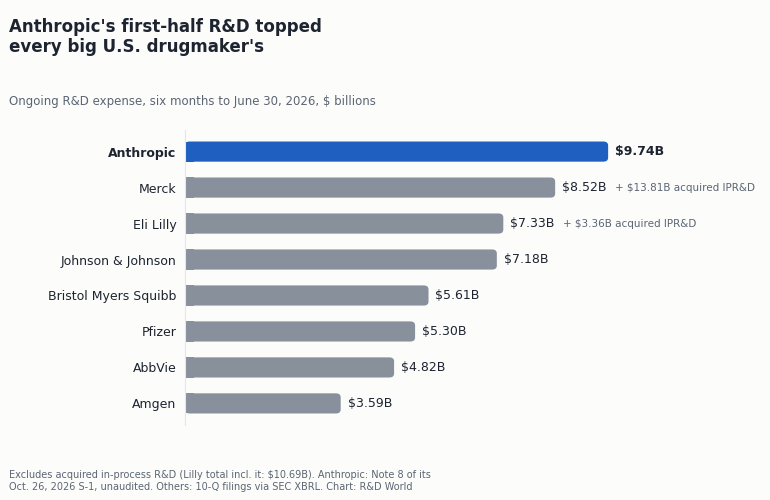
Credit: R&D World analysis of Anthropic’s S-1 and company 10-Q filings
Anthropic’s R&D spending has reached the scale of major drugmakers’ budgets, extending a trend of tech companies outspending pharma on research and development.
Take, for instance, Eli Lilly, the Indianapolis maker of the tirzepatide drugs Mounjaro and Zepbound, which has more than doubled its R&D spending in recent years, increasing it from about $6.0 billion in 2020 to $13.3 billion in 2025, with continued growth into 2026.
Anthropic is approaching Lilly’s spending, according to the S-1 registration statement it filed with the SEC on Oct. 26. Over the 12 months to June 30, the AI company, founded in 2021, spent about as much: Anthropic, the San Francisco developer of the Claude models, recorded $14.2 billion of R&D against Lilly’s $14.6 billion.
Alphabet and Meta each spent well over $50 billion on R&D in 2025.
Revenue vs. R&D, 2025
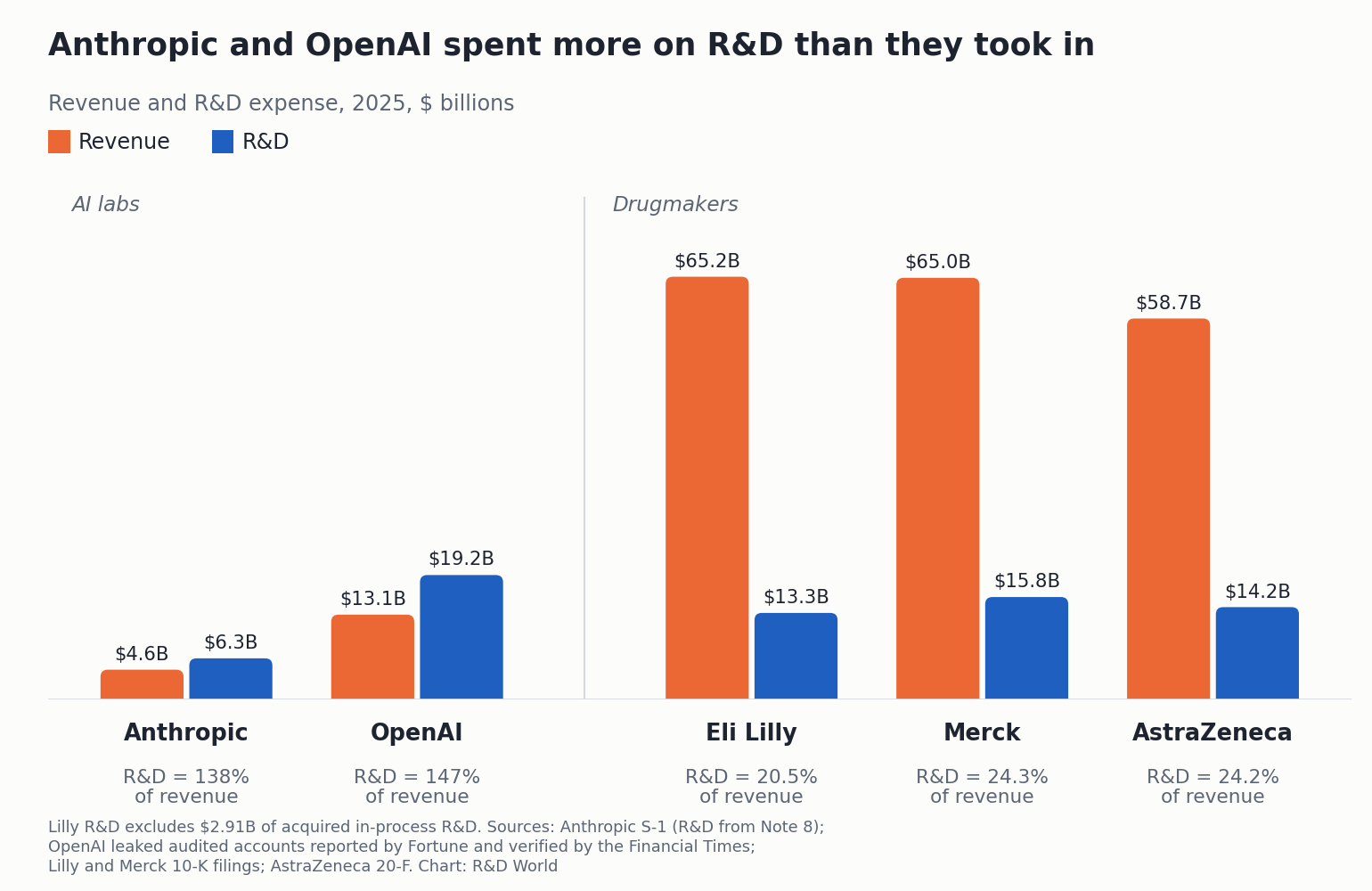
Credit: R&D World analysis of company filings; OpenAI figures from leaked audited accounts
| Company | Revenue, $ billions | R&D, $ billions | R&D as share of revenue | Note |
|---|---|---|---|---|
| Anthropic | 4.59 | 6.34 | 138% | First half 2026: $16.29B revenue, $9.74B R&D, 60% |
| OpenAI | 13.07 | 19.18 | 147% | leaked audited accounts, FT-verified |
| Eli Lilly | 65.18 | 13.34 | 20.5% | R&D excludes acquired IPR&D |
| Merck | 65.01 | 15.79 | 24.3% | worldwide sales |
| AstraZeneca | 58.74 | 14.23 | 24.2% | total revenue |
Sources: Anthropic S-1; OpenAI figures from leaked audited accounts reported by Fortune and verified by the Financial Times; Lilly and Merck 10-K filings; AstraZeneca full-year 2025 results.
In the Anthropic S-1, the R&D figure appears only in a note to the financial statements. During 2025 Anthropic reorganized its income statement around types of cost, such as compute and personnel, and moved research and development into Note 8, which keeps the older breakdown by function. That note shows R&D of $422 million in 2023, $2.28 billion in 2024 and $6.34 billion in 2025. In the first half of 2026, R&D hit $9.74 billion, 5.3 times the $1.85 billion of a year earlier. Anthropic defines the category as mainly compute for “model development, research, and internal usage workloads,” plus staff, software and overhead.
The six-month total tops the ongoing R&D of every large U.S. drugmaker over the same period. Merck spent about $8.5 billion, excluding a $13.8 billion charge for acquired research projects; Lilly spent $7.3 billion, excluding $3.4 billion of acquired in-process R&D; and Johnson & Johnson spent $7.2 billion. Including acquired in-process R&D, Lilly’s first-half total reached $10.7 billion.
Tech companies overtook drugmakers at the top of corporate R&D rankings a decade ago. Pfizer or Roche led the European Commission’s Industrial R&D Investment Scoreboard in 2004 and every year from 2006 to 2010, and three to five drugmakers sat in its global top 10 each year through 2014. Since 2019 the top 10 has held one: Roche through 2022, then Johnson & Johnson, ninth in 2024. In their latest fiscal years, Alphabet ($61.1 billion) and Meta ($57.4 billion) each spent more than three times the largest drug-industry R&D budgets. Microsoft ($35.6 billion) and Apple ($34.6 billion) spent more than twice as much.
Drugmakers still spend more of each sales dollar than most tech companies. R&D equaled 24.3% of Merck’s 2025 revenue, 24.2% of AstraZeneca’s and 20.5% of Lilly’s, against 15.2% at Alphabet, 10.7% at Microsoft and 8.3% at Apple; Meta, at 28.5%, ran above all of them. The AI labs run far higher. Anthropic’s R&D equaled 138% of its revenue in 2025 and 60% in the first half of 2026, as first-half sales rose 14-fold to $16.3 billion.
OpenAI, the ChatGPT developer, spent $19.2 billion on R&D in 2025, 147% of its revenue, according to leaked audited accounts the Financial Times verified in June. That exceeds any drugmaker’s 2025 R&D spending, including Lilly’s $16.3 billion with acquired research projects counted. OpenAI and Lilly both appear on R&D World’s list of the 100 most innovative companies of 2026.
R&D spending by company
| Company | R&D, $ billions | R&D as share of revenue | Period | Note |
|---|---|---|---|---|
| AI labs | ||||
| OpenAI | 19.18 | 147% | 2025 | leaked audited accounts, FT-verified |
| Anthropic | 14.23 | 72% | 12 months to June 30, 2026 | 2025: $6.34B, 138% |
| Tech companies | ||||
| Alphabet | 61.09 | 15.2% | 2025 | |
| Meta | 57.37 | 28.5% | 2025 | |
| Microsoft | 35.56 | 10.7% | FY to June 2026 | |
| Apple | 34.55 | 8.3% | FY to Sept. 2025 | |
| Amazon | – | – | 2025 | R&D sits inside $108.52B of technology and infrastructure, which includes data centers |
| Drugmakers | ||||
| Roche | 16.08 | 21.7% | 2025 | converted from CHF 13.35B |
| Merck | 15.79 | 24.3% | 2025 | |
| Johnson & Johnson | 14.67 | 15.6% | 2025 | whole company, incl. medtech |
| AstraZeneca | 14.23 | 24.2% | 2025 | |
| Eli Lilly | 13.34 | 20.5% | 2025 | $16.25B incl. acquired IPR&D |
| Novartis | 11.20 | 20.5% | 2025 | |
| Pfizer | 10.44 | 16.7% | 2025 | |
Sources: company 10-K and 20-F filings; Roche annual report (converted at the 2025 average exchange rate); Anthropic S-1 (Note 8); OpenAI figures from leaked audited accounts reported by Fortune and verified by the Financial Times. Drugmaker R&D excludes acquired in-process R&D unless noted.
Compute, software and overhead account for at least two-thirds of Anthropic’s first-half R&D spending, by R&D World’s calculation. Personnel expense across the whole company came to $3.15 billion, leaving at least $6.59 billion of the $9.74 billion R&D total for those other costs. Anthropic had about 5,300 employees at Sept. 30, a majority of them in research, engineering and product development. Lilly is buying compute too: in February it inaugurated LillyPod, an NVIDIA DGX SuperPOD in Indianapolis with 1,016 Blackwell Ultra GPUs.
Anthropic plans to list its Class A shares on the Nasdaq under the symbol ANT. Its preliminary prospectus leaves the share count and price range blank.
Tell Us What You Think!
You must be logged in to post a comment.