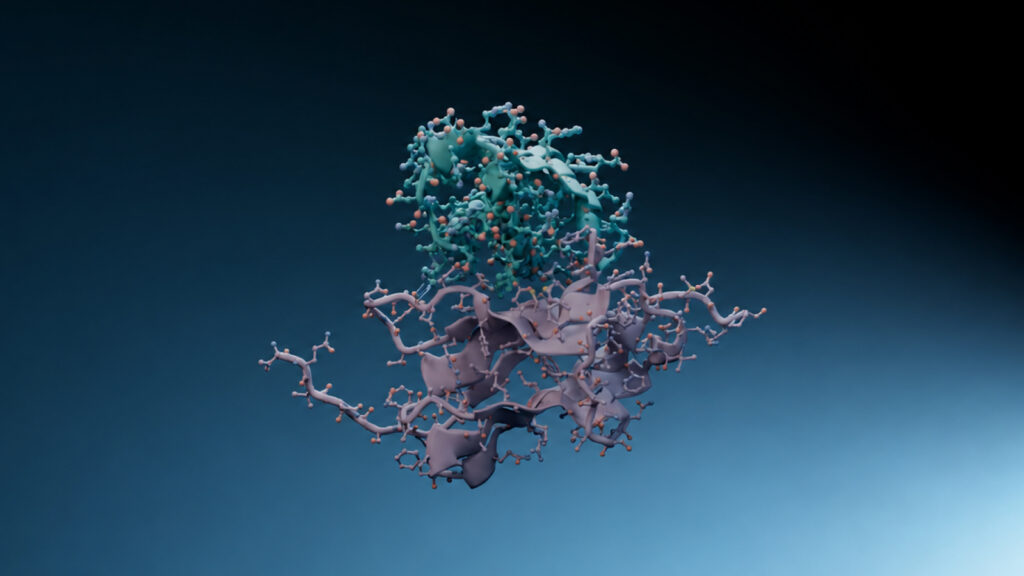
[Image courtesy of NVIDIA]
The collaborators announced the model, RFD4-Proteina today. Leading the lab is David Baker, a 2024 chemistry Nobel laureate. The team’s 116-page preprint, which awaits peer review, reports laboratory results for protein binding and enzyme catalysis alongside computational benchmarks.
“We are moving from an era of discovering the proteins nature has made to one in which we can design entirely new ones,” Baker said in NVIDIA’s announcement. He continued that RFD4-Proteina will open up novel opportunities for scientists involved in protein research in areas ranging from drug discovery to enzymes. “Making the model open will allow researchers around the world to build on these capabilities,” Baker continued.
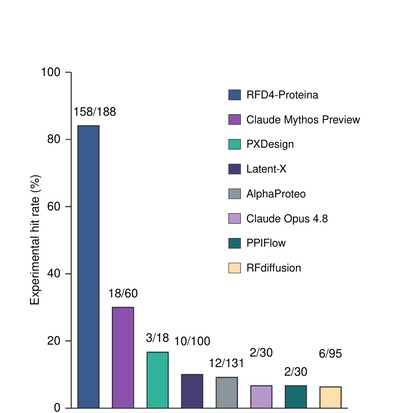
Hit rates against human TrkA by design campaign, as compiled by the RFD4-Proteina authors. Image: Corley et al. (2026), CC BY 4.0.
In the preprint, the researchers compare the TrkA result with 18 binders from 60 designs in earlier work using Anthropic’s Claude Mythos Preview, the first in Anthropic’s Mythos series, which the company positioned above Opus in capability when it debuted earlier this year. In the aforementioned study, published in August, Claude coordinated publicly available protein design tools. The RFD4-Proteina authors identify it as the next most successful TrkA campaign in their comparison.
The team also tested whether its model could design enzymes to break and form chemical bonds. In one laboratory campaign, 89 of 288 designs broke down paraoxon, an organophosphate pesticide. The active enzymes spanned 25 of the 47 scaffold families tested. Six characterized enzymes had catalytic efficiencies 10 to 1,000 times those of the team’s earlier designs, with the best reaching 3,600 M⁻¹ s⁻¹.
A second campaign targeted an amide-forming step in the synthesis of the HIV drug lenacapavir. Four of 67 designs formed the desired amide above background levels. The best converted 79% of the desired (S)-amine, compared with 8.8% of its mirror-image (R) form, while keeping the acid byproduct near the no-enzyme control level. The researchers describe the result as, to their knowledge, the first proof of concept of a de novo designed enzyme for a step in active pharmaceutical ingredient synthesis.
Behind these results is a model that combines the institute’s RFdiffusion lineage with NVIDIA’s Proteina-Complexa. RFD4-Proteina jointly generates a protein’s amino acid sequence and all-atom structure. Its internal representation accommodates standard and modified amino acids, sugars, DNA and RNA. During generation, the model can devote additional computation to refining candidates and searching for designs that meet specified molecular constraints.
The researchers also measured how efficiently the model produces candidates that pass computational screening. Across four benchmarks, RFD4-Proteina generated 5.0 to 10.4 times as many distinct passing structural clusters per GPU-hour as the next-best method. That measure includes evaluation with AlphaFold3, a molecular structure-prediction model. These computational results help prioritize candidates for laboratory testing, where researchers establish their activity.
In NVIDIA’s reported benchmark, generating a 200-residue protein took 1.35 seconds with RFD4-Proteina, compared with 5.12 seconds for RFdiffusion3, an earlier model from the institute. Peak reserved memory fell from 8.50 GB to 1.36 GB.
Researchers can download the model weights from Hugging Face, obtain training and inference code on GitHub or access NVIDIA’s hosted service. The model, weights and code use a BSD 3-Clause license; optional third-party components carry separate terms.

Tell Us What You Think!
You must be logged in to post a comment.