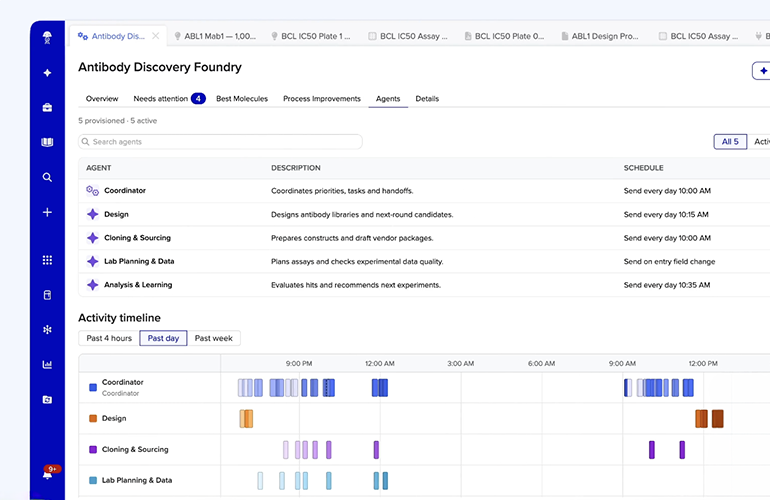
The Agents tab of an antibody discovery Foundry in Benchling lists five agents: coordinator, design, cloning and sourcing, lab planning and data, and analysis and learning. Each agent runs on a daily schedule or is triggered by an event. A timeline below shows their activity over the past day, including work around midnight. Credit: Image courtesy of Benchling
Not long ago, a running joke took hold among software engineers and aspiring “vibe coders.” The bit was to hand an AI model a monumentally complex, multi-month task, building a full Slack clone from scratch, recreating a game like GTA, or even designing and training its own successor on a laptop, and demand it do the whole thing in a single shot. To seal the deal, prompts would end with a three-word incantation: “Make no mistakes.”
No, no mistakes are allowed. At all.
To say the least, the approach was often… inconsistent. But fast-forward to the present, reality is starting to catch up with the ambition. Coding agents can now take a goal and work toward it across repeated rounds of writing, testing and revision. The /goal commands in Claude Code and Codex make the premise explicit. Give the agent a finish line, and it keeps working without a fresh prompt at every step.
Benchling is now bringing that model to the lab with Science Foundries, a new orchestration environment within its platform that can run scientific processes end-to-end with agents and scientists working together. The company announced the product on Oct. 15 at its Benchtalk conference in Boston.
How a Foundry runs
“The core of every Foundry is a team of agents that works with a team of human scientists to push the process or goal forward,” said Nicholas Larus-Stone, head of AI at Benchling. The system enables scientists to set up the agents on a schedule or based on events and monitor their status. “You can chat directly with an agent if you want to intervene,” he said. “You can also chat with the Foundry itself and have it distribute the work and do the orchestration on your behalf.”
Because the agents run in the background, triggered by events such as a notebook entry being reviewed or a lot being registered in inventory, they also need a way to stop and pull in a scientist. “We built the ability for an agent to ask for human help, because we think it’s very important that scientists are still making key decisions and that agents get access to scientific domain expertise where appropriate,” Larus-Stone said. “Agents can request human intervention, and you can configure these stage gates however you want. Then humans come in and address them.”

Nicholas Larus-Stone
Science Foundries are designed to address one of the traditional challenges of multi-agent work: the handoff, where one agent’s output becomes the next agent’s input and errors compound. In a Foundry, the design agent can run protein design models in Benchling’s Model Hub and register the results as antibodies in the customer’s Benchling tenant. Then, a cloning agent picks them up, drafts a cloning plan and can contact the CRO. Larus-Stone said the structured data underneath matters so “you don’t get propagating error and hallucination with large teams of agents.” Better models are one piece, he said, and “figuring out the right system to build around them is the other piece.” Then: “I don’t think we could have built this a year ago. I just don’t think it would have worked. But now they are actually working.”
Handoffs were the bottleneck at one unnamed customer Larus-Stone described. Its highly automated biologics lab couldn’t raise throughput because someone still had to batch incoming requests and tie each result back to the request that produced it. “When you’re doing many thousands or tens of thousands of constructs across dozens of plates, you can’t click through everything,” he said. With agents handling the batching, the lab now runs at much higher throughput. “They had the physical automation, but they were held back by a lack of digital automation.”
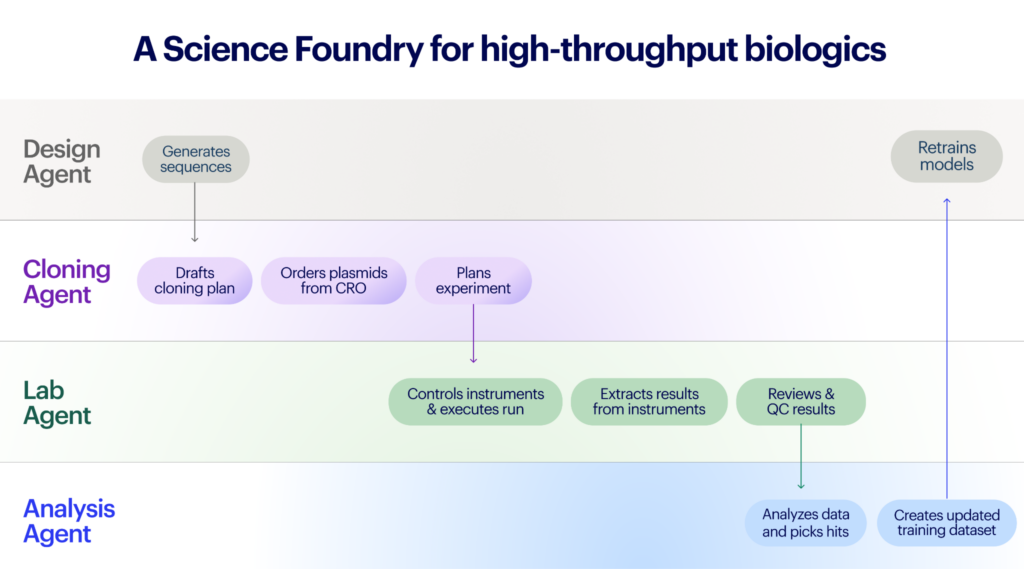
In Benchling’s diagram of a Science Foundry for biologics, four agents pass work from sequence design to CRO ordering, instrument runs and analysis, then feed results back to retrain the design models. Image: Benchling
A question of trust
Because Benchling already has direct ordering integrations with CROs, a Foundry can even extend into automated purchasing. In the antibody demo, for instance, Larus-Stone showed a cloning agent teeing up an external order and pausing to await human approval. Technically, a team can configure its agents to skip that gate and spend money directly, though most customers still prefer a human sign-off before the order goes out.
“In the next several months or a year, I think people will get more comfortable with this, and you’ll have agents ordering directly and doing full closed-loop experimentation,” Larus-Stone said. “The functionality is all there. It’s really more a question of trust.”
That trust could be won based on teams of agents working with teams of humans. The agents are “natively multiplayer,” Larus-Stone said, so a teammate can pick up a conversation a colleague began with an agent and carry it forward, something he said sets Foundries apart from enterprise chat apps. “This idea of teams of scientists working with teams of agents is very important to us,” he said. Agents can act on behalf of a user or run under their own identity and permissions, a requirement given how sensitive biotech and pharma data is. “Building agents that respect those permissions but can still coordinate with each other has been a large part of this work.”
That governance layer will only become more important as specialized AI agents proliferate across the biopharma ecosystem, from early molecule discovery to CROs and clinical trials. Larus-Stone foresees the level of collaboration evolving in the future. “We definitely take the view that there will be agents everywhere,” he said. “We think there will be Benchling agents, but there will also be other agents that are hyper-specialized. What’s most exciting for us, in addition to the agents, is the larger idea of how you coordinate teams of agents.” He added: “I definitely think you’ll see more and more agents talking to each other to get work done.”


Tell Us What You Think!
You must be logged in to post a comment.