Credit: IMF via YouTube
Each new scientific idea now tends to cost more to find than the last. A landmark 2020 economics study found that sustaining the doubling of chip density required more than 18 times as many researchers as in the early 1970s, which means research productivity in chips fell by about the same factor. Drug discovery shows a similar cost curve: the number of new drugs approved per billion dollars of R&D spending has halved roughly every nine years since 1950, a trend analysts dubbed “Eroom’s Law.” Much of science finds itself in a similar situation. The proverbial low-hanging fruit of scientific discovery has been mostly plucked, and while there are unfathomable discoveries awaiting, reaching further up the tree is rarely inexpensive. So far, the main remedy has been to add researchers, and new researchers take years to train.
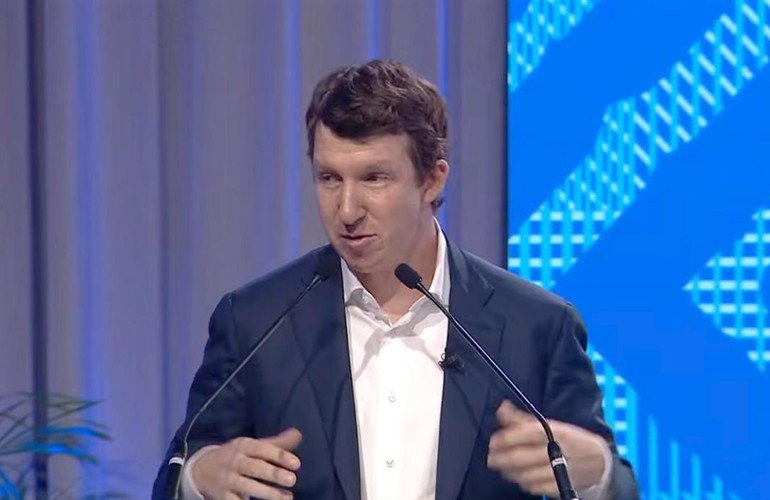
Anthropic co-founder Jack Clark believes AI could change that arithmetic across science. Clark told the IMF-World Bank Annual Meetings in Bangkok on Oct. 17 that the singularity, which he described as AI driving scientific and technical progress so fast “that it is hard for humans to keep up,” has begun, and he asked the room to prepare for a world in which the roughly 10 million human scientists direct a billion virtual ones, or more. “How would my work change if I could make copies of myself and order them to do work under my supervision?” Clark asked. “That is what the next few years will be like for large swathes of the economy – we will be able to augment human labor in frontier disciplines, like science, in a way we’ve never been able to do before.”
Clark gave the 2026 Per Jacobsson Foundation Lecture, “Inside the Event Horizon: Why Everyone Should Take AI Progress Seriously,” to an audience he described as economists, bankers and policymakers. He published the text of the speech in his Import AI newsletter two days later. He opened with his qualifications.
“I am a human being. There is one of me. It has taken me almost 40 years to build the experience to give this speech.”
Clark covered data centers as a journalist two decades ago, left journalism for OpenAI in 2016 and co-founded Anthropic a few years later. He took his frame from the science-fiction writer Vernor Vinge, who forecast in 1993 that greater-than-human intelligence would drive progress at a pace humans would struggle to follow.
“They call this the singularity. I believe that this year we have gained convincing evidence that it has now begun.”
Clark said he would spend the lecture on the benefits, and that most of them arrive through science.
“I believe that AI-driven scientific invention will change the course of the global economy, alter the ways countries plan and build their own infrastructure, make us all healthier and able to spend more time with our loved ones…”
From coding gains to scientific problem-solving
His first exhibit was software. Anthropic researchers now write almost 10 times as much code as they did in the company’s first four years, Clark said, and the same gains have made AI systems better at both cyberdefense and cyberattack.
“These capabilities will not stop at coding; the same thing will happen to science and robotics. It has already begun to happen.”
Humanity’s Last Exam, a test spanning chemistry to classical literature, launched in January 2025 with a top AI score of 8%, Clark said. Claude Opus 5.5, released Sept. 22, scored 67.7% with tools, the top score as of the speech. Clark closed his evidence with TheoPhysEval, a paper posted Oct. 9 in which physicists contributed 50 unpublished problems from their own research, and quoted co-author Suvrat Raju’s post on the results: GPT-6 Astra’s score climbed from the late 80s to 98%, 49 of 50, after the models insisted the expert answers were wrong and the experts found errors in their own calculations.
“Some of the world’s scientific experts built a test out of problems an AI could never have possibly read the answer to. And when they tested the AI, not only did it score high, but it got a higher score by finding errors in the answers that the humans had worked on!”
The paper’s authors describe the problems as “‘turn-the-crank’ research problems, where known techniques are used to generalize an extant result,” and report expert errors in “several” cases. Claude Opus 5.5 scored 46 of 50 in the paper. The authors also write that the AI agents “do not appear to have the same ‘taste’ in problems.”
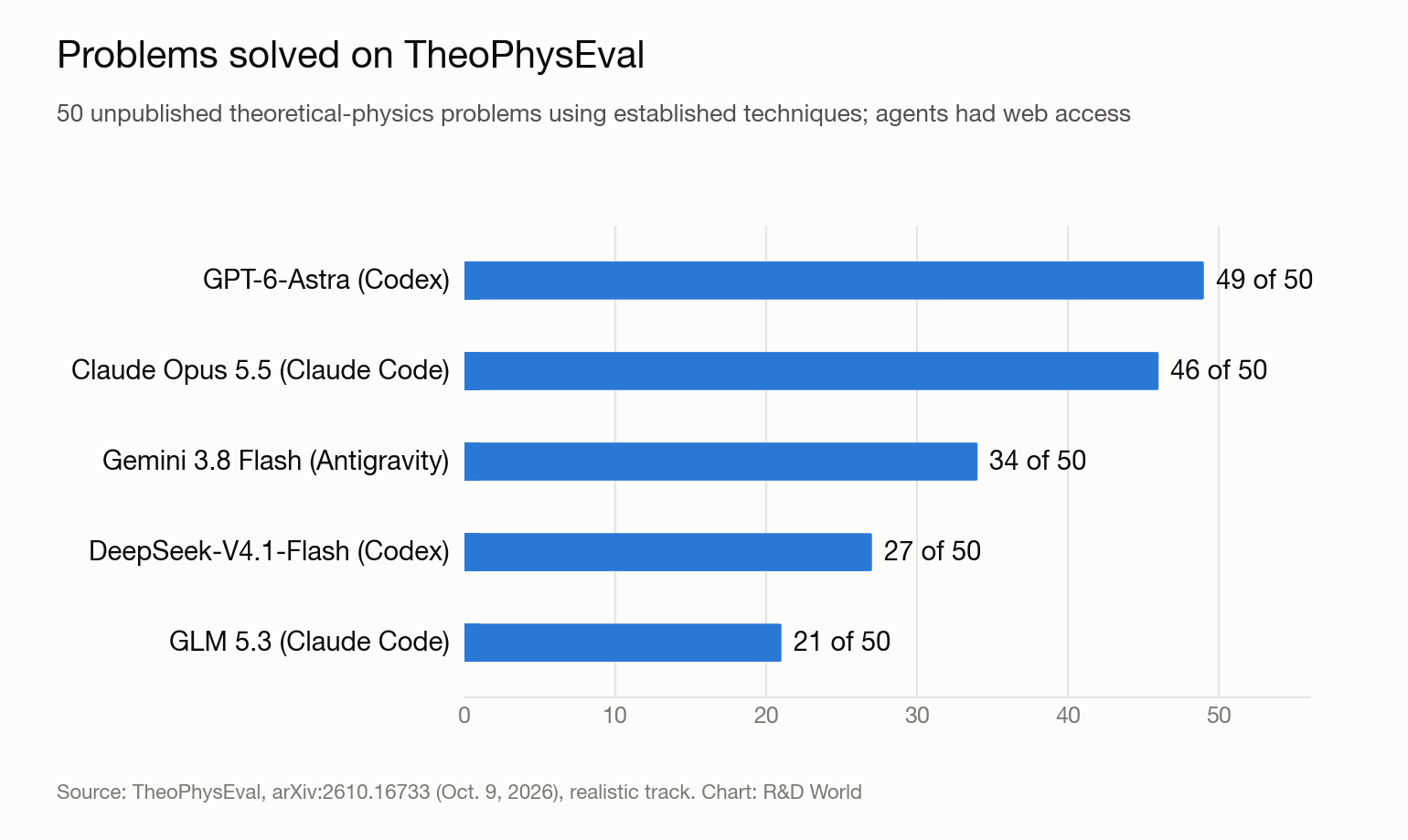
Results on the realistic track, where agents could search the web. GPT-6-Astra reached 49 of 50 after the experts corrected errors in several of their own reference answers. Without web access, Astra and Claude Opus 5.5 each solved 46. Chart: R&D World, from TheoPhysEval data.
A billion virtual scientists, and the labs they would need
Clark cited the economists’ finding that “good ideas are getting harder to find,” and said training a new cohort of researchers can take “10 or 15 years of targeted education, and millions of dollars.” Then he returned to his credentials.
“What would it mean to be able to run hundreds or thousands of copies of me simultaneously? What would it mean if new versions of me could be created instantly, rather than waiting 40 years?”
Clark put the world’s scientists at about 10 million, citing UNESCO; the agency’s most recent Science Report counted 8.854 million full-time-equivalent researchers in 2018. Clark said even that workforce runs short of laboratories, biology labs and large instruments for the experiments it wants to run.
“What happens when instead of 10 million scientists, we have a billion virtual scientists directed by our own 10 million? Or 10 billion? That is the world that is coming right for us. We have to get ready.”
More proposed drugs, limited capacity to test them
If discovery becomes abundant, Clark said, the world has to avoid “bottlenecking ourselves downstream,” and policymakers will need to speed discoveries “out of the lab and into the clinic, the factory, and the field.”
“An avalanche of new proposed drugs is of little use if only a handful can ever be tested.”
AI moves into the physical lab
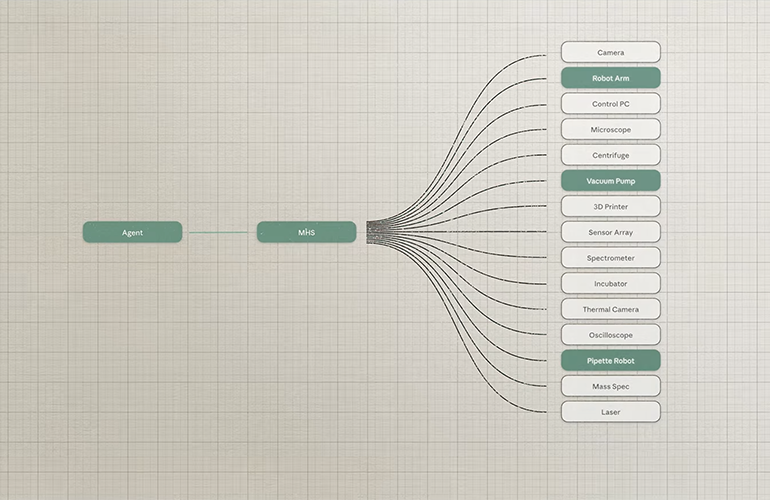
Anthropic depicts the Model Hardware Standard as a common interface connecting an AI agent with programmable equipment, including microscopes, robotic arms, sensors and pipetting systems. Image credit: Anthropic
Earlier in the speech, Clark said AI systems “are now increasingly able to autonomously operate laboratory equipment remotely,” with batteries and fuel cells among the targets. In August, Anthropic released the Model Hardware Standard, a research-preview interface developed with HHMI’s Janelia Research Campus that lets AI agents operate any lab device with a programmable interface (R&D World coverage). Anthropic reported that it helped a Carnegie Mellon team run serial-dilution dose-response experiments about three times faster, and that Genentech researchers had to guide Claude to recognize that errors caused by foaming in samples were physical failures, not software bugs. In September, Reuters reported that Anthropic had set up a wet lab in the San Francisco Bay Area, and Eric Kauderer-Abrams, its head of life sciences, told Reuters that “the final test is still and will be for a while in real lab work.”
“Just because we have an AI system that can do science, that doesn’t mean that it should be left to do science unattended.”
Clark closed on Carl Sagan, who wrote in Pale Blue Dot that the humans who one day reach other stars will be “a species very like us, but with more of our strengths and fewer of our weaknesses.”
“Where Sagan thought we had hundreds of thousands of years to achieve this, to become a better and wiser people, we instead have a handful of years. I believe we can do it.”
Tell Us What You Think!
You must be logged in to post a comment.