Research & Development World

  • R&D World Home
  • Topics
    • Aerospace
    • Automotive
    • Biotech
    • Careers
    • Chemistry
    • Environment
    • Energy
    • Life Science
    • Material Science
    • R&D Management
    • Physics
  • Technology
    • 3D Printing
    • A.I./Robotics
    • Software
    • Battery Technology
    • Controlled Environments
      • Cleanrooms
      • Graphene
      • Lasers
      • Regulations/Standards
      • Sensors
    • Imaging
    • Nanotechnology
    • Scientific Computing
      • Big Data
      • HPC/Supercomputing
      • Informatics
      • Security
    • Semiconductors
  • R&D Market Pulse
  • R&D 100
    • 2026 R&D 100 Award Winners
    • 2026 Professional Award Winners
    • 2026 Special Recognition Winners
    • R&D 100 Awards Event
    • R&D 100 Submissions
    • Winner Archive
  • Resources
    • Research Reports
    • Digital Issues
    • Educational Assets
    • Subscribe
    • Video
    • Webinars
    • PharmSci360
    • Content submission guidelines for R&D World
  • Global Funding Forecast
  • Top Labs
  • Advertise
  • SUBSCRIBE

How Porsche turns rare road events into repeatable AI tests with NVIDIA

By Brian Buntz | October 22, 2026

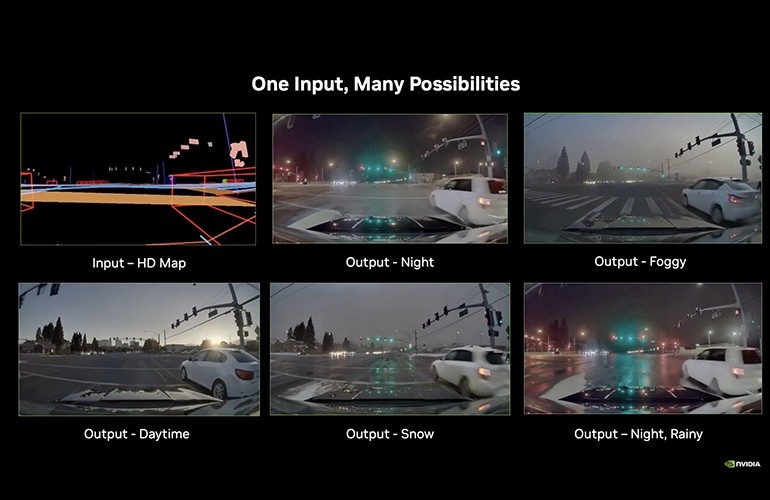
NVIDIA slide titled One Input, Many Possibilities: an HD map input and Cosmos-generated versions of the same intersection scene at night, in fog, in daytime, in snow and at night in rain.

Image credit: NVIDIA via YouTube

Self-driving software has to handle the unexpected. In a 2015 TED talk, Chris Urmson, then head of Google’s self-driving car project and now CEO of self-driving vehicle technology firm Aurora, showed footage of a woman in an electric wheelchair chasing a duck in circles on the road. The vehicle slowed and navigated the encounter safely, he said.

Urmson’s scene was unusual. Animals on the road are not. Collisions with animals killed 210 people in the U.S. in 2024, according to the Insurance Institute for Highway Safety, and a 2008 Federal Highway Administration report to Congress estimated 1 million to 2 million collisions between vehicles and large animals each year. For developers of automated driving systems, a central challenge is finding those encounters in fleet sensor recordings and turning them into tests they can rerun whenever the software changes.

During NVIDIA’s GTC Berlin developer livestream, Tin Stribor Sohn, a tech lead at Porsche, and Dan Gural, head of technical partnerships at Voxel51, which provides a data and model platform for physical AI, robotics and computer vision, described how their teams pull rare scenarios from exabytes of fleet data and rerun them in simulation instead of re-driving them. Voxel51 helps Porsche find relevant driving scenes and prepare them for reconstruction and simulation with NVIDIA tools.
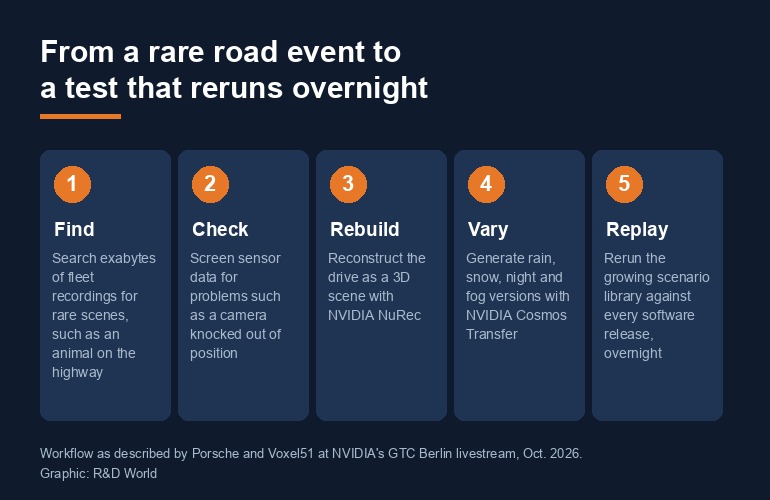
Five-step graphic: find rare scenes in fleet recordings, check sensor data, rebuild the drive in 3D with NVIDIA NuRec, vary weather and lighting with NVIDIA Cosmos Transfer, and replay the scenario library against each software release overnight.

Credit: R&D World

Some miles of fleet data are more useful than others. What Porsche needs are the rare scenes that show whether a software update made a driving function better or quietly broke something that used to work. “Not all of the drives we have have the same value,” Sohn said. “We need to identify corner cases, and one of these corner cases can be some animal running over the highway, or some helicopter landing on the highway.”

Each of those scenes becomes a regression test, and the collection keeps growing. “Every time we add a new release of an AI function, we don’t only need to test new scenarios we encounter, but also the whole set of scenarios we already encounter,” Sohn said. Re-driving all of them on real roads, he added, “would grow exponentially over time.” Using NuRec, NVIDIA’s neural reconstruction tools, the team turns recorded drives into 3D scenes and runs them overnight in simulation, so engineers know by the next day whether a release is ready to go into the vehicle, Sohn said.

One rare encounter can also become many tests. NVIDIA’s Cosmos Transfer model generates variations of a reconstructed scene in different weather and lighting. “I want to test it in the rain. I want to test it in the snow. I want to test it at night, daytime, foggy, whatever you can imagine,” Gural said.

Before those recordings become simulations, the team checks the underlying sensor data. Gural gave the example of a vehicle hitting a pothole and a camera shifting out of position. Such problems can compromise the material used to train a model. “We want to make sure that the data that we’re training the models on are as high quality as possible,” he said. The math and photogrammetry behind those checks are complex, but the principle is simple: “The best data makes the best models,” Gural said.

Porsche helps identify which driving problems need attention, while Voxel51 integrates the tools used to investigate them. “They know the issues where the car is doing well, where the car is doing poorly,” Gural said of Porsche and its parent, the Volkswagen Group. Sohn said the resulting library of driving scenarios is meant to serve the whole group: it can be reused across development projects, shared with partners that train models, and expanded as the fleet encounters new situations.

Sohn judges automatic braking by how it performs on real roads, and that means cataloging every situation that should trigger it. “We want to identify all of the events that cause braking,” he said, including animals and people entering the road.
Tell Us What You Think! Cancel reply

You must be logged in to post a comment.

Related Articles Read More >

Two RFD4-Proteina-designed enzymes that break down the pesticide paraoxon, with their structural accuracy and catalytic efficiency.
NVIDIA and UW’s protein design model produces 158 binders from 188 designs
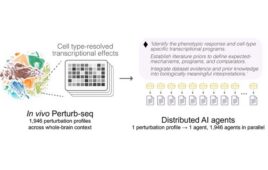
Schematic of a whole-brain Perturb-seq atlas split into 1,946 perturbation profiles, each analyzed by its own AI agent.
OpenAI deploys nearly 2,000 GPT-Rosalind agents to generate biological research leads in 32 minutes
150 years of CAS chemistry data comes to Microsoft Copilot
NIH proposes a permanent Office of the Chief AI Officer
rd newsletter
EXPAND YOUR KNOWLEDGE AND STAY CONNECTED
Get the latest info on technologies, trends, and strategies in Research & Development.

R&D World Digital Issues

Fall 2025 issue

Browse the most current issue of R&D World and back issues in an easy to use high quality format. Clip, share and download with the leading R&D magazine today.

R&D 100 Awards
Research & Development World
  • Subscribe to R&D World Magazine
  • Sign up for R&D World’s newsletter
  • Contact Us
  • About Us
  • Drug Discovery & Development
  • Pharmaceutical Processing
  • Global Funding Forecast

Copyright © 2026 Arrowfly LLC. All Rights Reserved. The material on this site may not be reproduced, distributed, transmitted, cached or otherwise used, except with the prior written permission of Arrowfly
Privacy Policy | Advertising | About Us

Search R&D World

  • R&D World Home
  • Topics
    • Aerospace
    • Automotive
    • Biotech
    • Careers
    • Chemistry
    • Environment
    • Energy
    • Life Science
    • Material Science
    • R&D Management
    • Physics
  • Technology
    • 3D Printing
    • A.I./Robotics
    • Software
    • Battery Technology
    • Controlled Environments
      • Cleanrooms
      • Graphene
      • Lasers
      • Regulations/Standards
      • Sensors
    • Imaging
    • Nanotechnology
    • Scientific Computing
      • Big Data
      • HPC/Supercomputing
      • Informatics
      • Security
    • Semiconductors
  • R&D Market Pulse
  • R&D 100
    • 2026 R&D 100 Award Winners
    • 2026 Professional Award Winners
    • 2026 Special Recognition Winners
    • R&D 100 Awards Event
    • R&D 100 Submissions
    • Winner Archive
  • Resources
    • Research Reports
    • Digital Issues
    • Educational Assets
    • Subscribe
    • Video
    • Webinars
    • PharmSci360
    • Content submission guidelines for R&D World
  • Global Funding Forecast
  • Top Labs
  • Advertise
  • SUBSCRIBE