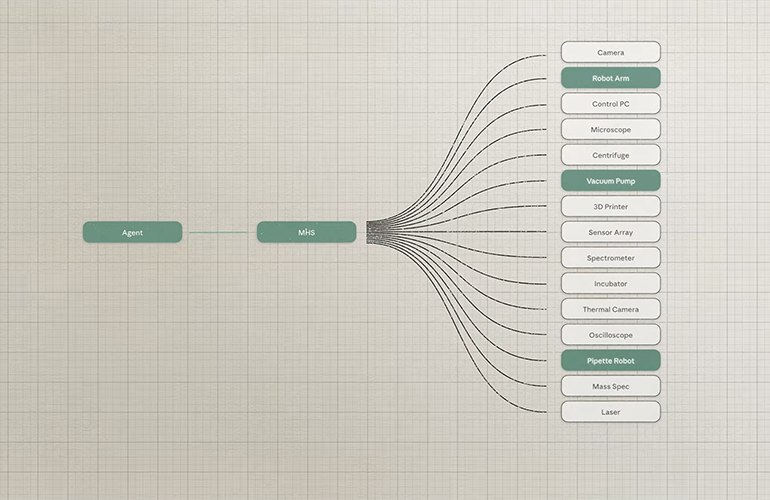
Anthropic depicts MHS as a common interface connecting an AI agent with programmable equipment, including microscopes, robotic arms, sensors and pipetting systems. Image credit: Anthropic
In late June, frontier AI lab Anthropic laid out a vision for its Claude models to run scientific workflows rather than only help plan them. In the weeks since, the pieces of that vision have grown clearer. Anthropic now says it has supplied part of the missing physical layer with the Model Hardware Standard (MHS), a common interface between AI agents and the instruments that perform experiments. MHS is intended to close the portion of the feedback loop that leaves the computer: carrying an agent’s instructions into laboratory equipment and returning experimental measurements for the agent to interpret.
“For the past year, we’ve been putting AI to work inside labs and manufacturing facilities. We kept hitting the same wall. There’s no common way to connect a model to physical equipment. The Model Hardware Standard changes that,” said Alek Kemeny, a member of Anthropic’s technical staff, in a promotional video.
Anthropic developed MHS with the Howard Hughes Medical Institute’s Janelia Research Campus to give AI agents a standardized way to discover, understand and operate programmable devices.
One way to understand MHS is as a hardware counterpart to the Model Context Protocol (MCP), the open standard Anthropic created in 2024. MCP gives AI applications a common way to connect with software tools and data sources. MHS carries a related idea into the physical world by describing what a device can do, which parameters an agent can change and which safety limits it must obey. MHS is not limited to MCP: agents can also reach compatible devices through a command-line interface or code.
“If you wanted your instruments to work together, say a camera and the stage of a microscope, you had to build a custom software integration between them. Every device you add complicates the picture. For complicated experiments, that’s weeks of work,” said Arco Bast, M.D., a postdoctoral scientist at the Howard Hughes Medical Institute’s Janelia Research Campus.
On the 2026 innovators list
Anthropic is one of R&D World’s 100 most innovative companies of 2026. The list examines what each company built, who is using it and the results it has reported. R&D World will publish the full comparison in the 2026 Global R&D Funding Forecast.
“With MHS, each device connects once through one interface. The setup is accelerated by the agent. Any device that speaks MHS can talk to anything else that does. Devices communicate at bare-metal speed. The agent has access to this context and can control operations.”
Anthropic is initially offering MHS as a research preview to a group of scientific laboratories and manufacturers. The company describes the standard as model-agnostic and says it plans to make it open source after working with early users on safety evaluations and operating practices.
A broader science push
The MHS announcement arrived alongside a broader expansion of Anthropic’s science programs. The company opened 10,000 seats through a Claude team plan for verified scientists at academic and nonprofit institutions. Standard seats are free for one year, while premium seats with higher usage limits cost $15 per month. Anthropic said it intends to extend the program beyond the initial 10,000 seats.
Anthropic also expanded its AI for Science program, which provides researchers with as much as $50,000 in Claude credits per project. Previously concentrated in the biological sciences, the program is widening its scope to other scientific fields and more compute-intensive research.
The company placed those announcements alongside recent demonstrations involving protein design, gene-function research, mathematics and analytical chemistry, as well as work by Claude Science users in areas including quantum mechanics, genomics and astrophysics.
Early tests span microscopy, drug discovery and lab automation
At Janelia, Bast used MHS to control a microscope examining neurons, directing it to move across a sample, change depth and capture side views in real time.
Anthropic reported additional tests across several laboratory settings in its MHS announcement. At Genentech, Claude used MHS to coordinate a BCA protein assay involving a liquid handler, robotic arm and plate reader. The agent tested liquid-transfer speeds, evaluated the results and adjusted its parameters. Human experts had to intervene when Claude misread errors caused by bubbles as software failures and initially responded in a way that produced more foam.
At Carnegie Mellon University, researchers used an agent to orchestrate a liquid handler, plate reader, robotic arm and monitoring cameras spread across three computers with incompatible interfaces. Anthropic said MHS helped the team conduct serial-dilution dose-response experiments approximately three times faster. At the University of Washington, researchers used the standard to monitor qPCR experiments and coordinate collision-free plate handoffs between a liquid handler and robotic arm.
Anthropic also listed support from cloud, laboratory automation, instrument and robotics vendors. AWS plans to support the research preview through its Strands Robots library, while Automata is adding MHS to its LINQ lab automation platform. MBF Bioscience, QIAGEN and Tecan are developing or testing support for microscopes, nucleic acid purification systems and liquid handlers. Danaher is exploring MHS for smart instruments and autonomous laboratories, while Doosan Robotics and Universal Robots are testing or planning support for robotic arms.
The deployments remain early, and MHS currently requires equipment with a programmable interface. Anthropic also acknowledges that Claude’s spatial and physical reasoning continues to require expert oversight.
The long-term vision remains sweeping. Kemeny framed MHS as a step toward compressing “a century of progress” into a decade.
That rhetoric echoes claims made elsewhere in the AI industry. Anthropic CEO Dario Amodei, in his 2024 essay “Machines of Loving Grace,” forecast that AI could compress 50 to 100 years of progress in biology into five to 10 years. Google DeepMind CEO Demis Hassabis has spoken of AI helping to cure all disease, while OpenAI CEO Sam Altman has predicted diseases being cured at an unprecedented rate.
At Janelia, Bast described a more immediate benefit. “The iteration cycle is much faster, and the focus for me as a scientist shifts to actual scientific questions,” he said. “Once everything is connected, running an experiment looks like asking Claude to start it.”