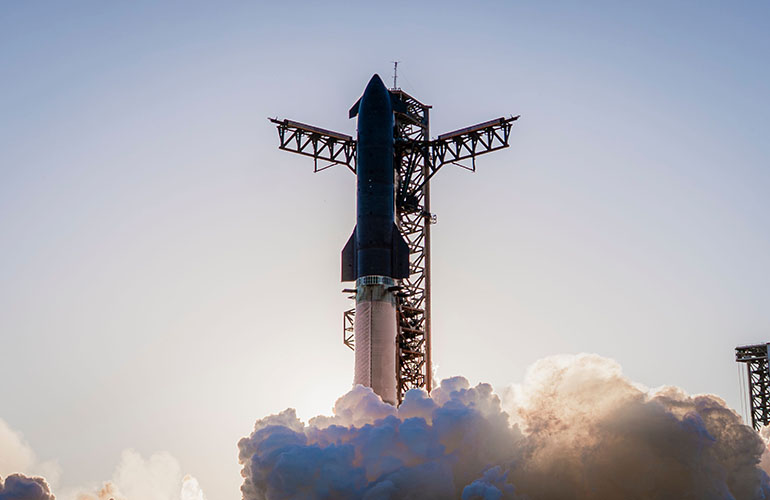
 On Sept. 28, SpaceX’s Starship spacecraft reached orbit for the first time during its 14th test flight, after 13 earlier flights on deliberately suborbital trajectories, and deployed 26 Starlink V3 satellites.
Flight 14 demonstrated satellite delivery and initial communications. The computing payloads, sustained heat rejection, economics and operation at the proposed constellation’s scale remain to be demonstrated.
While none of the satellites deployed on that launch are part of the million-satellite orbital data center SpaceX is planning, the flight tested several things that plan depends on.
On Jan. 30, SpaceX filed an application with the Federal Communications Commission (FCC) asking it to approve a plan for one million satellites orbiting at 500 to 2,000 km. The company said that satellites for the data center plan will rely heavily on the technology that the V3s use, including solar arrays and thermal-management systems.
The company estimates that launching a million metric tons of satellites a year could add 100 gigawatts of power capacity for AI computing annually, assuming 100 kilowatts per metric ton.
What Flight 14 demonstrated and what it didn’t
Flight 14 demonstrated Starship’s first orbit insertion, first real payload deployed to orbit and first deorbit burn. But not everything went according to plan.
The booster lost one engine on ascent, then relit 31 of 33 engines for its boostback burn, the burn that turns the booster back toward its landing zone, and 11 of 13 for its landing burn. SpaceX said it designed the boostback to burn through the booster’s remaining liquid oxygen to test its performance limits. On the ship, a Raptor vacuum engine shut down early during ascent, and SpaceX shortened the mission as a precaution. The ship still completed orbital insertion, satellite deployment and its deorbit burn.
Across three flights with Raptor 3 engines, every one has had anomalies, and booster landing relights have been a recurring problem.
The 26 satellites deployed during Flight 14 are the first V3s in orbit. SpaceX says they will go through checkout and raise their orbits before serving customers, but gave no timeline for when the satellites might be active. The company reported contact with all 26 V3s over laser links, ground stations and user terminals. As of Oct. 1, the 26 satellites had not yet appeared in the public U.S. Space Force satellite catalog.
While Flight 14 won’t tell us anything about the data center satellites themselves, including how they will burn up on reentry, which the FCC has questioned, and if their large solar arrays and radiators will make them brighter, a concern astronomers raised, it did demonstrate some important capabilities like deployment from Starship and communication over inter-satellite laser links.
While the public comment period on SpaceX’s FCC application ended in March, the FCC still hasn’t ruled. The application received about 1,500 public comments and a petition from Amazon Leo, Amazon’s satellite broadband network, to dismiss the application without prejudice on the grounds that it is incomplete. In a May 29 letter answering FCC questions about disposal and casualty risk, SpaceX said it designs its satellites so that no surviving component would strike Earth’s surface with more than 15 joules of kinetic energy. Based on its own modeling, SpaceX considers the casualty risk zero. The application language, as reproduced in Amazon’s petition, also allowed operators to instead demonstrate a casualty risk below 1 in 10,000.




Tell Us What You Think!
You must be logged in to post a comment.