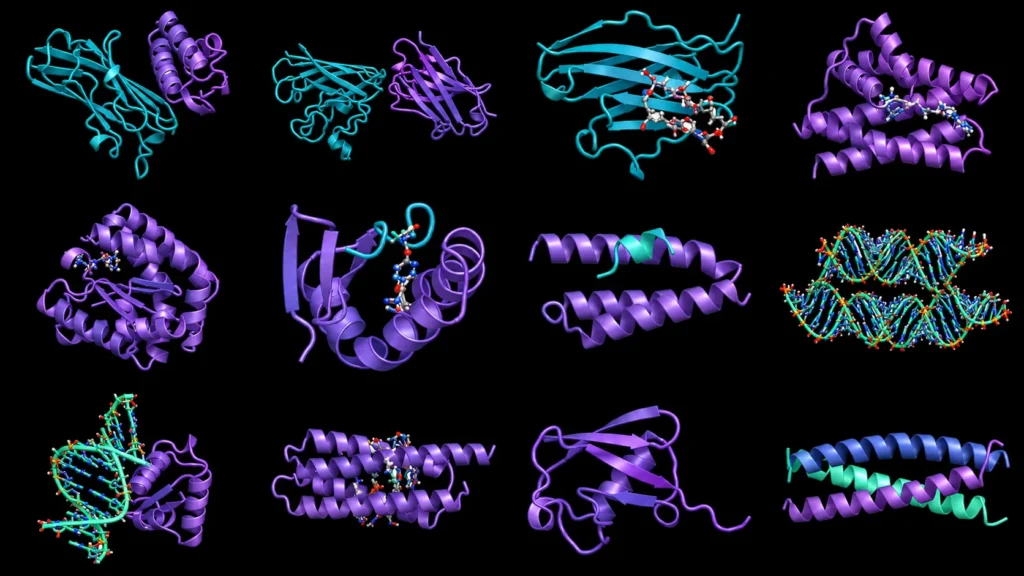
RFD4-Proteina co-designs protein sequences and all-atom structures, including proteins bound to ligands and to DNA and RNA. Image courtesy of NVIDIA
Proteins evolved to do the work organisms need to survive. Breaking down synthetic pesticides poses a much newer, and often trickier, problem. In a video from the University of Washington’s Institute for Protein Design, researcher Kieran Didi describes “things that nature never had the time or chance to develop against, such as degrading man-made pesticides.”
Designing an enzyme for that job takes more than knowing which amino acids drive the chemistry. The rest of the protein has to fold in a way that holds them in place. At the University of Washington, Nobel laureate David Baker and his colleagues had used a model called RFD3 to design enzymes that broke down the pesticide paraoxon. Those enzymes used six amino acids at the reaction site. The researchers thought two more might speed up the reaction.
Getting all eight into position around a metal ion was the challenge. “That’s a packing problem. It’s a sterics problem. It’s an electrostatics problem,” said Anthony Costa, NVIDIA’s director of digital biology.
Baker’s lab and NVIDIA developed a new model, RFD4-Proteina, and put it to work on the eight-residue design. The computational design work took four days, according to the UW video. In laboratory tests, 89 of 288 RFD4-Proteina designs broke down paraoxon. None of the 192 designs the researchers tested from RFD3 showed activity on the same task. The researchers examined six of the new enzymes more closely and measured catalytic efficiencies 10 to 1,000 times those of their earlier six-residue designs.
R&D World spoke with Anthony Costa, NVIDIA’s director of digital biology, about what the chemists specified and what the model worked out. We edited the conversation for length and clarity.
R&D World: Before RFD4-Proteina, how would researchers have approached the same design problem?

Anthony Costa, NVIDIA’s director of digital biology
Costa: You simply hypothesize some structures, you write them down, you give them to a molecular dynamics calculation or to a quantum chemistry calculation. These are slow, very labor-intensive, even from the operator standpoint, and they’re computationally intense as well. You’re guessing with a lot of knowledge, but you’re guessing, and that’s a really hard thing for a human being to do.
R&D World: What did the chemist have to specify, and what did the model work out for itself?
Costa: You have a design that works. There are enzymes that do this degradation process, and you know something about why that process works. Because we know something about the mechanism, we can say that if we have more close contacts with this metal ion that happens to be involved in the process, we believe that will increase the rate of this process. That’s insight that we ask the human being to actually reason about.
You have a metal ion. You have a bunch of stuff that’s packed around it. There are a number of ways to do that. [The model] came up with a number of different ways that were physically plausible. And then we can measure their catalytic activity through some assay in the lab.
The model itself cannot just take English language and do that. We actually teach the agent how to use the model. You can literally specify these things in plain English. Have an agent construct the input and the configuration of the model, even download the model, set it up, put it on a GPU somewhere.
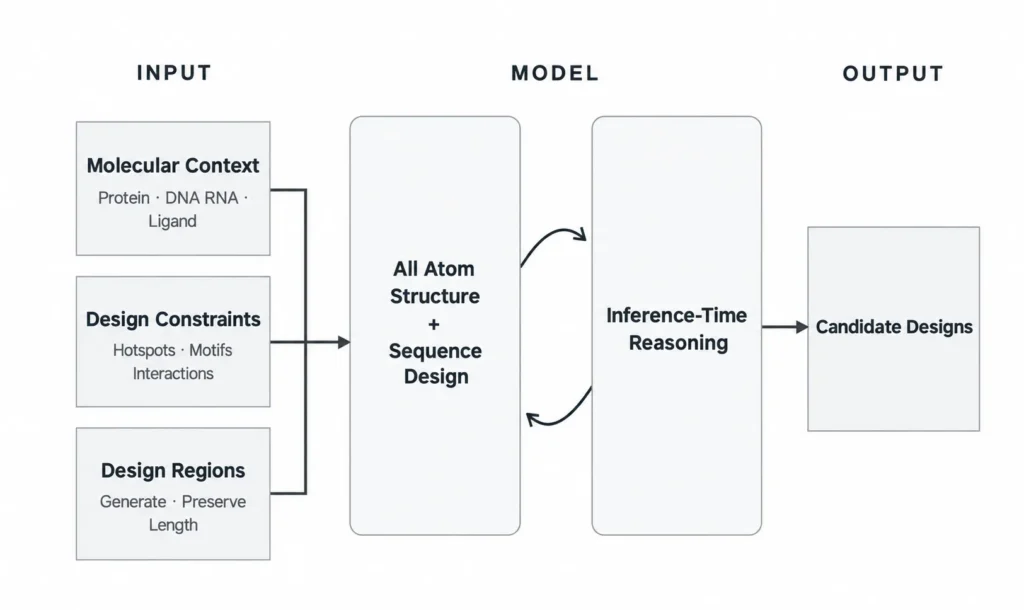
The chemist supplies the molecular context, the design constraints such as hotspots and motifs, and the regions to generate or preserve. RFD4-Proteina designs the sequence and all-atom structure together, looping through inference-time reasoning before it returns candidates. Image courtesy of NVIDIA
R&D World: How did the collaboration come about with David Baker’s lab?
Costa: David had this whole line of work called RFdiffusion, and we had an entire line of work called Proteina, and they both had different strengths. We contributed, from a model architecture standpoint, a lot of the details about how the model reasons.
You go to ChatGPT and you pick low reasoning or medium reasoning or high reasoning, and we literally have those buttons in these models. That allows the model to look at what it has generated, say, “Is this right?” Go and determine how right it is and make slight modifications in an iterative loop.
The lead author in the paper is a guy named Kieran Didi. He actually became a resident of Seattle and sat there with a team for more than a year and worked very closely with that team.
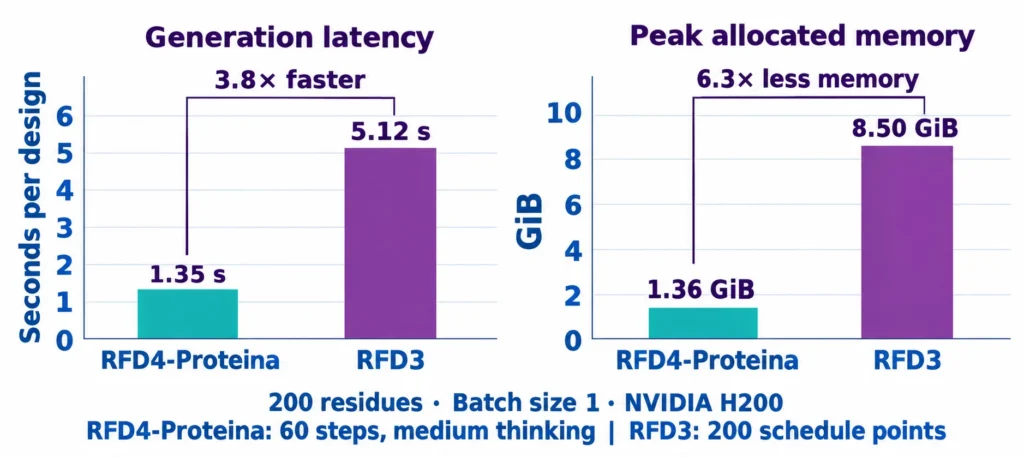
At 200 residues on an NVIDIA H200, RFD4-Proteina generated a design in 1.35 seconds against 5.12 seconds for RFD3, and used 1.36 GiB of peak allocated memory against 8.50 GiB. NVIDIA ran RFD4-Proteina at 60 steps on its medium thinking setting and RFD3 at 200 schedule points. Image courtesy of NVIDIA
R&D World: As AI agents take on more of the research workflow, how does that change where scientists apply their judgment?
Costa: You have to know what scientific question you want to ask, and you have to know, therefore, what workflow you need to stand up in order to answer that question. We make these things in the lab and we test how they actually work. The lab is an isolated environment in which we get to see if we’re right about the science, but we haven’t put this thing in the field yet.

Tell Us What You Think!
You must be logged in to post a comment.