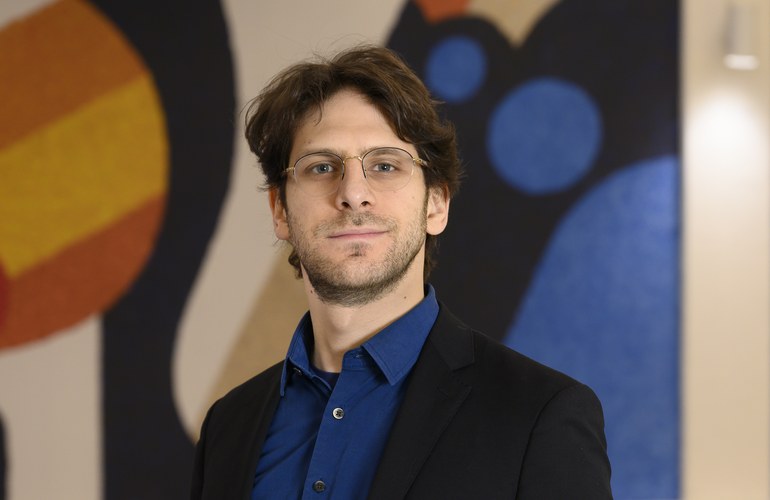
Ten63 co-founder and CEO Marcel Frenkel. Credit: Ten63 Therapeutics
Many of the proteins that drug developers struggle to target lack conventional binding pockets and offer little data for training AI models. Ten63 Therapeutics, a Durham, N.C.-based biotech, is using physics-based simulation and AI to search for molecules that can bind these difficult targets.
Founded in 2018 as a spinout from Duke University and the Toyota Technological Institute at Chicago, Ten63 takes its name from 1063, the estimated number of possible drug-like molecules that follow Lipinski’s rules of drug-likeness. The company says its BEYOND platform searches a chemical space of more than 100 trillion synthetically accessible molecules.
Chugai Pharmaceutical, a member of the Roche Group, has joined Ten63’s new BEYOND-Alpha early-adopter program as its first participant. Under the program, the Japanese company will nominate difficult targets and receive ranked molecular designs from the platform. Chugai will have the right to negotiate terms for further research, development and commercialization of molecules that include those designs, subject to a separate definitive agreement.
Building training data through simulation
Ten63’s co-founder and CEO, Marcel Frenkel, Ph.D., began looking for ways to tackle difficult drug targets after his mother received a pancreatic cancer diagnosis. “When we went to every single doctor, they said, ‘Look, these targets aren’t actionable. They’re not druggable. There’s nothing we can do,'” Frenkel said.
The subsequent discovery of KRAS inhibitors reinforced his belief that new chemistry could unlock treatments for difficult targets. “The right chemistry can unlock treatments that were previously believed to be impossible. That’s the whole idea behind the company, and that’s really what we’re focused on.”
Ten63’s bet centers on a data problem: Molecules shown to bind these targets remain scarce, so AI models have little to learn from. “By definition there’s no positive data for undruggables, and it’s very difficult to train an AI model on a relationship where there are no positive results,” Frenkel said.
Ten63’s answer draws on how such targets have been cracked in the past. Frenkel credited the “amazing work” others are doing to learn from sequence alignments, SMILES representations of molecules and binding data. Ten63 takes a different route: it relies on simulation and large-scale exploration of chemical and conformational space.
Such targets sometimes take 40 years to crack, and “normally it’s because someone tried chemistry in a new way,” he said, citing Redwood City-based Revolution Medicines, which developed daraxonrasib, a RAS inhibitor the FDA approved on Aug. 26 for adults with previously treated metastatic pancreatic cancer. “The way that RevMed tried chemistry has never been tried before,” Frenkel said. Ten63 set out to ask what it would take to try new chemistry at immense scale.
Making and testing new molecules at that scale in the lab would be “insanely expensive,” Frenkel said. Instead, Ten63 is building simulations accurate enough to approach reality, then running them across a vast chemical space. In a benchmark on Ten63’s website, BEYOND ran 260.3 molecular dynamics simulation steps per second on one 2020-vintage Nvidia A100 GPU, against 0.0188 for UMA-M, a machine-learned model from Meta. BEYOND searches both chemical space, the possible molecules, and conformational space, the shapes those molecules and their protein targets can adopt. “You would eventually be able to find solutions, and they would cost a fraction of what it would take to do it experimentally,” he said.
BEYOND’s simulations have “several iterations to go” before they match the accuracy of lab experiments, the point at which they could supply the binding data that undruggable targets lack. “Once that’s possible, BEYOND will allow you to create unlimited synthetic data at experimental accuracy, and that changes the game,” Frenkel said. BEYOND would then use the data it generates to design new molecules, easing the bottleneck that limits how many candidates a lab can test. Ten63 is building models that “in pretty short order will enable that flywheel to just start spinning,” he said.
Frenkel said BEYOND is already producing results on targets where co-folding models, AI tools that predict how a protein and a drug molecule fit together, “have a lot of difficulty.” In recent prospective studies, the company says, BEYOND designs reached hit rates of 11% to 75%, confirmed by surface plasmon resonance (SPR), with fewer than 20 molecules synthesized and tested per program. “There’s parts of the platform that we’re still building, but even what we have built right now is super exciting in what it can do,” he said. He compared its path to OpenAI’s GPT-4, released in 2023, which “was really good at some things, but still had some flaws,” and said BEYOND is improving quickly, as OpenAI’s later models did. METR, an AI evaluation group, estimated that GPT-4 succeeded about half the time on software tasks that take human experts about four minutes. For GPT-5.4, which OpenAI released in March 2026, the task length at that success rate was about 5.7 hours.
MYC as a test of the platform
MYC, a protein that regulates gene activity and is implicated in cancer, is one of the targets where Frenkel said BEYOND is producing “really differentiated chemistry.” He said MYC has been undruggable for more than 40 years; by pursuing it, Ten63 is “putting our money where our mouth is.” Frenkel described its shifting structure and highly charged surface as obstacles to designing a small molecule that binds it.
“This is a protein that’s moving all the time and is highly dynamic, and really doesn’t have a natural pocket,” he said. “It’s the canonical undruggable target that we want to solve.”
Other developers have made progress against MYC in patients with a different kind of drug. The most advanced, Frenkel said, is Barcelona-based Peptomyc, whose OMO-103, a 91-amino-acid miniprotein given by weekly intravenous infusion, produced evidence of target engagement and preliminary clinical activity in a phase 1 trial published in Nature Medicine in 2024. Frenkel said such peptides face delivery challenges; Ten63 set out to make a small molecule that patients could take by mouth.
He gave two reasons for pursuing an oral small molecule against MYC. It is “an incredibly important target that we think is still undruggable and still underdrugged,” he said, and its physics make it a hard test: “MYC is a transcription factor that is intrinsically disordered; it’s highly charged, so it presents a type of challenge that we want to be able to solve. This isn’t a stable enzyme where you can just fit something into a substrate pocket.”
For Ten63, the MYC program also tests whether its approach, generative chemistry paired with a machine-learned physics model that the company says delivers “quantum-physics levels of accuracy at the speed of classical molecular mechanics,” can work across proteins with difficult physical characteristics. “Can we demonstrate that this biology that’s been hidden behind difficult targets can be cracked in a generalizable way through technology?” Frenkel asked. The approach grew out of the Duke University lab of co-founder Bruce Donald, whose faculty titles span computer science, mathematics and chemistry. Donald’s lab applied “provable” search algorithms to the shapes molecules and proteins can take, and in the 2010s it published work that predicted drug resistance and then overcame it through computational design, Frenkel said.
More than 20,000 papers link MYC to cancer, Frenkel said, and academic, pharma and biotech groups have published and patented compounds against it. When Ten63 tested those compounds side by side with its own molecules in several experimental assays, he said, “the grand majority” failed to hit MYC. He described Ten63’s results as encouraging, while acknowledging the work ahead. “We’re seeing some positive data around assays that other groups have found challenging,” he said. “Still early days, still a lot to develop.”
Developing a drug against MYC also requires understanding the biological consequences of changing the activity of a transcription factor that, in Frenkel’s words, “affects 12,000 genes.” A 2012 study in Cell, in immune cells and embryonic stem cells, found MYC at nearly every gene those cells had already switched on, amplifying their output, a model some later studies have challenged. Ten63 has focused on extending its technology across multiple targets while retaining plans to develop its own therapeutics.
Asked where the MYC program stands, Frenkel said that investigating its biology would require “a really huge amount of effort.” “We made a decision to say what we want is to demonstrate a technology that gets you to that point across several different targets,” he said. Frenkel said the company’s work now spans more than a dozen programs. He described BEYOND-Alpha, the program Chugai joined, as one way to “diversify biology risk” while Ten63 continues to advance its chemistry platform. Chugai Venture Fund, Chugai’s corporate venture arm, invested in Ten63’s February financing alongside the Gates Foundation, and its managing director, Mike Dial, joined Ten63’s board.
A Gates Foundation grant for a global strategy against cervical cancer funds one of Ten63’s programs, which targets proteins from human papillomavirus, or HPV. Frenkel named E6, an HPV protein, among the targets Ten63 has expanded to. “The thing that’s really exciting about them is that the biology is really well understood,” Frenkel said, but the proteins are “very tricky from a biophysical standpoint.”
“These are viral targets, so you can hit them, and there’s nothing in the human that’s going to care that you hit these targets,” Frenkel said.
“They’re not canonically druggable, and we’re starting to see some pretty exciting results there as well.” —Frenkel
Frenkel said a molecule that binds well, “even if it’s potent, specific, permeable, soluble,” is “not a drug. You got to fix how it’s going to go into the body and what is it going to do.” He made the point when asked about former Intel CEO Andy Grove’s 2007 argument that drug research should work more like chip design, an idea medicinal chemist Derek Lowe criticized at the time. “I think partially it’s a very fair concern,” he said, but he pointed to KRAS, a cancer protein that resisted drug developers for about four decades until Kevan Shokat’s lab at the University of California, San Francisco, found molecules that bind a mutant form of it, a first handle on the target that he called “the unlocking step.”
Frenkel said curing all disease, a goal Google DeepMind CEO Demis Hassabis has called within reach, should be the field’s vision, but “people should understand that’s a lofty vision.” Nearer term, he said, “the industry focuses around a short number of targets,” and chemistry that unlocks more of them would let researchers test more biology in humans. “Every time we’ve built the right tools, we’ve asked the right questions,” he said.
“So if we can make the right tools to ask the right biology questions, I think we would see significant breakthroughs,” he said.

Tell Us What You Think!
You must be logged in to post a comment.