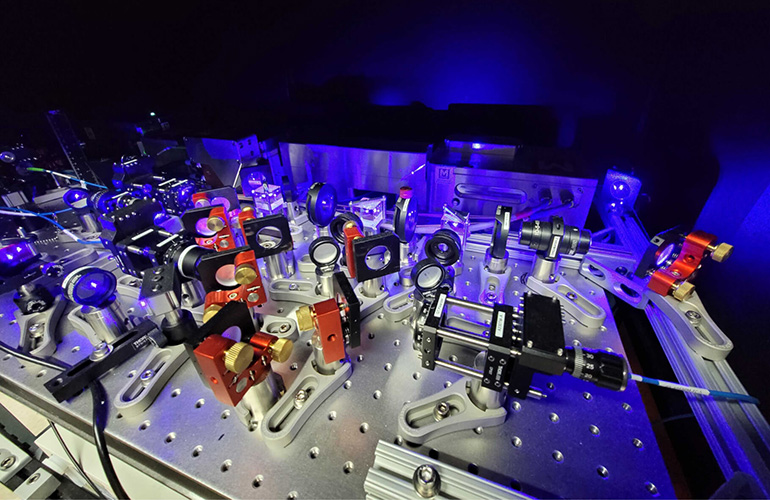
QuEra’s optical layout. Credit: QuEra Computing
Claude has also been working on quantum hardware at QuEra Computing, a Boston-based quantum computer developer. In August, QuEra said earlier Claude models had helped automate laser control, and in October, a preprint from Harvard, Anthropic and QuEra researchers reported Claude-designed quantum circuits that need fewer gates and qubits. QuEra’s machines use lasers to control individual neutral atoms that serve as qubits, the basic units of quantum information. Keeping those lasers at precise frequencies is essential to operating the hardware.
“People often expect drug discovery to be the first big win. I don’t.”
Yuval Boger, chief commercial officer, QuEra
In the following interview, Yuval Boger, QuEra’s chief commercial officer, expects materials research to produce some of the first major scientific payoffs from quantum computers equipped with error correction. Below, Boger shares how AI is helping engineers operate quantum systems and reduce the resources their calculations require, and what remains to be demonstrated.
R&D World: In August, QuEra reported that a Claude-built controller restored a laser’s frequency lock in 695 of 700 testbed trials. What has happened since, and what safeguards did your engineers set before trusting the code?

Yuval Boger
Boger: The laser lock got the attention, but it’s one piece of a bigger story. AI is now showing up in three parts of our work: designing the algorithms, correcting errors, and running the systems themselves.
The biggest news since August is on the algorithm side. In October, with Harvard and Anthropic, we published a preprint showing that Claude could discover fault-tolerant circuits that beat the designs people had built by hand. In seven of eight core tasks, the new circuits needed fewer gates and fewer qubits. I think of it as algorithmic compression. Take FeMoco, the classic chemistry benchmark. Researchers cut its estimated cost about 150,000-fold, and it took them eight years. Can AI do that kind of thing in months? For some building blocks, this paper is an early sign that it can.
Error correction is moving too. Machine-learned decoders are getting more logical performance out of the same hardware. The cascade-decoder result we wrote about in October is our Harvard collaborators’ work, and the credit is theirs.
I’d add two cautions. AI is helping classical methods just as much, so the bar quantum has to clear keeps moving. And I won’t tell you AI has pulled our roadmap in by some number of years. Libra is still planned for 2028.
As for the laser, the relock controller is past the pilot stage. It’s now a standalone production script, ordinary software you can read line by line, and the AI isn’t involved when it runs. Tuning still uses the AI, and turning that into a standalone tool is next. Then it goes to live systems. I’d be surprised if the laser were the last subsystem we handle this way.
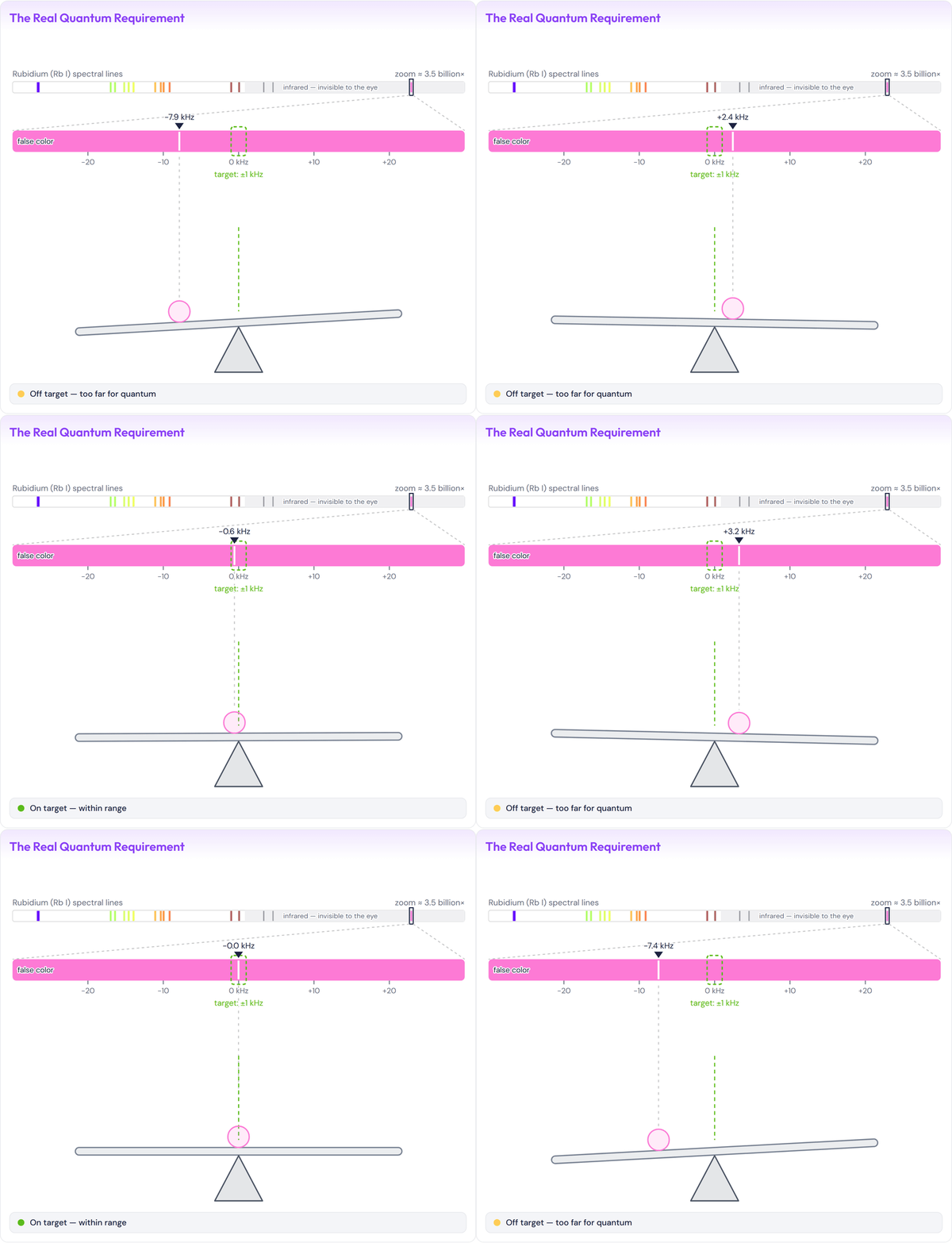
The laser must hold its frequency within about ±1 kHz of a rubidium spectral line. Credit: QuEra Computing
On safety, Claude never had free rein. The Model Hardware Standard enforces limits, interlocks and emergency stops at the hardware interface, and the model can’t override them. Our engineers set those limits. To give a sense of scale, a laser running logical-qubit operations has to hold its frequency within about ±1 kHz, so the envelope is tight. People stayed in charge the whole way. They set the scope, reviewed every step and decided what counted as proof.
We were also strict about what “success” meant. The controller only declares a lock when the cavity signal confirms it and the wavelength matches the target. We ran 100 timed trials for each of seven fault types, which is where 695 of 700 comes from. The five misses all traced back to one problem with the test rig, not the control logic. Along the way, the laser hopped modes on its own 43 times, and the controller caught all 43.
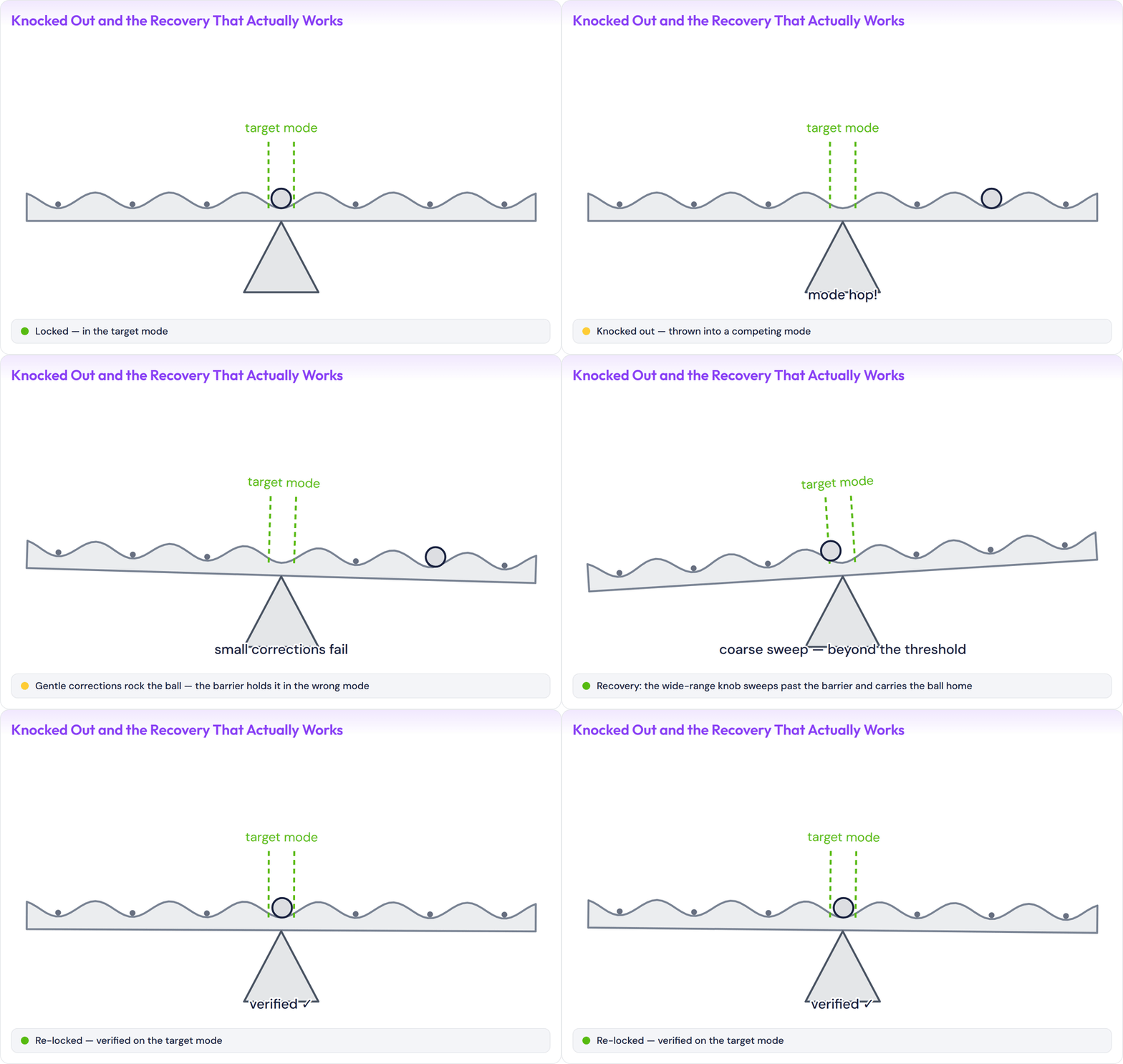
A disturbance knocks the laser into the wrong mode; a coarse sweep brings it back and fine control recaptures the lock. Credit: QuEra Computing
R&D World: The October preprint from Harvard, Anthropic and QuEra researchers (arXiv 2610.22367) reports leaner circuits on seven of eight tasks, as resource estimates. What did the chemistry tasks show, and when could you run these circuits on hardware?
Boger: There are two chemistry results in the paper. One is Fe2S2, an iron-sulfur cluster chemists use as a benchmark, where the AI-found routine improved Toffoli count times qubit count by 4.1x. The other is the Coulomb potential, which improved 9.9x: Toffoli gates went from 6,355 to 1,140, and qubits from 252 to 142. I want to be careful here. These are verified circuit designs and resource estimates for building blocks, not hardware runs and not full applications.
So why does it matter? Every fault-tolerant system has a fixed budget. Libra, for example, is designed for 256 logical qubits and about a million reliable operations. If AI cuts what each building block costs, the same budget fits a bigger problem: a larger molecule, a bigger active space, a finer simulation. Think of better compression on a phone. The storage hasn’t changed, but you can fit more on it. The catch is that a full application only gains as much as these building blocks contribute to its total cost, so it has to be checked one application at a time.
As for when, these circuits are written for fault-tolerant hardware, so the natural place to run them is Libra. We plan to make it available in 2028 on Amazon Braket and at HPC centers. Until then, we can test them in emulation.
R&D World: DFT and machine-learned force fields are already strong. What molecular problem will a fault-tolerant machine solve first that they can’t, and how many logical qubits will it need?
Boger: People often expect drug discovery to be the first big win. I don’t. DFT and ML force fields are very good, and AI is making them better every year. I expect fault tolerance to pay off first on strongly correlated materials, the problems where classical methods give you different answers depending on which one you use. Fermi-Hubbard lattice models up to 10×10 are a good example. That fits Libra: 256 logical qubits, a 10⁻⁶ logical error rate, roughly a million reliable operations.
Molecular chemistry comes after that. Think ground-state energies of strongly correlated molecules with small-to-medium active spaces, such as metalloprotein active sites and transition-metal chemistry. That’s work for our next-generation system, which targets 1,000+ logical qubits at 10⁻⁹, about a billion reliable operations, in 2028/2029. That’s a roadmap target, not a delivery date. And the bar keeps dropping. FeMoco estimates went from about 50 trillion Toffoli gates to about 340 million in eight years, and our preprint suggests AI can speed that up.
We’re not doing this alone. Chemistry specialists in the QuEra Quantum Alliance, notably QC Ware and Phasecraft, are working on exactly this question: which molecular problems break classical methods, and what would they need on our systems? The point is to have those answers before the hardware arrives.
R&D World: Are you working with pharma or AI drug-discovery companies on quantum-generated data, and what would that data look like as AI training data?
Boger: Yes, though I wouldn’t call it quantum-generated training data yet. In 2025, Merck, Amgen, Deloitte and QuEra published a study that used quantum reservoir computing to predict molecular properties. It ran on more than 100 qubits on our hardware, and a classical model learned from features the quantum system produced. That’s the closest thing we have to what you’re describing. Two of the six finalists in Wellcome Leap’s Quantum for Bio Phase 3 also run on our hardware. One looks at covalent inhibitors for myotonic dystrophy, with Nottingham and Phasecraft. The other works on binding affinity and NMR estimation, with Harvard and MIT.
What would the data look like? Probably a fairly small set of very accurate energies and properties, each with an error bar, for the molecules and configurations where classical methods are least reliable. You’d use those points to train or correct classical models, so a few expensive quantum calculations improve millions of cheap predictions. I like the idea, but it hasn’t been demonstrated yet. To produce data classical methods can’t, you need fault-tolerant hardware.


Tell Us What You Think!
You must be logged in to post a comment.