
[Adobe Stock]
Elsevier published the results Nov. 12 in its Corporate R&D of the Future report. The online survey ran by email invitation from August to October 2026 and drew 1,038 respondents at R&D-led corporations in 55 countries. The figures are weighted, and the flawed-decision figures exclude respondents who answered “don’t know” or preferred not to say. Elsevier also sells evidence and AI tools to corporate R&D teams. Its LeapSpace research workspace went live in January and added claim-checking tools in June.
While 78% of respondents say their teams can access the third-party evidence they need, 56% of that group still report at least one barrier. Across respondents, the leading obstacles were scattered sources (42%), slow finding and synthesis (32%) and uncertainty about what evidence exists (30%). “Fragmented data sources and disconnected systems create silos that slow down analysis and reduce transparency and weaken confidence in outcomes,” an R&D leader in Europe told the survey.
AI adds another layer to those evidence-quality concerns as R&D teams adopt tools that can generate inaccurate answers or unsupported claims. Nearly half of respondents (47%) say their organization’s R&D function uses AI regularly, and another 40% say it is piloting the technology. For literature searches, 48% of those answering use general-purpose tools such as ChatGPT or Copilot, compared with 23% using specialist scientific AI tools. Elsevier has a commercial stake in how companies address those risks: its LeapSpace research workspace includes claim-checking tools added in June.
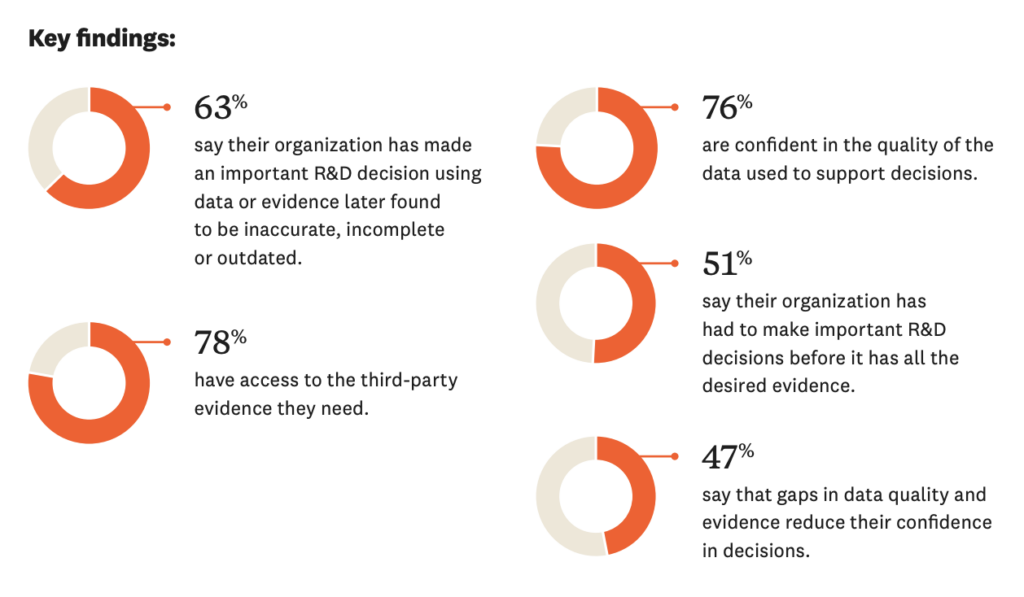
Elsevier’s survey found that 76% of respondents were confident in the quality of data supporting R&D decisions, while 63% reported that their organization had made an important decision using evidence later found to be inaccurate, incomplete or outdated. Graphic: Elsevier, Corporate R&D of the Future, 2026.
Respondents’ priorities include improving how evidence feeds into decisions. Asked what their organizations should focus on over the next five years, 62% selected turning data and evidence into actionable insights, and 59% chose tailoring AI to organizational knowledge and workflows. Building AI skills across the organization was the most-selected priority, at 65%.
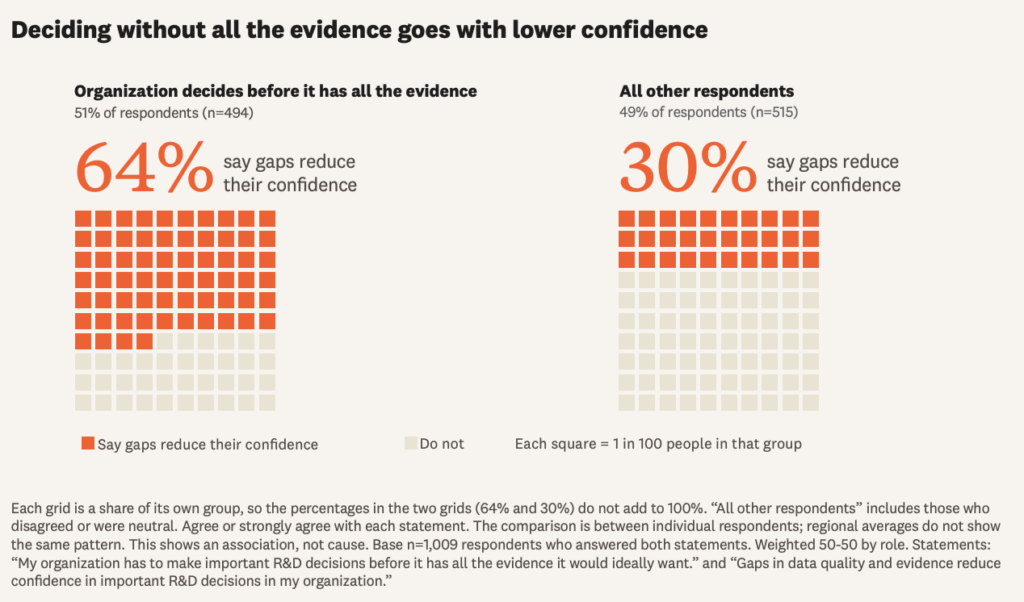
Respondents whose organizations decide before all the evidence is in are about twice as likely to say data gaps reduce their confidence (64% vs. 30%). [Source: Elsevier]


Tell Us What You Think!
You must be logged in to post a comment.