Research & Development World

  • R&D World Home
  • Topics
    • Aerospace
    • Automotive
    • Biotech
    • Careers
    • Chemistry
    • Environment
    • Energy
    • Life Science
    • Material Science
    • R&D Management
    • Physics
  • Technology
    • 3D Printing
    • A.I./Robotics
    • Software
    • Battery Technology
    • Controlled Environments
      • Cleanrooms
      • Graphene
      • Lasers
      • Regulations/Standards
      • Sensors
    • Imaging
    • Nanotechnology
    • Scientific Computing
      • Big Data
      • HPC/Supercomputing
      • Informatics
      • Security
    • Semiconductors
  • R&D Market Pulse
  • R&D 100
    • 2026 R&D 100 Award Winners
    • 2026 Professional Award Winners
    • 2026 Special Recognition Winners
    • R&D 100 Awards Event
    • R&D 100 Submissions
    • Winner Archive
  • Resources
    • Research Reports
    • Digital Issues
    • Educational Assets
    • Subscribe
    • Video
    • Webinars
    • PharmSci360
    • Content submission guidelines for R&D World
  • Global Funding Forecast
  • Top Labs
  • Advertisers
    • Advertise
    • PR Submissions
    • Eblast Submissions
  • SUBSCRIBE

Google is teaching healthcare professionals to incorporate AI into the everyday practice of medicine

By Brian Buntz | November 10, 2026

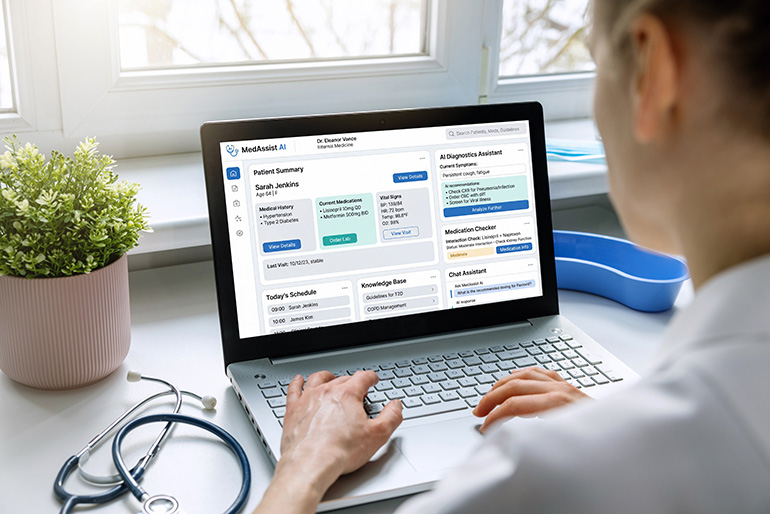
Female doctor using medical AI assistant on laptop computer in clinic office. modern medicine

Illustrative image of a medical AI system. [Adobe Stock]

Two decades ago, patients began arriving at doctors’ offices with questions inspired by Google searches while the same platform transformed how many physicians look up and manage clinical information. Today, genAI is driving a similar sort of transformation. In a 2025 Rock Health survey, 32% of U.S. adults said they had used an AI chatbot for health information while an American Medical Association survey found that 81% of physicians used AI professionally in 2026. Google has launched a new AI for Healthcare Professionals Certificate to help clinicians put those tools to use in their daily work.

The four-course program, designed to take under five hours and eligible for up to five AMA PRA Category 1 continuing medical education credits, covers patient communication, administrative work and professional learning. In the U.S. and Canada, it costs $49 a month through a Coursera subscription. Clinical diagnosis, medical decision-making and treatment recommendations fall outside its scope, according to Google. “We want to keep the healthcare professional as the center point, that human in the loop,” said Sohini Stone, Google’s chief medical officer for global employee healthcare.

In creating the course, Google drew on draft AI competencies from the Association of American Medical Colleges and sought feedback from clinicians practicing in different countries. Beta testers included physicians, nurses, hospital administrators and staff working at outpatient clinic front desks. Stone said those different roles shaped the examples. A physician writing discharge instructions faces a different workload than an administrator arranging shift coverage. Google’s program page quotes leaders at Touro University and at the Uniformed Services University, the U.S. military’s medical school, on training their faculty with the certificate; USU calls itself an early adopter.

Portrait of Sohini Stone, Google's chief medical officer for global employee healthcare.

Sohini Stone, Google’s chief medical officer for global employee healthcare. Photo courtesy of Google

Healthcare professionals “hear a lot about AI,” Stone said. “They’re encouraged to use AI, but they haven’t really been explained that under the hood,” she added.

Making more time for patients

Stone trained in hospitals that still used paper orders and in others with electronic medical records, sometimes three different systems in the same workplace. Paper charts had their frustrations, she recalled, although physicians had developed habits that helped them maintain eye contact. With electronic records, “it was a new skill to learn to still be able to maintain that eye contact now with a device in between,” she said.

“Our hope was that we would be able to inspire people to leverage AI to help reduce that administrative time and burden,” Stone said.

In the patient communication course, learners create a resource patients can use at home, turn written instructions into visual guides or videos, and rehearse difficult conversations in AI roleplays. Her training in pediatrics offered a familiar example: “You have to be able to explain the same concept to a four-year-old and their parent, and do it in different ways.”

The administrative tasks course has learners pull action items from email, turn dense protocols into audio briefings and build staff schedules that account for coverage requirements, shift rules and time-off requests.

From schedules to custom apps

For clinicians who want to go further, Google introduces the possibility of building tools tailored to their own administrative needs. The administrative course includes a 12-minute assignment to create a custom app with vibe coding, in which users describe the app they want in natural language and AI generates the code.

Stone sees opportunities for healthcare professionals, “most of whom probably don’t have a lot of coding skills,” to use AI to “create tools for themselves and their teams that are much more advanced than something that a new user might do.”

Some clinicians are already describing their experiments online. In a February 2026 Reddit discussion, a self-described pediatric hospitalist reported building a scheduling website after spending hours juggling colleagues’ time-off requests. The poster described existing solutions as cumbersome for the group’s needs. Other participants reported building a patient-list app for rounds and a vaccine-administration reference. These are self-reported projects; the discussion also included questions about patient-data privacy.

The course also addresses how institutional policies govern tool use. Stone said learners need to understand “what the guardrails are for their specific institution, for the specific tools that they have in mind.”

The fundamentals course assigns learners to improve an AI-assisted clinical resource, create a resource aimed at more equitable communication and draft AI-use guidelines for their team. “Introducing people to where and when it’s important to do check steps within their workflows when they’re using AI was a really important foundational part of how we designed every single one of the exercises and activities that we have people go through as part of the certificate,” Stone said.

Tell Us What You Think! Cancel reply

You must be logged in to post a comment.

Related Articles Read More >

Carnyx targets 2027 IND filing for oral sleep candidate CNYX-005
OpenAI unveils BioBasicsBench, a benchmark to gauge how well AI agents read raw experimental data across 100 routine wet-lab tasks.
Kosmos world model diagram: three colored paths of connected nodes trace three discoveries built from data-analysis agent steps, literature-review agent steps and established findings.
Edison’s Kosmos AI scientist moves into Pfizer R&D; Edison details the math behind its $99 million-per-program estimate
Headshot of Michael Schnall-Levin, chief technology officer of 10x Genomics, against a light gray background.
10x Genomics CTO expects AI to leave some of biomedical R&D ‘painfully slow’ while other parts are ‘massively accelerated’
rd newsletter
EXPAND YOUR KNOWLEDGE AND STAY CONNECTED
Get the latest info on technologies, trends, and strategies in Research & Development.

R&D World Digital Issues

Fall 2026 issue

Browse the most current issue of R&D World and back issues in an easy to use high quality format. Clip, share and download with the leading R&D magazine today.

R&D 100 Awards
Research & Development World
  • Subscribe to R&D World Magazine
  • Sign up for R&D World’s newsletter
  • Contact Us
  • About Us
  • Drug Discovery & Development
  • Pharmaceutical Processing
  • Global Funding Forecast

Copyright © 2026 Arrowfly LLC. All Rights Reserved. The material on this site may not be reproduced, distributed, transmitted, cached or otherwise used, except with the prior written permission of Arrowfly
Privacy Policy | Advertising | About Us

Search R&D World

  • R&D World Home
  • Topics
    • Aerospace
    • Automotive
    • Biotech
    • Careers
    • Chemistry
    • Environment
    • Energy
    • Life Science
    • Material Science
    • R&D Management
    • Physics
  • Technology
    • 3D Printing
    • A.I./Robotics
    • Software
    • Battery Technology
    • Controlled Environments
      • Cleanrooms
      • Graphene
      • Lasers
      • Regulations/Standards
      • Sensors
    • Imaging
    • Nanotechnology
    • Scientific Computing
      • Big Data
      • HPC/Supercomputing
      • Informatics
      • Security
    • Semiconductors
  • R&D Market Pulse
  • R&D 100
    • 2026 R&D 100 Award Winners
    • 2026 Professional Award Winners
    • 2026 Special Recognition Winners
    • R&D 100 Awards Event
    • R&D 100 Submissions
    • Winner Archive
  • Resources
    • Research Reports
    • Digital Issues
    • Educational Assets
    • Subscribe
    • Video
    • Webinars
    • PharmSci360
    • Content submission guidelines for R&D World
  • Global Funding Forecast
  • Top Labs
  • Advertisers
    • Advertise
    • PR Submissions
    • Eblast Submissions
  • SUBSCRIBE