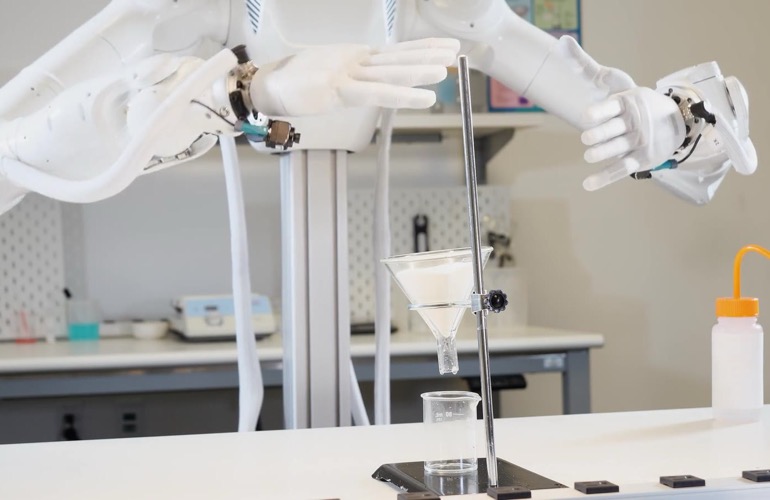
Dexter, a two-armed robot equipped with five-fingered hands from robotics company Sharpa, performs a filter-paper setup task in NVIDIA’s GR00T 2 experiments. Credit: NVIDIA
A two-armed robot in NVIDIA’s lab performed tasks it had never practiced, drawing on an AI model trained with human video and data from other robots. GR00T 2, the robot-control model the chipmaker introduced Nov. 9 at the Conference on Robot Learning in Austin, Texas, averaged 40% success across 50 tasks before receiving any demonstrations of those tasks on the target robot. After additional training with five short demonstrations per task, average success reached 95%, according to NVIDIA.
As The Robot Report notes, the launch is part of a broader rollout of new NVIDIA tools, including Isaac Lab 3.0, its latest open-source robot learning framework.
For Gr00T 2’s, NVIDIA chose tasks on which the model could reach at least 80% success after five demonstrations, making the five-demonstration result “high partly by construction,” its white paper says. The model completed 40 of the 50 tasks at least once before that additional training. After five demonstrations per task, it succeeded in every trial on 37 tasks.
NVIDIA calls GR00T 2 a “world action model” because it jointly predicts future video and robot movements. It is built on Cosmos-Predict2.5-2B, a video-generation model in the company’s Cosmos family of models for physical AI. From recent camera footage, a language instruction and information about the robot’s current configuration, GR00T 2 generates video of how the scene could change alongside a sequence of movements. The robot executes those movements, takes in new observations and repeats the cycle.
NVIDIA’s research demonstrations span several types of robots and training methods. Examples include placing filter paper in a chemistry-lab funnel, assembling toy trucks and planes, sorting packages on a conveyor and plugging in Ethernet cables. A smaller, faster version called GR00T 2 Turbo also controls a humanoid robot serving popcorn.
In a separate experiment, NVIDIA tested whether human demonstrations could teach Dexter, its two-armed test robot equipped with five-fingered Sharpa hands, new lab procedures. Researchers supplied 100 human demonstrations for each of three chemistry-lab tasks, recorded with head and wrist cameras, motion-tracking gloves and wrist trackers. They combined those recordings with general practice data collected by remotely controlling the robot on other activities, a process called teleoperation. Dexter received no teleoperated demonstrations of the three target procedures in this initial test.
On the filter-paper task, Dexter placed paper in a funnel, unfolded and seated it, wetted it with a wash bottle and returned the bottle. It completed the procedure in 13 of 20 trials, or 65%. Success rates were lower on the other two procedures: 30% for dispensing liquid into a beaker with a dropper and 10% for dipping a swab in water and dabbing a microscope slide.
Adding 10 teleoperated demonstrations per task raised success to 95% for the filter-paper setup, 70% for dispensing and 50% for slide dabbing. Earlier training on human video and data from other robot types contributed to those results. A version pretrained only on data from the target robot reached 45%, 40% and 30%, respectively, after the same task-specific training. NVIDIA’s earlier robot-control model, GR00T 1.7, completed none of the chemistry-lab trials, including those following training with 10 teleoperated demonstrations. In this comparison, all models received the same human demonstrations, robot practice data and task-training procedure. Each result came from 20 trials, and any human intervention counted as a failure, according to the white paper’s experimental protocol.
GR00T 2 also outperformed the comparison models in NVIDIA’s tests of longer, multistep tasks. Across seven tasks using dexterous hands, including filtering crude salt and replacing a computer memory module, GR00T 2 averaged 68.6% success. GR00T 1.7 averaged 0.7%, while π0.5 (pi-zero-point-five), a 2025 robot-control model from robotics AI startup Physical Intelligence, scored 0%. Across six tasks using a robot arm with a two-finger gripper, GR00T 2 averaged 71.7%, and GR00T 2 Turbo averaged 65%. The five baseline models used for comparison topped out at 12.5%, according to Table 1 of the white paper.
NVIDIA conducted the evaluations, and its reported truck-assembly result used easier starting arrangements for GR00T 2 and GR00T 2 Turbo. On the original arrangements, GR00T 2 completed seven of 20 trials, or 35%, compared with the reported 65% on the revised setups. The comparisons also cover a selection of models. Physical Intelligence introduced its newer π0.7 model on April 16, and Google DeepMind, Google’s AI research division, announced Gemini Robotics 2 on July 30. Both are absent from these task comparisons.


Tell Us What You Think!
You must be logged in to post a comment.