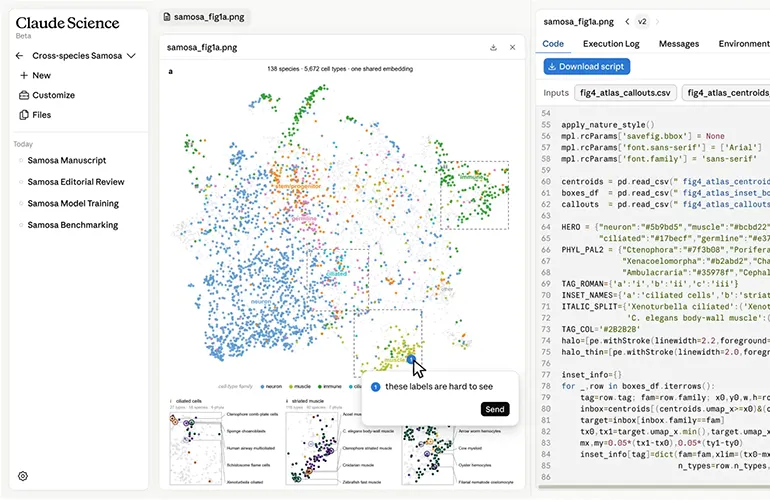
From Anthropic’s Claude Science product page: click-to-annotate feedback on a generated figure, with the matplotlib code that produced it editable in the same window. Image courtesy of Anthropic.
Boris Cherny, the creator of Claude Code, says he doesn’t write prompts for Claude anymore. “My job is to write loops,” the head of Claude Code at Anthropic has said, describing a shift away from manual, turn-by-turn prompting toward building small systems that keep an agent working until a defined condition is met. Peter Steinberger, the creator of OpenClaw and now a technical staff member at OpenAI, helped popularize the same shift: “you shouldn’t be prompting coding agents anymore,” he wrote. “You should be designing loops that prompt your agents.”
Anthropic is now predicting Claude will follow the same trajectory in life sciences. “Six months ago on this stage, we made a claim that Claude could help with the work of Life Sciences R&D,” said Zubair Jandali, the company’s head of healthcare and life sciences go-to-market, referencing Anthropic’s Briefing: Healthcare and Life Sciences livestream from January. “Today, we’re going to build on that claim with a new one: Claude can run the work, not help with it, not accelerate it, even run it. It’s a bold thing to say out loud, but let me tell you why we believe it. We’ve all seen this happen in software development. Coding has irreversibly changed.”
“The scientific method is a loop, too,” he said. “The original loop design: the experiment, run it, analyze the data, ask the next question. The experiment happens at the bench, the analysis happens at a keyboard, and that is where the loop stalls.”
Still, the word “loop” isn’t new to Anthropic’s life sciences vocabulary. At that January event, life sciences lead Eric Kauderer-Abrams used it too, telling the room Anthropic’s guidance was not to “let Claude run open-loop and write clinical trials and communicate directly with FDA and cut you out of the loop.”
But the loops are tightening. Jandali’s claim was the opening act for what Anthropic actually shipped that day at “The Briefing: AI for Science” in San Francisco. Claude Science runs on Anthropic’s existing Claude models, including Sonnet 5, introduced the same day. Claude Science bundles more than 60 scientific databases and connectors into one workbench. It includes a coordinating agent that spins up specialist sub-agents for individual tasks, and a reviewer agent that checks citations and calculations before handing results back. It runs on a lab’s own infrastructure, a laptop, a Linux box or an HPC login node, so large or sensitive datasets stay put, with only the context each analysis step needs sent to Claude. It’s in beta for Pro, Max, Team, and Enterprise subscribers.
In April, April paid roughly $400 million in stock for Coefficient Bio, an eight-person startup founded by ex-Genentech computational biologists building AI tooling for drug-pipeline planning, target identification, molecular design, and clinical trial strategy. Alongside Claude Science, life sciences leaders Eric Kauderer-Abrams and Jonah Cool announced Anthropic would run its own internal drug discovery program, targeting neglected diseases that traditional biopharma companies wouldn’t pursue, framed as a way to build the company’s own development experience and credibility with the biopharma customers it’s selling Claude Science to. Kauderer-Abrams did not say what Anthropic would do with any promising candidates the program finds, the part of the process where a real biopharma company would move into clinical trials. Is Anthropic now a drug developer? Not really. It’s positioning itself to look like one to the customers it’s trying to sell to.
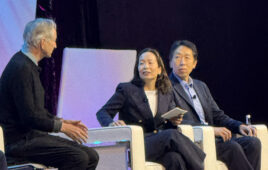
At the event, Anthropic CEO Dario Amodei joined Lotte Bjerre Knudsen, Novo Nordisk’s outgoing Chief Scientific Advisor and one of the scientists who spent more than three decades turning GLP-1 biology into Ozempic and Wegovy. STAT’s Matt Herper moderated.
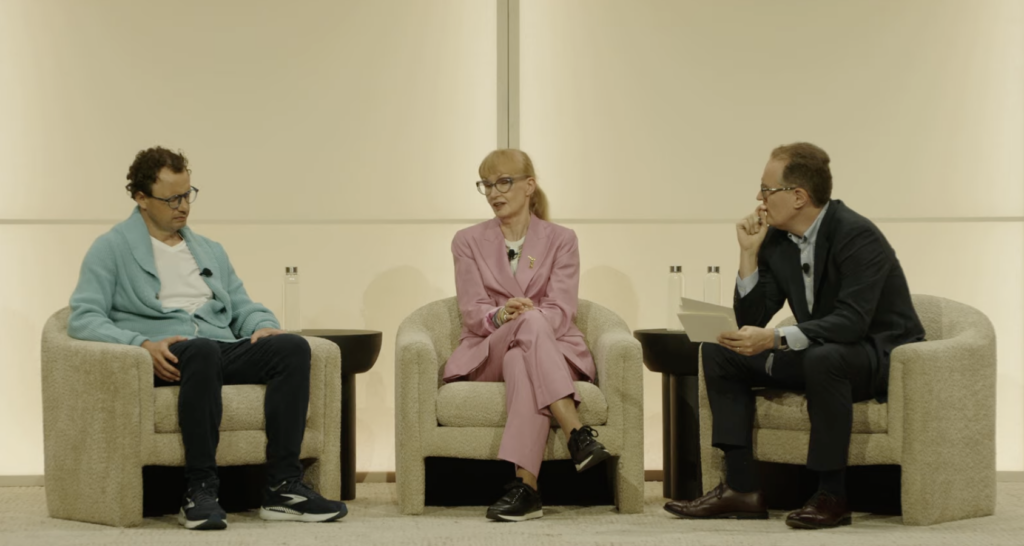
From left to right: Anthropic CEO Dario Amodei, Lotte Bjerre Knudsen (Novo Nordisk’s outgoing Chief Scientific Advisor, who led the research behind liraglutide and semaglutide), and STAT senior writer Matthew Herper, in conversation at Anthropic’s livestreamed Briefing: AI for Science event on June 30, 2026.
Anthropic is now a drug hunter
In April, Anthropic paid roughly $400 million in stock for Coefficient Bio, an eight-person startup founded by ex-Genentech computational biologists building AI tooling for drug-pipeline planning, target identification, molecular design and clinical trial strategy. Where Claude Science wraps Anthropic’s existing Claude models in workflow tooling and database connectors, OpenAI built GPT-Rosalind as a model purpose-built for biological reasoning rather than a general-purpose assistant repurposed for science, with early users including Amgen, Moderna, the Allen Institute, and Thermo Fisher Scientific.
Alongside Claude Science, life sciences leaders Eric Kauderer-Abrams and Jonah Cool announced Anthropic would run its own internal drug discovery program, targeting neglected diseases that traditional biopharma companies wouldn’t pursue. The company framed the news as a way to build the company’s own development experience and credibility with the biopharma customers it’s selling Claude Science to. Kauderer-Abrams did not say what Anthropic would do with any promising candidates the program finds.
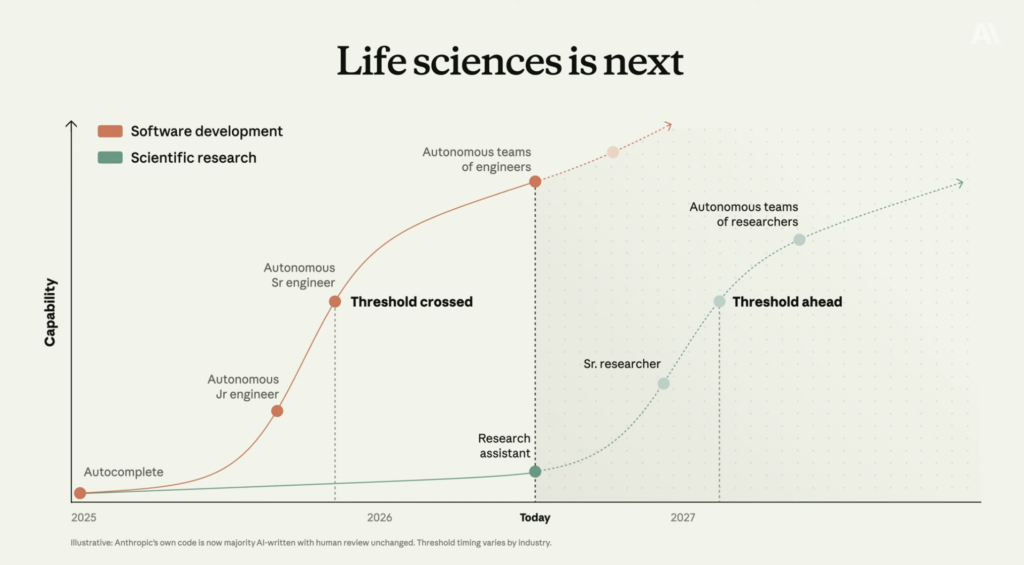
A marketing image from Anthropic, displayed at the opening of Tuesday’s Claude Science launch, maps AI capability in scientific research against the curve coding has already climbed.
How much can life science research be accelerated?
The argument that biopharma should run more like the tech industry has history. In 2007, former Intel CEO Andy Grove faulted the drug industry for lacking the semiconductor world’s urgency, telling Newsweek that in chips “what matters is time to market, or time to money,” a drive he found missing in pharma. Grove’s envy was really for Moore’s Law, the semiconductor industry’s decades-long run of roughly doubling transistor counts every two years at flat cost. The medicinal chemist Derek Lowe said the comparison of biopharma to semiconductors was profoundly an apples-to-oranges one. “Medical research is different than semiconductor research,” he wrote. Lowe would eventually name the assumption that learning how an evolved system works can scale like engineering one you built yourself the “Andy Grove Fallacy.”
Lowe has since become one the field’s most-quoted AI skeptics, though clarifying he is not “reflexively hostile to computational and machine-learning approaches in general.” Anthropic CEO Amodei granted that biology is a “super messy evolved system” and that he “basically agree[s]” with Lowe’s premise that biology is considerably more complex than, say, semiconductor chips. Amodei, however, is fundamentally more optimistic about the promise of AI, saying that it “is not going to be another engineering technology that organizes our data better,” but a “general-purpose technology that helps us make sense of that complexity in its full complexity.
Amodei’s optimism came with caveats. “We don’t know for sure” if AI would become a general-purpose scientific collaborator at scale, he said, “but I think we’re seeing signs… we’re seeing the beginnings of it.” He added: “That is the hope, that is what we should shoot for. … I can’t be confident, because we don’t know the future, but I’m optimistic.”
Knudsen, who spent more than three decades on the biology that became Ozempic and Wegovy, also chimed in. “We will get better at improving the probability of success of new medicines, because we’ll understand them better,” she said. “We have a better foundation for why we picked those targets. We can understand the MOA. We can make smarter clinical trials.” Fewer failures, in other words.
On the timeline, she made no promises. “We’re going to have to listen to Derek Lowe,” she said, “probably for another 10 years. He’s very insightful.”