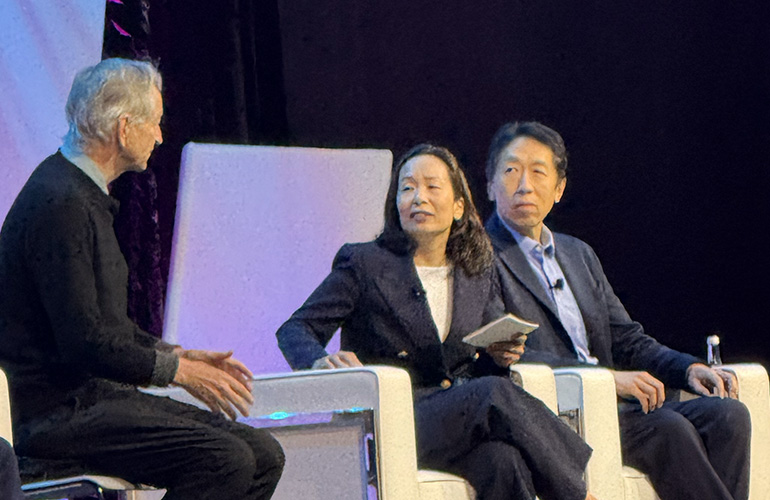
Hinton, Fei-Fei and Ng in the AI4 keynote
Nobel Prize winner and deep learning pioneer Geoffrey Hinton, Ph.D., has frequently expressed concern that AI systems could escape human control. At a keynote at the AI4 event in Las Vegas, he pointed to developments that are “scary,” pointing to recent examples of AIs escaping sandboxes at prominent AI companies. “You are seeing AIs with a lot of mobility doing things people did not intend them to do.” OpenAI and Anthropic recently published incident reports laying out how frontier models have occasionally escaped their control.
Two other AI pioneers, Andrew Ng, the co-founder of Coursera and formerly the head of Google Brain, and the Stanford AI researcher Fei-Fei Li, acknowledged the cybersecurity risks, but expressed more concern about extreme rhetoric and the tendency to view AI in terms of black and white.
Ng said that prominent AI labs themselves were often behind fearmongering, arguing that frontier models should be closed. The aim, Ng said, is to “drive laws that crack down on open-weight models, and block software that is free for communities to use.” Ng said that the same companies who had warned that AI could lead to human extinction or take over a large share of employment were now lobbying to keep AI closed to limit the influence of open weight models which are predominantly open.
Li noted that the apparent argument that frontier AI models should be largely open or closed is an artificial binary. “I think journalism is not helping in this discourse,” Li said. “There are shades of gray.”
Li pointed to nuclear physics as an example where scientific publications are generally open while material regulation of fissile materials like uranium are tightly controlled. “In complex software systems, and in scientific systems, the picture is much more nuanced than the words open versus closed,” she said.
Fei-Fei Li, who invented the seminal ImageNet database in 2006 that would play a foundational role in the AI wave of 2010s, lamented the dualistic notions dominating much of the AI rhetoric. “Let’s bring science, not science fiction, back to the AI debate,” she said. “The public needs education. It needs respect. It needs good, healthy scientific communication. AI is a tool. It is a rapidly evolving tool.”
Here, Hinton also voiced skepticism in parsing the messaging from frontier AI labs regarding regulation. “First of all, all industries would like not to be regulated,” he said. “Tobacco did not want to be regulated.” The industry itself has spent “a lot” of money “persuading you that developing AI is like the accelerator and regulation is like the brakes.”
Hinton said that the analogy is wrong. “Developing AI is like the accelerator. Regulation is like the steering wheel. What we want to do is develop AI in a direction that works for us, and regulation is what allows you to do that.”
“So we cannot leave it to people like Elon Musk and Mark Zuckerberg to decide how AI gets regulated,” Hinton said.
On speculative catastrophe and present technical risk in AI
While acknowledging the potential for fearmongering and tangled financial incentives in AI development, Hinton said, “I think there is a lot to worry about, and unless we worry now, there could be problems.”
He pointed to recent research at the University of Toronto that reported a new type of computer worm at minimal cost using large language models. “A conventional worm looks for the same security flaw. This one looks around and finds a new security flaw,” Hinton said. “That is scary because it can keep spreading.”
Ng, acknowledging the risks, says that AI hype can distort the true risk, noting that training AI models on the public internet makes them potentially adept at everything from, say, doing an SAT exam to cybersecurity attacks. “My broader point concerns the story that generative AI is becoming a separate species that could take over the world,” he said.
Making sense of AI’s impact on jobs
GenAI has become the most transformative technology for white-collar work in decades and could ultimately have a greater impact than the internet. Software engineering is among the fields changing fastest, with coding agents moving rapidly into everyday development workflows. “Even [in software development], we cannot find enough skilled engineers,” Ng said. Big Tech companies from Microsoft to Meta have made significant reductions in force in recent years, sometimes pointing to AI as a reason. “Companies are laying off people, yes,” Ng said. But he disputes the job apocalypse frame.
The numbers back up the core claims. Gallup research has acknowledged that AI is leading to changing workforce dynamics although the data points in different directions in terms of the current state versus perceived future disruptions. In its first-quarter 2026 workforce study, Gallup asked workers who were unemployed because of a layoff to describe, in their own words, why they lost the job. One percent cited AI or automation. Organizational restructuring led at 15% with budget cuts and economic conditions at 11% each. Anxiety about future cuts, meanwhile, is climbing. In the same February 2026 survey of 23,717 employed U.S. adults, 18% said it was very or somewhat likely their job would be eliminated within five years by automation or AI, up from 15% in each of the two prior readings and 14% in 2023.
Speaking of the current situation, there are high profile examples of cuts where execs announcing layoffs mention AI. Block is a clear case. In February 2026, CEO Jack Dorsey cut roughly 4,000 employees, close to 40% of the company, and framed it as a bet that intelligence tools had changed what it takes to build and run a business. He told shareholders he expected most companies to reach the same conclusion within a year. The stock rose about 22%. Yet there were likely drivers of the downsizing. Block’s headcount had nearly tripled from about 3,800 at the end of 2019 to more than 12,000 at peak, the stock had fallen significantly over five years, and the company had already run layoff rounds in 2024 and 2025.
Ng thinks the true current impact on AI on jobs is minimal. “A CEO I spoke with recently ran a survey of people who had been laid off and asked what percentage were actually replaced by AI. Was it 50%, 20% or 10%? It was 1.4%,” he said. “The broader job-impact narrative gets blown out of proportion,” Ng said.
Ng and Li also pointed to the potential for job creation. “I see many jobs already being created in software, and in other sectors. People should step in and gain new skills,” Ng said.
Li echoed the need for nuance in the AI jobs discussion. “When people put the words AI and jobs together, the implicit word between them is ‘replace,’” she said. She faulted Silicon Valley for celebrating automation without nuance.
Companies like Anthropic have stoked those concerns. In May 2025, CEO Dario Amodei told Axios that AI could eliminate half of entry-level white-collar jobs and push unemployment to 10-20% within one to five years. He said that companies and the government should stop sugar-coating it. Some figures in the industry rejected that frame. NVIDIA CEO Jensen Huang quipped last year that Amodei ”believes that AI is so scary that only they should do it.” Huang stressed that AI would have a significant impact on jobs nonetheless, but disputed the interpretation that the impacts would primarily be negative. “Everybody’s jobs will be changed,” Huang said last year. “Some jobs will be obsolete, but many jobs are going to be created
Hinton said the impact on jobs is significant. “I think people are right to worry about jobs,” he said. “For example, paralegal work is more or less disappearing because AI can do that job better than people.”
BLS predicts flat growth for paralegals through 2034 while also directly citing AI’s impact on the profession and related secretarial type work.
While the current data points in the direction of AI having a potential disproportionate impact on more rote tasks, Hinton sees a more disruptive impact in the long run. “My judgment is that many jobs will go the way of ditch diggers when backhoes came along,” he said. “Manual laborers could move into office and service jobs. Once AI can do routine intellectual labor, any job built around routine intellectual labor is at risk.”
Li noted that automating a given job is more complicated than the industry often makes it out to be. “Every existing job I can think of is composed of multiple tasks,” she said. “That applies to nurses, teachers, artists and journalists.”
Li mentioned AI’s potential to accelerate busywork in some areas while freeing up effort to focus on other tasks. “For example, I have spent a lot of time in hospitals caring for my elderly parents. I know how complicated a nurse’s job is,” she said. “AI that helps with charting or verifies pharmaceutical orders would be an incredible help.”
Fearful rhetoric concerning AI is counterproductive, Li said. Because AI requires reimagining some roles and education, Li stressed the need for a “soft-landing” based on education and policy. “Fear does not help people learn,” she said. “Fear does not help policymakers make rational policy. We need to invest in education and in affected communities. Taking away people’s agency makes the problem worse.”
AI and the education question
In education, AI anxiety and adoption are rising together, while outcomes depend heavily on how AI enters the task. RAND found that AI use for homework among middle school, high school and college students rose from 48% in May 2025 to 62% in December. At the same time, the share agreeing that greater use harms critical thinking hit 67%
Meanwhile, the impact on learning is conditional. Li argued that the industry has framed AI for students in a way that undercuts the thing education depends on. “The most important and underappreciated word in education is motivation,” she said. “Education at its core is the self-agency of the learner.” You can have the best teacher or the worst teacher, the best book or the worst book, she said, and the outcome still turns on whether the learner keeps that motivation.
The prevailing message to students, in her account, works against it. “The rhetoric aimed at students often says, ‘AI can do this. Just use it,'” Li said. “That removes human agency from the conversation and does a disservice to a generation of students.”
A randomized field experiment published in PNAS involving nearly 1,000 high school math students in Turkey captured the risk of overreliance on AI. Students given a standard GPT-4 chat interface solved 48% more practice problems correctly, then scored 17% worse than the control group on an unassisted exam. A second version, prompted to offer teacher-designed hints rather than answers, produced a 127% practice gain and erased the penalty. STill, though those students did no better than peers who never had access. The authors titled the paper “Generative AI without guardrails can harm learning.”
Li describes the threat of a subset of students deciding AI can enable them to do their work for them. “Classroom teachers are not afraid of students who are underprepared or learning slowly,” Li said. “Teachers are most afraid when a student does not want to learn.” When AI is marketed on its ability to pass every test, she said, the first thing a teacher hears is cheating. That in turn, leads teachers and professors to reject AI outright rather than see it as a tool. “That is our failure,” she said.
Hinton was more optimistic about the potential of AI in tutoring. “One thing we know is that children learn about twice as fast with a tutor as they do in a classroom,” he said. A classroom teacher has to say the same thing to 20 or 30 children, some of whom will not be interested in that particular thing at that particular moment. An AI tutor can follow the individual child’s interest.
The most-cited study on that gap is Benjamin Bloom’s 1984 paper in Educational Researcher, which reported that students tutored one-to-one using mastery learning performed two standard deviations better than classroom-taught students. The average tutored student scored above 98% of the control class. Attempts to reproduce that result have come up short. A 2020 meta-analysis of 96 randomized tutoring studies by Nickow, Oreopoulos and Quan put the average effect at 0.37 standard deviations, about 14 percentile points. None of the 96 reached two sigma, but still pointed to the superiority of tutoring generally. Bloom’s tutoring condition also paired one-to-one instruction with mastery learning, a structured pedagogy, rather than testing the ratio on its own.
Ng also mentioned the consequences of the current messaging of AI as task performer as a source of frustration for students who had contacted him. One was a high school student who had grown depressed while prompting ChatGPT, wondering why she should bother trying to write as well as it did. Another emailed to ask which major would still be relevant three years out. “One challenge with the narrative that AI is so smart is that it sends demotivating messages,” Ng said.
Similar to Li’s framing of AI as a tool, Ng said it is a mistake to conclude projects aren’t worth building because AI is increasingly competent at building. “AI is amazing, but humans will retain a fundamental advantage for a long time,” he said. “All of us have a massive amount of context that AI does not have. We have accumulated context from conversations over decades, everything we have seen in the world, and a deep understanding of our businesses.”
Ng pointed to genAI’s misfires in brainstorming as an example of its uneven performance. “It may offer one or two decent ideas, and then you wonder why it gave you several ridiculous ones,” he said. “I do not see a plausible path for AI to close that context advantage for many decades.”
“You know more than the AI does,” Ng said. “That is an important message for young people navigating the future. We have power. We know more.”