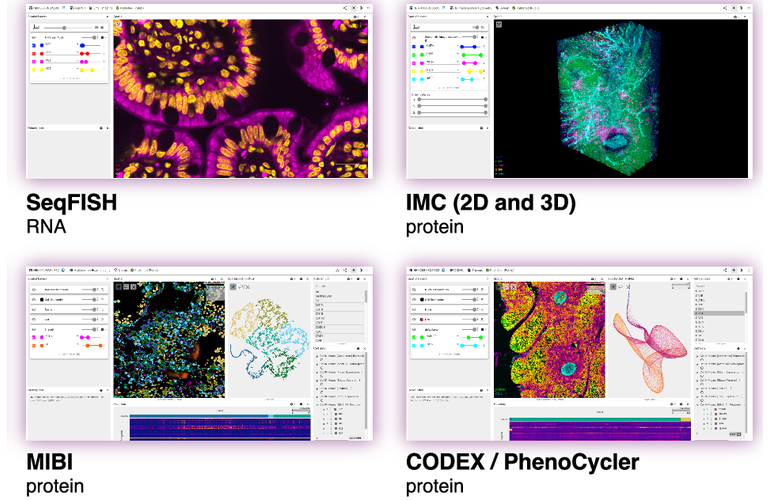
The HuBMAP Data Portal’s Vitessce viewer displays spatial data in the browser, including seqFISH RNA imaging and three protein-imaging methods. Credit: Turner et al., Nature Communications (2026), Fig. 5, CC BY 4.0
Harvard Medical School describes the Human BioMolecular Atlas Program (HuBMAP) Data Portal, which the National Institutes of Health (NIH) funds, as “one of the most comprehensive” atlases of healthy human tissue, and the school’s Nov. 2 release says the data is AI-ready. But the paper describing the portal warns that its 501 donors don’t fully reflect human demographic diversity.
Researchers at Harvard Medical School and five other institutions (the Pittsburgh Supercomputing Center, the University of Pittsburgh, Carnegie Mellon University, the University of Pennsylvania and Stanford University) led the team that built the portal and detailed it Nov. 2 in Nature Communications. The portal offers free, open access to data from an eight-year effort involving more than 600 consortium members at more than 60 institutions; sequencing data that could identify donors requires an approval process, according to the release. The paper puts the portal at 9,316 datasets from 501 donors as of August, and the portal’s data overview, last updated Oct. 29, lists 9,727 datasets from 512 donors. The paper presents the portal as an open reference for healthy human tissue but also notes that organ coverage is uneven.
The researchers caution that donor tissue availability and the research priorities of NIH-funded projects limit the atlas’s scope. They say that users treating HuBMAP as a healthy reference or training set should consider that findings may not generalize across demographic groups or tissue contexts.
The same paper says the atlas serves researchers “training AI models” and that computational biologists can use it to find “large uniformly processed datasets across multiple organs to train AI models or benchmark computational tools.” Morgan Turner, the paper’s first author and director of scientific operations in the Humans in Data Integration, Visualization, and Exploration (HIDIVE) Lab at Harvard Medical School, said in the release that the consortium’s data standards “make the data ready for AI.”
Where the data comes from
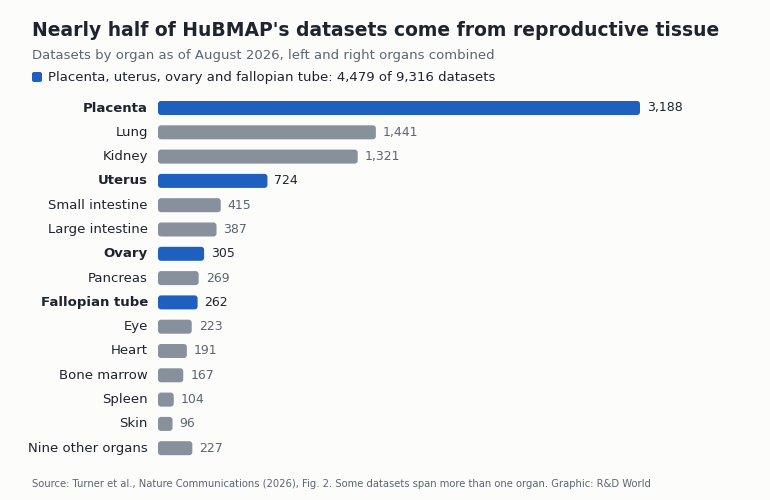
Credit: R&D World graphic. Source: Turner et al., Nature Communications (2026), Fig. 2
As of August, 3,188 of the 9,316 datasets (34%) came from 29 donor placentas, according to the paper. Two assays account for most of them: GeoMx spatial profiling and probe-based RNA sequencing each produced 1,362 placenta datasets. Placenta yielded about 10 datasets per sample (3,188 from 315 samples), while skin yielded about one for every eight samples (96 from 774). The paper says organ-level spatial sampling is “uneven and biased by research questions.”
Reproductive and pregnancy-related tissues (placenta, uterus, ovaries and fallopian tubes) account for about 4,480 datasets, nearly half the atlas. Uterus came from 87 donors, more than any other organ class; the paper counts left and right kidneys separately, at 64 and 53 donors.
Lungs are also well represented. More than 1,400 datasets come from lung tissue. Six donor left lungs produced 641 datasets, and 17 donor right lungs produced 800.
In contrast, 37 donor hearts produced 191 datasets and 117 donor kidneys produced 1,321, about five datasets per heart and 11 per kidney, compared with about 107 per left lung.
Diversity by the numbers
The datasets came from 501 donors as of August: 284 female, 209 male and eight of unknown sex, ages 0 to 90 and older, with more than a third in their 20s and 30s.
As of Nov. 4, the portal listed 284 of its 512 donors as White, 108 as Black or African American, 86 as unknown and 26 as Asian. The authors note “relatively low sampling from underrepresented groups.”
The portal’s own donor diversity page frames representation as central to the atlas’s purpose. It says that to serve “as a reference atlas for future studies in human disease,” HuBMAP needs donors representing a broad range of factors that affect health, including age, sex, race and ethnicity. On Nov. 4, that page, like the rest of the portal, opened with a banner reading “This Repository Is Under Review For Potential Modification In Compliance With Administration Directives.”
Atlas gaps and AI models
AI researchers use reference atlases like this to train and benchmark single-cell and spatial foundation models (large, general-purpose AI models that researchers adapt to many tasks) and to define what “normal” looks like for anomaly or disease detection. Researchers who study atlas bias warn that gaps in who gets sampled can carry into the AI models that learn from the data.
Kuan-lin Huang, an associate professor of genetics and genomic sciences and of artificial intelligence and human health at the Icahn School of Medicine at Mount Sinai, led a July audit in Cell Genomics of more than 13,500 samples in three other major single-cell atlases: the Human Cell Atlas, an international effort to map every human cell type; the Human Tumor Atlas Network; and the PsychAD brain dataset. The audit found that the atlases overrepresented people of European ancestry and that nearly 70% of samples in the Human Cell Atlas lacked any ancestry data. “These gaps can be passed into AI models trained on the datasets,” Huang said in a statement, adding that this often happens without the models’ users realizing it.
HuBMAP runs each data type through its own standardized processing pipeline, and each processed dataset lists the pipeline version that produced it so users can check comparability. Every dataset traces back to its sample and donor.
A 2024 review for an NIH Common Fund program, which the paper cites, found HuBMAP was the only one of 28 biomedical databases to document everything on a 29-question checklist for whether data is findable, accessible, interoperable and reusable (FAIR).
The paper says the consortium is still publishing data and expects the volume of datasets to grow after publication.
Tell Us What You Think!
You must be logged in to post a comment.