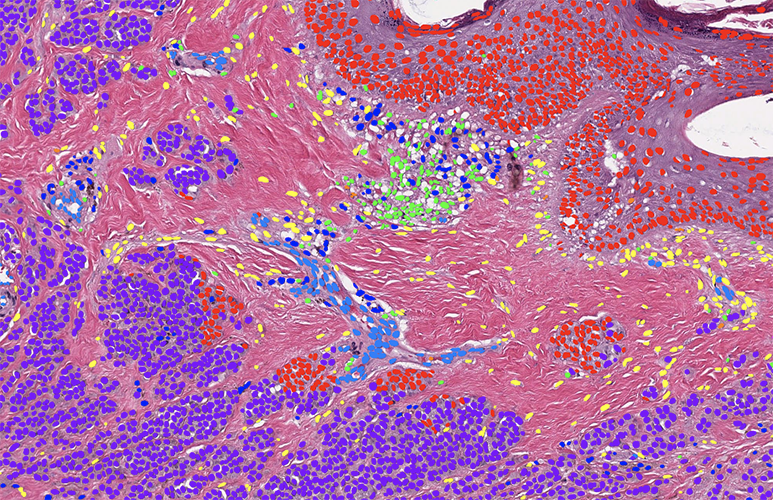
Aignostics’ Atlas H&E-TME model marks individual cell types with colored dots on an H&E-stained tissue section. Proscia offers the research-use-only model in its portfolio of third-party AI applications that work with Concentriq. Credit: Proscia
Laboratory equipment maker Agilent Technologies signed a multiyear distribution agreement with Proscia in September 2022 to offer its Concentriq software alongside Agilent’s pathology staining products. Now Agilent owns the software. The Santa Clara, Calif., maker of analytical and clinical laboratory instruments said on Nov. 4 that it had completed its acquisition of Proscia, paying $240 million in cash at closing, with up to an additional $30 million payable based on future performance milestones. Proscia, founded in 2014 and based in Philadelphia, is now part of Agilent’s Life Sciences and Diagnostics Markets Group. Agilent announced the deal on Oct. 13 and had targeted a closing early in its fiscal 2027, which began Nov. 1. Agilent’s fiscal year ends Oct. 31.
Agilent describes Concentriq, a software platform for managing and reviewing digital images of tissue samples, as a central operating layer for digital pathology. The software connects slide scanners, lab information systems, image-analysis applications and AI tools so that labs can manage images, data and workflows in one environment. It works with scanners from multiple vendors. In its October announcement, Agilent said Proscia serves more than 4,000 laboratories, hospitals and clinics and 16 of the top 20 pharmaceutical companies, with trailing 12-month revenue above $18 million. Agilent put the pathology market at $5 billion. Agilent reported revenue of $6.95 billion in fiscal 2025.
“The acquisition establishes an Agilent platform for scientific intelligence in tissue-based precision medicine, connecting data generation with AI-based interpretation in a workflow that supports biomarker research through routine clinical use,” Agilent President and CEO Padraig McDonnell said in October. Agilent also said Proscia’s growing repository of real-world data offers AI-enabled synergies with its companion diagnostics business, benefiting biopharma partners and clinical and translational research customers.
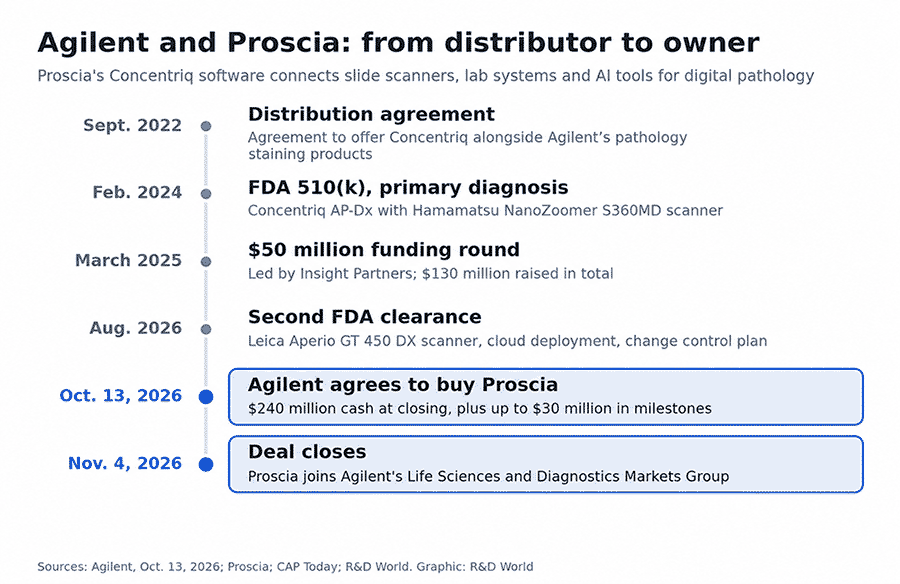
Credit: R&D World graphic. Sources: Agilent, Proscia, CAP Today, R&D World
“Agilent shares our vision for advancing pathology through open, digital, and AI-enabled solutions,” David West, Proscia’s co-founder and CEO, said at the time. “Together, we can accelerate innovation while continuing to provide customers with the flexibility they need across clinical and life-sciences workflows.”
Proscia described its real-world data in September 2025, when it launched Aperture, an AI platform designed to identify potential clinical-trial candidates at the moment of diagnosis, Drug Discovery & Development reported. Proscia put its repository at more than 12 million de-identified tissue images linked to clinical and genomic records, said its Concentriq lab network was on track for about 8 million pathology diagnoses that year, and listed Agilent as Aperture’s partner for end-to-end workflow distribution. Later that month, Proscia said it would add Pictor Labs’ virtual H&E, IHC and special stains to Concentriq, for research use.
The clinical version of the software, Concentriq AP-Dx, received FDA 510(k) clearance for primary diagnosis in February 2024, paired with Hamamatsu’s NanoZoomer S360MD slide scanner. A second clearance, reported Aug. 10, 2026, by CAP Today, added compatibility with Leica’s Aperio GT 450 DX scanner and cloud deployment. It also included a predetermined change control plan allowing Proscia to validate and add support for additional FDA-cleared scanners, image formats and displays within the plan’s scope without submitting a new 510(k).
Proscia raised $50 million in a funding round led by Insight Partners in March 2025, bringing its total funding to $130 million. The company earned 2026 Best in KLAS for digital pathology in Europe and the highest overall performance score in KLAS’s U.S. digital pathology report, according to Proscia’s March announcement.
The acquisition follows Agilent’s purchase of Biocare Medical earlier this year. On March 9, Agilent agreed to acquire Biocare Medical for $950 million in cash, and it had completed that deal by the time it announced the Proscia agreement. Biocare makes more than 300 specialized antibodies, along with immunohistochemistry, in situ hybridization and fluorescence in situ hybridization products for oncology and clinical pathology.
Tell Us What You Think!
You must be logged in to post a comment.