Research & Development World

  • R&D World Home
  • Topics
    • Aerospace
    • Automotive
    • Biotech
    • Careers
    • Chemistry
    • Environment
    • Energy
    • Life Science
    • Material Science
    • R&D Management
    • Physics
  • Technology
    • 3D Printing
    • A.I./Robotics
    • Software
    • Battery Technology
    • Controlled Environments
      • Cleanrooms
      • Graphene
      • Lasers
      • Regulations/Standards
      • Sensors
    • Imaging
    • Nanotechnology
    • Scientific Computing
      • Big Data
      • HPC/Supercomputing
      • Informatics
      • Security
    • Semiconductors
  • R&D Market Pulse
  • R&D 100
    • 2025 R&D 100 Award Winners
    • 2025 Professional Award Winners
    • 2025 Special Recognition Winners
    • R&D 100 Awards Event
    • R&D 100 Submissions
    • Winner Archive
  • Resources
    • Research Reports
    • Digital Issues
    • Educational Assets
    • Subscribe
    • Video
    • Webinars
    • PharmSci360
    • Content submission guidelines for R&D World
  • Global Funding Forecast
  • Top Labs
  • Advertise
  • SUBSCRIBE

Harvard researchers are closer to human heart fabrication

By Chris Newmarker | July 19, 2022

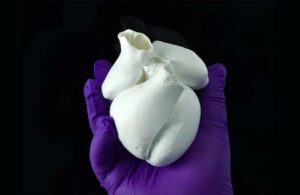
Harvard SEAS image of biohybrid model of a four-chambered heart engineered with focused rotary jet spinning or FRJS

A biohybrid model of a four-chambered heart engineered with focused rotary jet spinning (FRJS) technology [Image courtesy of Harvard SEAS]

Harvard University researchers used focused rotary jet spinning (FRJS) technology to fabricate polymer fibers that mimic the helical structure of heart muscles.

They created ventricle structures with the method and then seeded them with rat cardiomyocyte or human stem cell-derived cardiomyocyte cells, according to a news release from the Wyss Institute for Biologically Inspired Engineering at Harvard University. Roughly a week later, they had several thin layers of beating tissue covering the scaffold. The cells in the beating tissue followed the same helical alignment as the fibers underneath.

The bioengineers, who were from the Wyss Institue and the Harvard John A. Paulson School of Engineering and Applied Sciences (SEAS), were then able to run experiments that compared the performance of ventricles made from helically aligned fibers with those made from circumferentially aligned fibers. They found the helically aligned tissue outperformed the circumferentially aligned tissue on every front. The result provided evidence backing a decades-old hypothesis — biomathematician Edward Sallin’s idea from 1969 that the heart’s helical alignment is critical to achieving large ejection fractions.

“In this case, we went back to address a never tested observation about the helical structure of the laminar architecture of the heart. Fortunately, Professor Sallin published a theoretical prediction more than a half century ago, and we were able to build a new manufacturing platform that enabled us to test his hypothesis and address this centuries-old question,” said Kit Parker, professor of bioengineering and applied physics at SEAS, an associate faculty member at the Wyss Institute and senior author of the research paper appearing in Science.

Get the full story at our sister site, Medical Design & Outsourcing.

Related Articles Read More >

July 2026 issue of Medical Design & Outsourcing: Robotic stroke telesurgery’s time is now
The Medical Design & Outsourcing Medtech Big 100 2025 logo.
R&D alert: Research and development spending stalls in the 2025 Medtech Big 100 ranking
Carnegie Mellon University EEG-based BCI to control robotic hand
Non-invasive BCI enables robotic hand dexterity
MassGeneralBrigham
Mass General Brigham research finds pulse rate could predict cognitive decline
rd newsletter
EXPAND YOUR KNOWLEDGE AND STAY CONNECTED
Get the latest info on technologies, trends, and strategies in Research & Development.

R&D World Digital Issues

Fall 2025 issue

Browse the most current issue of R&D World and back issues in an easy to use high quality format. Clip, share and download with the leading R&D magazine today.

R&D 100 Awards
Research & Development World
  • Subscribe to R&D World Magazine
  • Sign up for R&D World’s newsletter
  • Contact Us
  • About Us
  • Drug Discovery & Development
  • Pharmaceutical Processing
  • Global Funding Forecast

Copyright © 2026 Arrowfly LLC. All Rights Reserved. The material on this site may not be reproduced, distributed, transmitted, cached or otherwise used, except with the prior written permission of Arrowfly
Privacy Policy | Advertising | About Us

Search R&D World

  • R&D World Home
  • Topics
    • Aerospace
    • Automotive
    • Biotech
    • Careers
    • Chemistry
    • Environment
    • Energy
    • Life Science
    • Material Science
    • R&D Management
    • Physics
  • Technology
    • 3D Printing
    • A.I./Robotics
    • Software
    • Battery Technology
    • Controlled Environments
      • Cleanrooms
      • Graphene
      • Lasers
      • Regulations/Standards
      • Sensors
    • Imaging
    • Nanotechnology
    • Scientific Computing
      • Big Data
      • HPC/Supercomputing
      • Informatics
      • Security
    • Semiconductors
  • R&D Market Pulse
  • R&D 100
    • 2025 R&D 100 Award Winners
    • 2025 Professional Award Winners
    • 2025 Special Recognition Winners
    • R&D 100 Awards Event
    • R&D 100 Submissions
    • Winner Archive
  • Resources
    • Research Reports
    • Digital Issues
    • Educational Assets
    • Subscribe
    • Video
    • Webinars
    • PharmSci360
    • Content submission guidelines for R&D World
  • Global Funding Forecast
  • Top Labs
  • Advertise
  • SUBSCRIBE