Medtech Big 100 revenue hit a new record high, but collective R&D spending by the world’s largest medical device companies is leveling off.
By Managing Editor Jim Hammerand and Senior Editor Danielle Kirsh

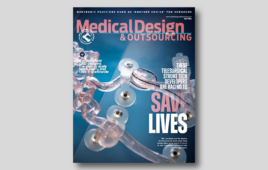
The Medical Design & Outsourcing Medtech Big 100 ranks the world’s largest medical device companies by revenue. [Illustration by Matt Claney with Adobe Firefly for Medical Design & Outsourcing]
Aggregate research and development spending growth across the world’s largest medical device companies is grinding to a halt after double-digit growth in recent years.
That’s the most urgent finding from Medical Design & Outsourcing’s analysis of our 2025 Medtech Big 100 ranking of medtech developers and manufacturers by revenue. The companies and business segments in our latest ranking include public and private firms across the world.
Collectively, Medtech Big 100 companies reported aggregate revenue of $486.7 billion in their most recent fiscal years, a nearly 3% increase over the year before and a new high record for the Medtech Big 100. Total employment grew at a similar pace.
But the R&D trend is a worrying sign as medical device manufacturers grapple with higher costs for materials and components due to new import taxes, which could push the U.S. economy into a recession.
Related: Intuitive’s trade war strategy holds lessons for other device developers
On top of the tariffs, medical device developers face potential slowdowns due to layoffs at the FDA, CDC, NIH, Centers for Medicare & Medicaid Services (CMS) and elsewhere within the U.S. Department of Health & Human Services. The Trump administration is also slashing federal R&D funding and could cut healthcare spending by more than $1 trillion over the next decade.
Some of the double-digit R&D growth from recent years can be attributed to companies coming out of the worst of the COVID-19 pandemic. But the slowdown is concerning because today’s R&D investments are the future’s groundbreaking products.

Former Medtronic CEO Bill George [Photo courtesy of Bill George]
“This is an industry that’s built on innovation,” former Medtronic CEO Bill George said in an MDO interview. “Everything that I was associated with at Medtronic was built on innovation, and the companies that have been highly successful [focused] on innovation and R&D. When I say innovation, I’m distinguishing between another stent or another hip and real innovation where you’re talking about new, breakthrough ideas that fulfill unmet medical needs and bring new technology to patients.”
We’ll have more from Bill George in the weeks ahead, along with a deeper look at medtech R&D and our Medtech Big 100 list in an MDO webinar and special report. Subscribe to our free email newsletter to keep up on the latest from our team.
Medtech Big 100 R&D spending by the numbers
Seventy-three Medtech Big 100 companies disclosed their annual R&D spending for a total of $29.2 billion, up less than 1% from last year. Medtech Big 100 R&D spending grew 10% last year and 20% the year before.
Nine companies in the Medtech Big 100 spent more than $1 billion on R&D, with varying year-over-year growth:
- Johnson & Johnson MedTech ($3.7 billion, up 19%)
- Medtronic ($2.7 billion, down 0.1%)
- Siemens Healthineers ($2.1 billion, up 3%)
- Royal Philips ($1.9 billion, down 8%)
- Boston Scientific ($1.6 billion, up 14%)
- Stryker ($1.5 billion, up 6%)
- GE HealthCare ($1.3 billion, up 9%)
- Intuitive Surgical ($1.1 billion, up 15%)
- Edwards Lifesciences ($1.1 billion, down 2%)

Medtronic EVP and CFO Thierry Piéton [Photo courtesy of Medtronic]
Medtronic spokespeople did not respond to messages from MDO editors for our Big 100 coverage, but the world’s largest medical device company said in its latest annual report that its flat R&D budget reflects a drive to “optimize innovation” and improve R&D productivity.
Medtronic “will significantly increase investment in our growth drivers to maximize future growth” in fiscal 2026, CFO Thierry Piéton said on the company’s end-of-year earnings call in May.
“For the first time in four years, we are planning to grow R&D faster than revenue … deliberately focused” on cardiac ablation, surgical robotics and renal denervation, he said, forecasting an R&D spending increase of roughly $200 million.
Related: This Medtronic innovation ‘could be the biggest thing we ever do,’ CEO Geoff Martha says
Of the 43 companies that reported increased R&D spending, the average year-over-year growth was 14.4%.
Orthopedics companies and broad interventional device makers accounted for 13 of those companies, including Globus Medical, Stryker and J&J MedTech. Six patient monitoring and imaging developers also raised their R&D budgets, despite flat or falling sales at several.
Investment in chronic disease management continued as well. Diabetes management and continuous glucose monitoring companies like Tandem Diabetes Care, Dexcom and Insulet all boosted R&D spending, while Fisher & Paykel Healthcare and ResMed did the same in respiratory and sleep care. In critical care, Getinge, B. Braun and ICU Medical increased spending on life support platforms such as ventilators, infusion pumps and heart-lung machines.
The largest year-over-year R&D spending increase was 91% at Elekta, but the oncology firm said that spending included impairments from the development project discontinuations.
“The decision to discontinue some projects has been affected by the continuous development of new techniques that will serve Elekta’s future products in a better way than internally developed solutions,” the company said in its annual report, offering as an example an internally developed cloud solution that will be replaced by a supplier’s platform.
Getinge increased its spending 76% to advance its ventilator and heart‑lung technology, while Globus Medical raised R&D spending 32% as it folded in NuVasive.
Twenty-three companies cut R&D spending year-over-year. Six of those companies had double-digit reductions. MicroPort reported the largest cut at 43%, with Chair Zhaohua Chang saying the company narrowed its focus to projects with “clearer returns.”

Glaukos makes its iStent infinite Trabecular Micro-Bypass System implants to reduce the intraocular pressure of the eye for glaucoma patients. Glaukos spent more on R&D as a share of its revenue than any other company on the Medical Design & Outsourcing Medtech Big 100 ranking of the world’s largest device companies. [Illustration courtesy of Glaukos]
Twenty-five companies spent more than 10% of their revenue on R&D in their most recent fiscal year. Of those companies, Glaukos spent the largest percentage of revenue on R&D (36%) to support clinical trials of its ophthalmic implants.
“We expect our R&D and clinical expenditures to increase as we continue to devote significant resources to clinical trials and regulatory approvals of our pipeline products,” Glaukos wrote in its annual report. “We currently conduct R&D activities primarily in the U.S. but continue to expand our clinical capabilities to sites internationally.”
The R&D slowdown is a wider trend across the economy, with private-sector R&D down nearly 2% (adjusted for inflation) over the last three quarters, economist Daniel Altman told MDO.
“It means the economy is becoming less innovative and losing its potential to grow,” he said. “… There’s been a lot of uncertainty since the election in November, and uncertainty tends to freeze investment decisions in corporate boardrooms.”
“To a great degree, this uncertainty has been justified,” he continued. “Tariffs are taking a big bite out of profits, though their costs will soon be passed on to consumers. But more importantly, the costs of inputs are changing almost weekly as tariff rates fluctuate. Also, long-term interest rates are still high, so the cost of capital is prohibitive. The growing federal debt does nothing to help long-term rates, either.”
Altman predicts the medtech industry’s R&D slowdown will result in a slower pace of innovation and, for patients, “a stall in the trend of longer life expectancies.”
“That’s something we’re unfortunately seeing already, for a variety of reasons,” he said.
Medtech companies cutting R&D “may be sitting on cash to be able to handle what might be coming” from those import taxes along with other big changes globally and from the Trump administration, Stanford Mussallem Center for Biodesign co-founder and Director Dr. Josh Makower said after being briefed on our findings.
“The headwinds with private insurance/artificial intelligence/prior-authorization and delays for CMS coverage could also be playing a role, but it’s unclear,” he said.
George says executives who cut R&D are primarily pressured to hit more immediate financial targets by short-sighted shareholders.
“You have to give it a long time,” he said. “That’s what makes the industry go. To the ones that are up in R&D: Great. Bravo. I think everyone should be.”
There’s opportunity for those able and willing to ramp up R&D.
“In this environment, companies that can still invest in R&D are likely to maintain their potential to grow in the long term,” Altman said. “Moreover, they might be able to pick up talent. … This will be especially true of companies that have deep cash pools and can avoid tapping external capital markets. They can take advantage of the constraints their competitors are facing to push ahead.”
The aggregate decrease in R&D growth suggests heightened merger-and-acquisition activity ahead by large device OEMs with deep pockets.
MedTech Innovator founder and CEO Paul Grand says he’s been hearing directly from major device companies that are predicting an increase in strategic deals for “big, needle-moving innovations that come from smaller companies.”
“Having a robust external innovation capability and and pipeline is a critical for for all these manufacturers,” he said. “… I had a manufacturer — I won’t say who, but not a MedTech Innovator partner — who said they see a real need for ramping up their external innovation capability. [These companies] are telling me they’re planning for a lot more M&A.”
Most Medtech Big 100 companies are growing sales
Seventy Medtech Big 100 companies reported sales gains, 23 posted declines and six companies made their debut to the list.
Four companies — Inari Medical, Shockwave Medical, Axonics and Silk Road Medical — are no longer ranked after acquisitions by Stryker (Inari), Johnson & Johnson (Shockwave) and Boston Scientific (Axonics and Silk Road). And this will be Nevro’s last year on the Medtech Big 100, as Globus Medical acquired the spinal cord stimulation developer earlier this year.
Glaukos, Barco, and OrthoPediatrics entered the rankings this year after coming close last year. Mobility company Arjo also made its debut on this year’s list.
Some orthopedic and diabetes firms led growth, some patient monitoring developers lost sales and R&D spending stayed flat compared to our analysis last year.
Medtronic retained the No. 1 spot in the Medtech Big 100 ranking with $33.5 billion in revenue, up 4% year-over-year. Medtronic could lose the top spot when it separates from its Medtronic Diabetes business, which has $2.8 billion in revenue.
J&J MedTech held the No. 2 spot with $31.9 billion in revenue (up 4.8%) and could pass Medtronic in the years ahead as recent acquisitions like Shockwave Medical fuel sales growth.
Related: J&J MedTech is growing Shockwave’s R&D budget by double digits
Spine implant maker Globus Medical reported the greatest year-over-year revenue growth at 61% after merging with NuVasive and accelerating placements of its ExcelsiusGPS surgical robots and related imaging hubs.

Former Globus CEO Daniel Scavila [Photo courtesy of Dentsply Sirona]
“We had a banner year in enabling tech with our highest level of robot, imaging system and hub placements, setting the stage in 2025 and beyond for increased implant pull-through,” former Globus CEO Daniel Scavila (now CEO at Dentsply Sirona) said on a year-end earnings call.
Other double‑digit risers included Inspire Medical Systems (29%), Alphatec (27%), Tandem Diabetes Care (26%), Enovis (24%) and Insulet (22%), showing increased demand for orthopedic devices, neurostimulation for sleep apnea and next‑generation insulin pumps.
On the other side of the spectrum, Baxter recorded the steepest drop, with sales down 28% after selling its BioPharma Solutions unit, spinning off its $4.5 billion kidney care business, and intravenous solutions production disruptions starting in September 2024 due to flooding from Hurricane Helene.
By February, Baxter said production was back to pre-hurricane levels, and in May the company said its inventory levels were fully restored. The FDA declared an end to the resulting IV solutions shortage in August.

Baxter EVP, Chief Operating Officer and Interim Group President of Medical Products & Therapies Heather Knight [Photo courtesy of Baxter]
“I am incredibly proud of the Baxter team worldwide who stepped up for their colleagues, our patients and customers in response to the devastation caused by Hurricane Helene,” Baxter Chief Operating Officer Heather Knight said.
Other sizable declines came from Omron Healthcare (down 10%), Cardinal Health’s medical segment (down 18%) and Highridge Medical ( down 21%). Highridge spun out of ZimVie in 2024 and reported lower revenue due to the June 2025 sale of its EBI bone healing business.
Related: Highridge Medical is betting on this spine tech
Of the 21 companies that reported sales losses, one-third make patient monitoring or imaging systems. Royal Philips (which continues to deal with its massive Respironics recall), Olympus, Canon Medical, Fujifilm, Nihon Kohden, Fukuda Denshi and Omron Healthcare all recorded lower sales. In particular, Omron, down 10%, blamed softer demand for nebulizers and oxygen concentrators as respiratory illness patterns normalized.
Hiring follows high-growth niches
Eighty-three companies disclosed employee counts for a total of 1.28 million workers across the Medtech Big 100, a 2% increase from last year. Employment increased 6% in our 2024 analysis, decreased 5% in 2023, and increased 6% in 2022.
Avanos Medical had the greatest employment decrease at 41%. The company divested its respiratory health business in October 2023 as part of a three-year transformation program. The company hired former Siemens Healthineers and Abbott leader David Pacitti as CEO in June.
The Medtech Big 100 businesses with the most employees are Medtronic (100,229, down 0.5%), Siemens Healthineers (72,000, up 1%), Royal Philips (67,823, down 2%) and B. Braun (64,262, up 2%).
Fifteen medtech companies reported double-digit headcount increases. Insulet led the pack, hiring 30% more people in its most recent fiscal year.
After reporting double-digit revenue growth for the year and a nearly 10% increase in R&D spending for its diabetes management technology, Insulet has since then increased its guidance for the current year, driven by strong adoption of its Omnipod 5 automated insulin delivery system.

Insulet CEO Ashley McEvoy [Photo courtesy of Insulet]
“Our more than 500,000 Podders are passionate and engaged R&D partners with a deep interest in continuously enhancing our products for the benefit of everyone with diabetes,” Insulet CEO Ashley McEvoy said on an earnings call in August, just 100 days after she joined the company. “Building off of this grassroots space, we have tremendous potential to broaden our reach, become an iconic world-class brand, and grow faster with targeted and compelling marketing strategies to reach distinct segments of type 1 and type 2 patients.”
“We’ll accelerate the pace of innovation,” she later continued. “We will ensure we are earlier on next-generation sensor integrations, invest in technology to modernize the customer experience and improve retention and patient outcomes.”
Related: Diabetes device developers turn their sights to type 2