Research & Development World

  • R&D World Home
  • Topics
    • Aerospace
    • Automotive
    • Biotech
    • Careers
    • Chemistry
    • Environment
    • Energy
    • Life Science
    • Material Science
    • R&D Management
    • Physics
  • Technology
    • 3D Printing
    • A.I./Robotics
    • Software
    • Battery Technology
    • Controlled Environments
      • Cleanrooms
      • Graphene
      • Lasers
      • Regulations/Standards
      • Sensors
    • Imaging
    • Nanotechnology
    • Scientific Computing
      • Big Data
      • HPC/Supercomputing
      • Informatics
      • Security
    • Semiconductors
  • R&D Market Pulse
  • R&D 100
    • 2025 R&D 100 Award Winners
    • 2025 Professional Award Winners
    • 2025 Special Recognition Winners
    • R&D 100 Awards Event
    • R&D 100 Submissions
    • Winner Archive
  • Resources
    • Research Reports
    • Digital Issues
    • Educational Assets
    • R&D Index
    • Subscribe
    • Video
    • Webinars
    • Content submission guidelines for R&D World
  • Global Funding Forecast
  • Top Labs
  • Advertise
  • SUBSCRIBE

Researchers use tiny crystals to deliver long-lasting drugs

By Sean Whooley | March 26, 2025

MIT long-lasting delivery of drugs

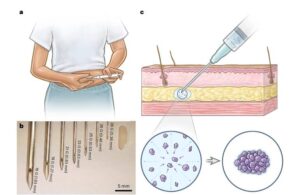
MIT engineers have devised a new way to deliver certain drugs in higher doses with less pain by injecting them as a suspension of tiny crystals. Once under the skin, the crystals assemble into a drug “depot” that could last for months or years, eliminating the need for frequent drug injections. [Illustrations by Virginia E. Fulford, Alar Illustration, courtesy of Nature Chemical Engineering]

Engineers at MIT say that, by injecting certain drugs as a suspension of tiny crystals, they can deliver them in higher doses with less pain.

The approach could help deliver long-lasting contraceptives or other drugs that require delivery for extended periods. Because the drugs disperse in a suspension before injection, they can be delivered through a narrow needle that’s easier for patients to tolerate.

“We showed that we can have very controlled, sustained delivery, likely for multiple months and even years through a small needle,” said Giovanni Traverso, an associate professor of mechanical engineering at MIT, a gastroenterologist at Brigham and Women’s Hospital (BWH), an associate member of the Broad Institute, and the senior author of the study. Traverso was joined in the project by lead authors Vivian Feig, Sanghyun Park, and Pier Rivano.

The project began as an effort to expand contraceptive options, particularly in developing nations. Researchers wanted to create a formulation capable of injection through a small-gauge needle lasting at least six months and up to two years. They began working with levonorgestrel, a contraceptive drug that can form crystals.

Researchers discovered that suspending crystals in a particular organic solvent caused them to assemble into a highly compact implant after injection. This depot could form without needing large amounts of polymer, enabling injection through a narrow-gauge needle. The solvent, benzyl benzoate, can mix with biological fluids. This allows the solid drug crystals to self-assemble into a depot under the skin after injection.

The team tested its approach by injecting the drug solution subcutaneously in rats. It showed that the drug depots could remain stable and release drug gradually for three months. After three months, about 85% of the drug remained in depots. That suggested the possibility of releasing the drugs for a much longer period of time. Park said the team anticipates that the depots could last for more than a year, as the team embarks on follow-up studies to validate the efficacy beyond the initial proof-of-concept.

Once the depots form, they remain compact enough for retrieval through surgical means if treatment needs to stop. The approach could also help deliver drugs to treat neuropsychiatric conditions as well as HIV and tuberculosis.

“This is a very simple system in that it’s basically a solvent, the drug, and then you can add a little bit of bioresorbable polymer. Now we’re considering which indications do we go after: Is it contraception? Is it others? These are some of the things that we’re starting to look into as part of the next steps toward translation to humans,” Traverso said.

Related Articles Read More >

The Medical Design & Outsourcing Medtech Big 100 2025 logo.
R&D alert: Research and development spending stalls in the 2025 Medtech Big 100 ranking
Carnegie Mellon University EEG-based BCI to control robotic hand
Non-invasive BCI enables robotic hand dexterity
MassGeneralBrigham
Mass General Brigham research finds pulse rate could predict cognitive decline
Researchers engineer functional blood vessels in lab-grown liver tissue
rd newsletter
EXPAND YOUR KNOWLEDGE AND STAY CONNECTED
Get the latest info on technologies, trends, and strategies in Research & Development.
RD 25 Power Index

R&D World Digital Issues

Fall 2025 issue

Browse the most current issue of R&D World and back issues in an easy to use high quality format. Clip, share and download with the leading R&D magazine today.

R&D 100 Awards
Research & Development World
  • Subscribe to R&D World Magazine
  • Sign up for R&D World’s newsletter
  • Contact Us
  • About Us
  • Drug Discovery & Development
  • Pharmaceutical Processing
  • Global Funding Forecast

Copyright © 2025 WTWH Media LLC. All Rights Reserved. The material on this site may not be reproduced, distributed, transmitted, cached or otherwise used, except with the prior written permission of WTWH Media
Privacy Policy | Advertising | About Us

Search R&D World

  • R&D World Home
  • Topics
    • Aerospace
    • Automotive
    • Biotech
    • Careers
    • Chemistry
    • Environment
    • Energy
    • Life Science
    • Material Science
    • R&D Management
    • Physics
  • Technology
    • 3D Printing
    • A.I./Robotics
    • Software
    • Battery Technology
    • Controlled Environments
      • Cleanrooms
      • Graphene
      • Lasers
      • Regulations/Standards
      • Sensors
    • Imaging
    • Nanotechnology
    • Scientific Computing
      • Big Data
      • HPC/Supercomputing
      • Informatics
      • Security
    • Semiconductors
  • R&D Market Pulse
  • R&D 100
    • 2025 R&D 100 Award Winners
    • 2025 Professional Award Winners
    • 2025 Special Recognition Winners
    • R&D 100 Awards Event
    • R&D 100 Submissions
    • Winner Archive
  • Resources
    • Research Reports
    • Digital Issues
    • Educational Assets
    • R&D Index
    • Subscribe
    • Video
    • Webinars
    • Content submission guidelines for R&D World
  • Global Funding Forecast
  • Top Labs
  • Advertise
  • SUBSCRIBE