[Adobe Stock]
For its part, Anthropic reports R&D in a note to its financial statements, as a nine-month total. The company reported $19.24 billion through September 30. Subtracting the $9.74 billion it reported for the first half in its October 26 filing leaves about $9.5 billion for July through September, by R&D World’s calculation. That is about 5.4 times the $1.74 billion it spent in the same quarter of 2025.
In the first half, Anthropic’s R&D already rivaled Eli Lilly’s. In the third quarter it was more than double the ongoing R&D of Lilly ($4.25 billion) and of Johnson & Johnson (about $3.65 billion across its drug and medtech businesses), excluding the cost of acquired drug candidates. J&J’s reported R&D line of $4.65 billion included about $1.0 billion for its acquisition of Firefly Bio.
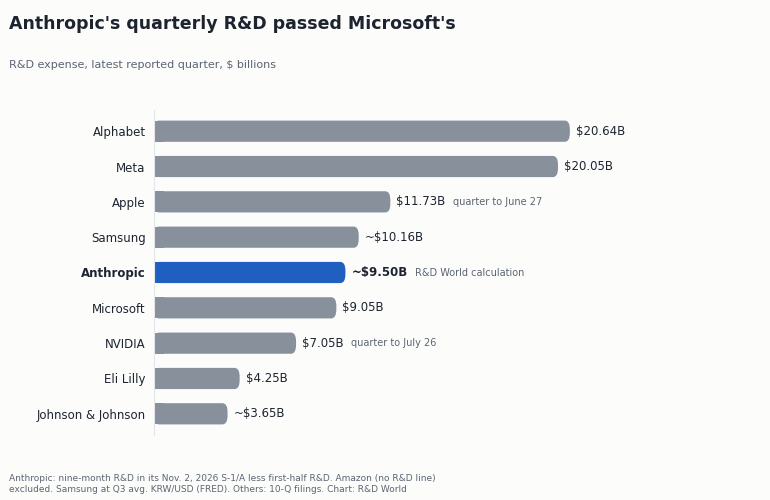
Chart: R&D World. Sources: Anthropic S-1/A, company filings
Compute-based R&D
Anthropic says its R&D expense “primarily consist[s] of compute and infrastructure costs associated with model development, research, and internal usage workloads,” along with personnel, software and overhead.
Much of that compute is rented. Anthropic says it has financed its compute “primarily under arrangements with CSPs,” or cloud service providers, “with costs recognized as compute is made available to us,” and that before 2026 it obtained substantially all of it from three of them. Amazon is one of those suppliers and one of Anthropic’s investors. It invested up to $8 billion through convertible notes in 2023 and 2024 and another $5 billion in May 2026, and in April Anthropic committed to spend more than $100 billion over 10 years on up to 5 gigawatts of AWS capacity. Anthropic’s compute payments, including the share it books as R&D, become revenue for its cloud suppliers.
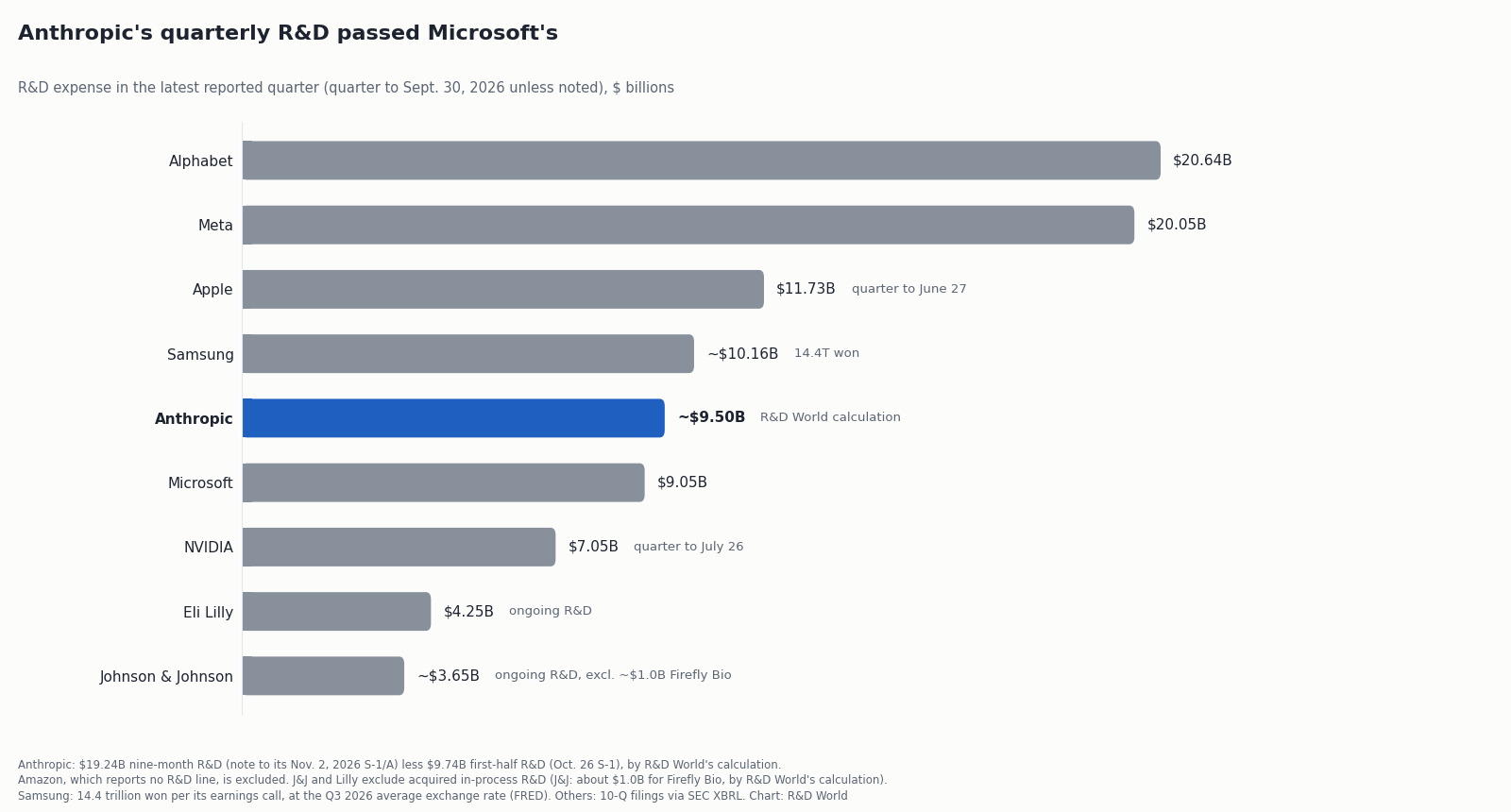
Anthropic’s third-quarter R&D, by R&D World’s calculation from its amended IPO filing, topped Microsoft’s. Amazon, which reports a broader technology and infrastructure expense instead of an R&D line, is excluded. Sources: Anthropic S-1/A, company 10-Q filings, Samsung earnings call. Chart: R&D World
Some of that computing capacity is becoming part of the research workforce. Anthropic said approximately 30,000 AI agents were doing research and engineering work at any given time on its most-used internal platform in August. Its prototype R&D Automation Index rated Claude as leading 26% of measured AI R&D work, meaning it could complete most of a task from a high-level prompt, with a human supervising. “AI systems are getting more powerful, and they’re increasingly being used to build the next version of themselves,” the company wrote in its report on internal AI development.
OpenAI has followed a similar R&D playbook. By mid-August, its research organization was using 3.1 agent-workdays for every human workday, according to a September report. That measures agent runtime, with each workday defined as eight hours, and the company cautioned that activity metrics translate imperfectly into research progress.
Anthropic’s amended filing also put the company’s cash, cash equivalents and short-term investments at $131.8 billion on September 30. Counting agreements signed through the filing date, its purchase commitments and lease agreements total about $895.4 billion, CNBC reported.
How the ranking was built
| Company | Latest quarter | R&D, $ billions |
|---|---|---|
| Alphabet | Sept. 30, 2026 | 20.64 |
| Meta | Sept. 30, 2026 | 20.05 |
| Apple | June 27, 2026 | 11.73 |
| Samsung Electronics | Sept. 30, 2026 | about 10.2 |
| Anthropic | Sept. 30, 2026 | about 9.5 |
| Microsoft | Sept. 30, 2026 | 9.05 |
| NVIDIA | July 26, 2026 | 7.05 |
| Eli Lilly (ongoing) | Sept. 30, 2026 | 4.25 |
| Johnson & Johnson (ongoing) | Sept. 27, 2026 | about 3.65 |
The ranking leaves out Amazon, whose technology and infrastructure line combines R&D payroll with server, networking and data center costs. The European Commission’s Industrial R&D Investment Scoreboard counts the whole line as R&D and ranks Amazon first among corporate spenders. Apple’s latest reported quarter ended in June. Samsung said on its October earnings call that R&D expenses totaled 14.4 trillion won in the third quarter, about $10.2 billion at the quarter’s average exchange rate. Huawei, which reports R&D once a year, spent 192.3 billion yuan in 2025, an average of about $6.7 billion a quarter. Other figures come from 10-Q filings.
The ranking covers companies that publish their R&D. OpenAI’s most recent figure is $19.18 billion for 2025, from audited accounts Fortune reported in June, about equal to Anthropic’s spending over the first nine months of 2026. OpenAI put off its IPO this fall, and its 2026 R&D remains private.
Anthropic and OpenAI both appear on R&D World’s list of the 100 most innovative companies of 2026. R&D World’s 2026 Global R&D Funding Forecast found that Alphabet and Meta together reported $118.5 billion of R&D expense in 2025.

Tell Us What You Think!
You must be logged in to post a comment.