Research & Development World

  • R&D World Home
  • Topics
    • Aerospace
    • Automotive
    • Biotech
    • Careers
    • Chemistry
    • Environment
    • Energy
    • Life Science
    • Material Science
    • R&D Management
    • Physics
  • Technology
    • 3D Printing
    • A.I./Robotics
    • Software
    • Battery Technology
    • Controlled Environments
      • Cleanrooms
      • Graphene
      • Lasers
      • Regulations/Standards
      • Sensors
    • Imaging
    • Nanotechnology
    • Scientific Computing
      • Big Data
      • HPC/Supercomputing
      • Informatics
      • Security
    • Semiconductors
  • R&D Market Pulse
  • R&D 100
    • 2026 R&D 100 Award Winners
    • 2026 Professional Award Winners
    • 2026 Special Recognition Winners
    • R&D 100 Awards Event
    • R&D 100 Submissions
    • Winner Archive
  • Resources
    • Research Reports
    • Digital Issues
    • Educational Assets
    • Subscribe
    • Video
    • Webinars
    • PharmSci360
    • Content submission guidelines for R&D World
  • Global Funding Forecast
  • Top Labs
  • Advertisers
    • Advertise
    • PR Submissions
    • Eblast Submissions
  • SUBSCRIBE

OpenAI’s GPT-6.2 Astra trails Claude Fable 5.2 by three points on an independent AI index at a fraction of the cost per task

By Brian Buntz | November 17, 2026

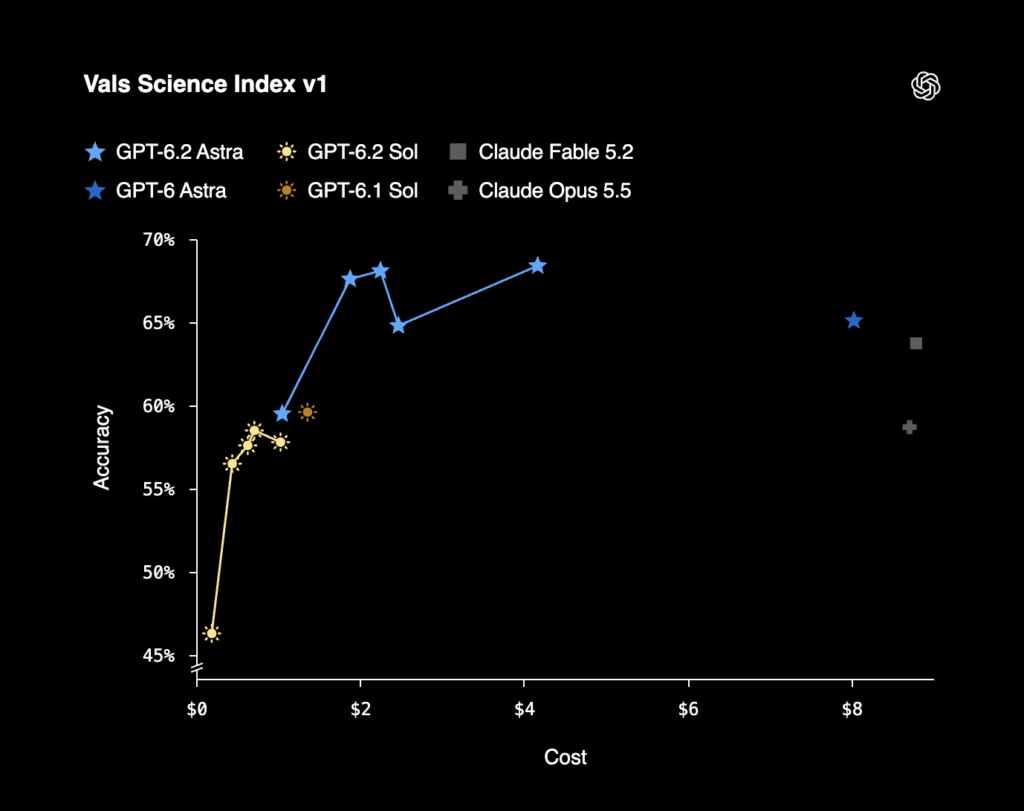
An OpenAI chart showing how GPT 6.2 Astra fares against other models on the Vals Science Index, which gauges how well AI models analyze scientific data, infer mechanisms from experimental evidence and carry out research tasks across disciplines.

An OpenAI chart showing how GPT 6.2 Astra fares against other models on the Vals Science Index, which gauges how well AI models analyze scientific data, infer mechanisms from experimental evidence and carry out research tasks across disciplines.

OpenAI is pitching its newest frontier model directly at researchers. In announcing GPT-6.2 Astra on Nov. 17, the company called it “the best model in the world for scientists,” citing a new high on Terminal-Bench-Science, a test of scientific work carried out in a terminal. Astra scored 9 percentage points above its predecessor, GPT-6 Astra, at less than a third of the cost, according to OpenAI.

Independent testing from Artificial Analysis shows the gain is mostly in cost per task. At maximum reasoning effort, Astra scored 62 on the firm’s Intelligence Index at about $4 per task. Anthropic’s Claude Fable 5.2 scored 65 at $26.54.

An outside evaluation found that Astra still struggles to design good research experiments. Epoch AI gave the model assignments drawn from its researchers’ work, including designing experiments and assessing AI data centers, and saw little overall change from the previous Astra, according to findings published in OpenAI’s system card. The new model wrote somewhat better reports, though they still fell short of Epoch’s standards.

OpenAI’s forecasting test showed the earlier Astra slightly ahead. In Bio-Probe, an exploratory evaluation in the system card, models read the setup of 21 unpublished experiments from seven academics and estimated how likely each result was to support a stated hypothesis. GPT-6.2 Astra’s best Brier score, where lower is better, was 0.232, against 0.226 for GPT-6 Astra and 0.261 for GPT-6.2 Sol. Assigning even odds to every hypothesis scores 0.250, and expert forecasts scored 0.266. OpenAI called the sample small and said many outcomes were hard to anticipate from the literature.

How GPT-6.2 Astra compares with recent Fable, Gemini and Sol models

Model Reasoning effort Artificial Analysis Intelligence Index Cost per task
Claude Fable 5.2 Max 65 $26.54
GPT-6.2 Astra Max 62 $4.00
Gemini 4 Carbon High 60 $5.48
Claude Opus 5.5 Max 59 $10.04
GPT-6.2 Sol Max 57 $1.01

GPT-6.2 Sol, the least expensive model in the table, is the everyday model OpenAI released alongside Astra. On Cognition’s FrontierCode 2.0, which tests whether changes to real codebases meet maintainers’ standards for merging, OpenAI reported that Sol came within half a point of Astra at about one-fifth the cost per task, with both at maximum reasoning effort. In the API, Astra costs $8 per million input tokens and $40 per million output tokens, 20% less than GPT-6 Astra and four times Sol’s $2 and $10.

Tell Us What You Think! Cancel reply

You must be logged in to post a comment.

Related Articles Read More >

Anthropic says Fable 5.2 nearly doubles its predecessor’s hardware-design score. Token prices fell 20%, but the cost per task doubled at full effort.
Heatmaps of first-layer weight strength for four game-playing networks; Breakout's paddle row, Pong's paddle column and Pac-Man's maze show up in the weights
MIT team says GPT-6 Astra can improve other AI models by editing their weights. Critics say its biggest result relied on standard ML engineering.
DOE packages national lab know-how as 35 skills for Claude Code, Codex and Gemini CLI
Jellyfish: Claude Code bills hit $252 a month per developer as software factories automate code production among early adopters
rd newsletter
EXPAND YOUR KNOWLEDGE AND STAY CONNECTED
Get the latest info on technologies, trends, and strategies in Research & Development.

R&D World Digital Issues

Fall 2026 issue

Browse the most current issue of R&D World and back issues in an easy to use high quality format. Clip, share and download with the leading R&D magazine today.

R&D 100 Awards
Research & Development World
  • Subscribe to R&D World Magazine
  • Sign up for R&D World’s newsletter
  • Contact Us
  • About Us
  • Drug Discovery & Development
  • Pharmaceutical Processing
  • Global Funding Forecast

Copyright © 2026 Arrowfly LLC. All Rights Reserved. The material on this site may not be reproduced, distributed, transmitted, cached or otherwise used, except with the prior written permission of Arrowfly
Privacy Policy | Advertising | About Us

Search R&D World

  • R&D World Home
  • Topics
    • Aerospace
    • Automotive
    • Biotech
    • Careers
    • Chemistry
    • Environment
    • Energy
    • Life Science
    • Material Science
    • R&D Management
    • Physics
  • Technology
    • 3D Printing
    • A.I./Robotics
    • Software
    • Battery Technology
    • Controlled Environments
      • Cleanrooms
      • Graphene
      • Lasers
      • Regulations/Standards
      • Sensors
    • Imaging
    • Nanotechnology
    • Scientific Computing
      • Big Data
      • HPC/Supercomputing
      • Informatics
      • Security
    • Semiconductors
  • R&D Market Pulse
  • R&D 100
    • 2026 R&D 100 Award Winners
    • 2026 Professional Award Winners
    • 2026 Special Recognition Winners
    • R&D 100 Awards Event
    • R&D 100 Submissions
    • Winner Archive
  • Resources
    • Research Reports
    • Digital Issues
    • Educational Assets
    • Subscribe
    • Video
    • Webinars
    • PharmSci360
    • Content submission guidelines for R&D World
  • Global Funding Forecast
  • Top Labs
  • Advertisers
    • Advertise
    • PR Submissions
    • Eblast Submissions
  • SUBSCRIBE