Image adapted from Adobe Stock
Coding agents now touch more than a quarter of the pull requests, or proposed code changes, at the typical company, and people still sign off on nearly every change that merges. In September, AI agents opened or committed code to 27.7% of pull requests at the median company in Jellyfish’s data, up from about 2% in January. Across companies, the median share of code written by AI tools was 29%, and the median share of merged pull requests approved on AI review alone was 0.5%. Software factories, pipelines in which agents pick, write, review and ship the work, remain concentrated among early adopters. Their share of pull requests rounded to 0.0% even at the 90th-percentile company.
Jellyfish, a Boston company whose engineering-management platform pulls activity data from tools such as Git and Jira, drew those figures from more than 1,300 companies, 276,000 developers and 100 million pull requests for its October AI Engineering Trends report, released Oct. 27. Two-thirds to three-quarters of those companies sell software, said Adam Ferrari, Jellyfish’s senior vice president of engineering; the rest are companies where software is a cost center.
By late September, Claude Code spending reached a median of $63 per active developer per week, or $252 using the report’s four-week monthly conversion. At the 90th percentile, the report’s monthly equivalent reached $1,666.
In an interview with R&D World, Ferrari and Nicholas Arcolano, Jellyfish’s head of research, described the organizational work behind greater autonomy: building controls around agents, giving them useful context, and training developers to use them effectively.
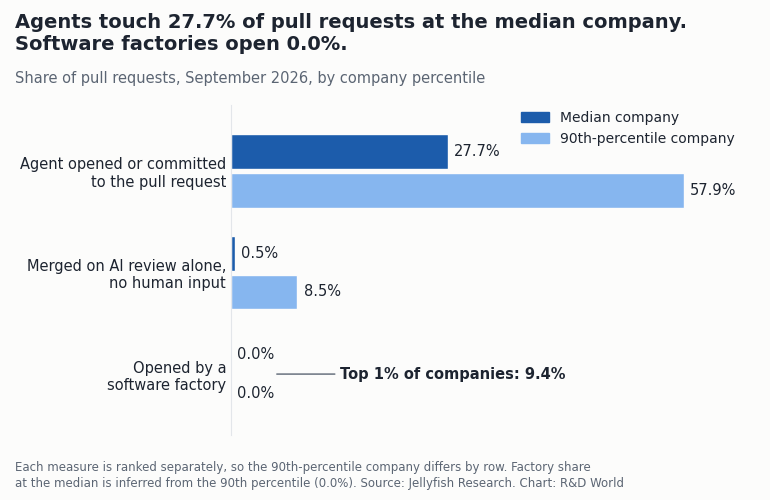
Credit: R&D World analysis of Jellyfish Research data
What counts as a software factory
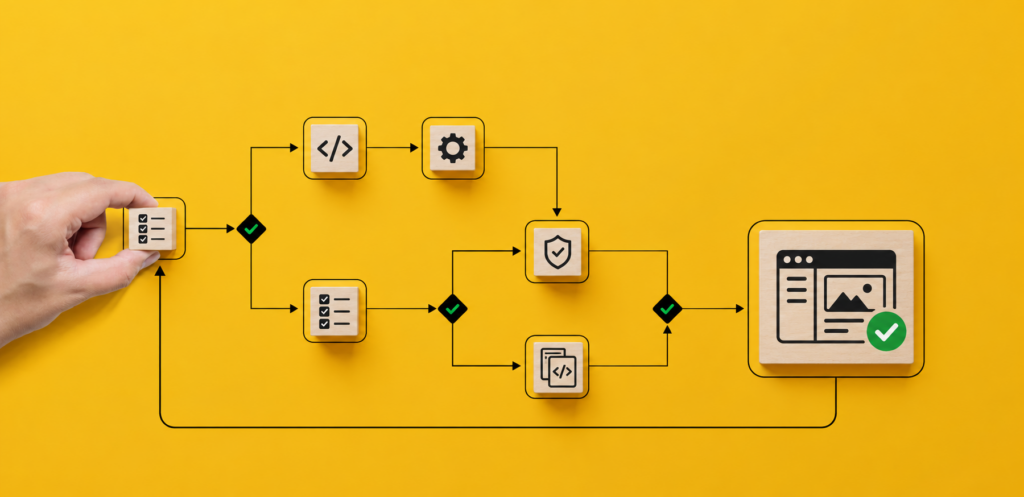
Ferrari breaks software development into planning and work definition, building and coding, review, and shipping. “A software factory, in short, is where you’ve automated each part so there’s little to no human involvement as work gets passed through those stages,” he said. Hitachi established its Software Works in 1969, applying manufacturing principles to large-scale software development as it faced a shortage of skilled programmers and growing customer complaints about bugs.
In most pipelines, people still pick the work. “Typically, with a human in the loop, the most obvious place for the human is choosing what work gets done and defining the intent and goal of the work,” Ferrari said. In the most mature factories, “you’ve got an agent or an orchestrator creating tickets and then pushing them to an agent to start executing.” Handing over that choice signals trust, he said: “That’s the signal to me that you’ve introduced the context and infrastructure so that you trust the agent to pick the thing that’s worth doing and then execute on it.”
Arcolano described the payoff as the ability to “scale beyond the limits of human attention.” “If a person needs to be involved every step of the way, babysitting the process, then we’ve gotten as fast as we can get,” he said. “We’ve hit the limit.”
His advice is to begin by delegating a complete task. “To break through that limit, you need to start offloading entire tasks,” Arcolano said. “Even if they’re simple and safe ones, that’s the place to start. You need to offload the whole job to the agent.”
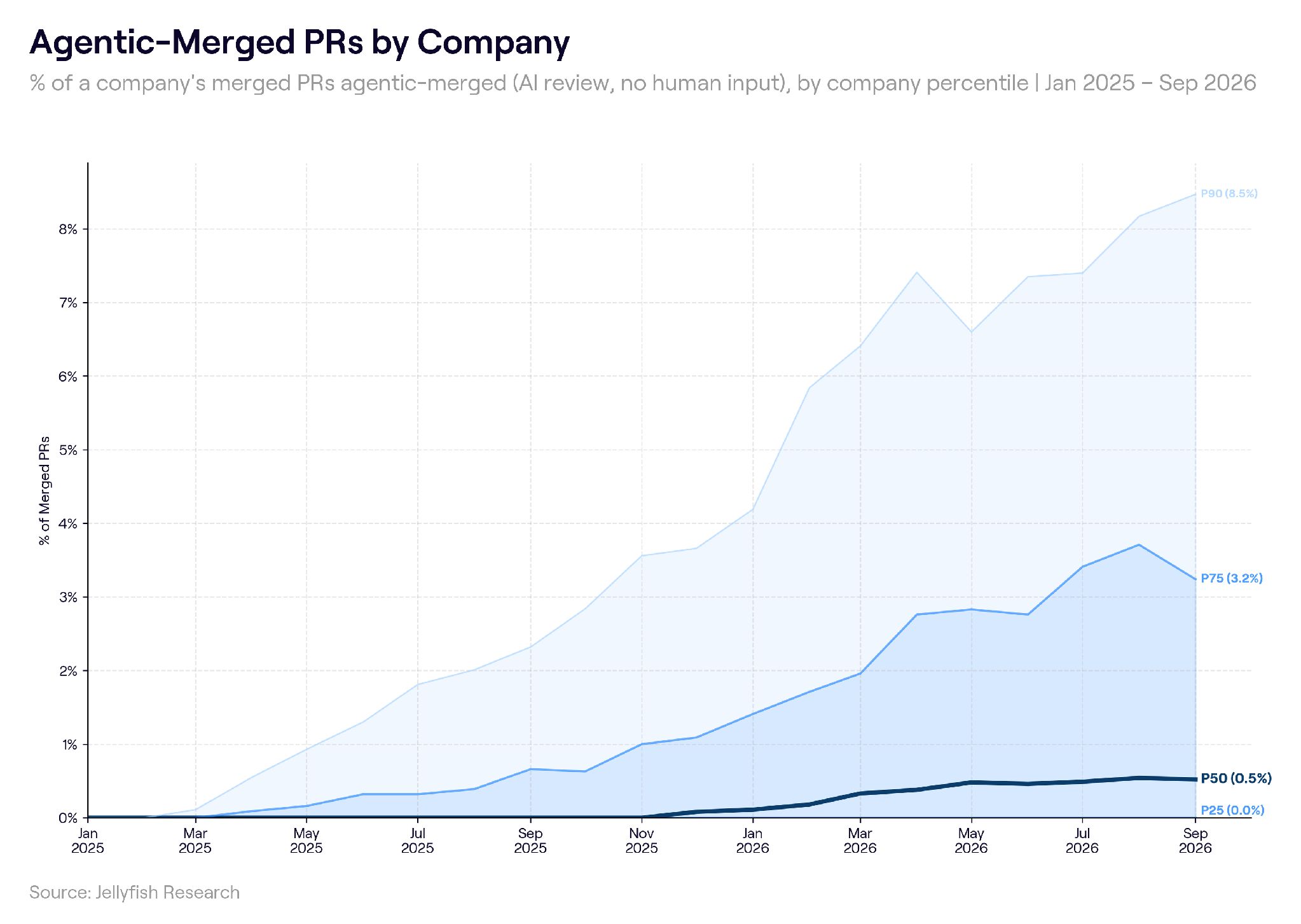
At the 90th-percentile company, 8.5% of merged pull requests went through on AI review with no human input in September, up from about 4% in January. The median company sat at 0.5%. Credit: Jellyfish Research
A turning point in adoption came around the end of 2025, Arcolano said, as coding agents became reliable enough to handle more substantial work. OpenAI co-founder and former Tesla AI director Andrej Karpathy described a similar shift in a February post on X: “coding agents basically didn’t work before December and basically work since.” He recounted giving an agent a project to build a dashboard for his home cameras. It spent roughly 30 minutes researching solutions, resolving problems, writing and testing code, and setting up the services. “I didn’t touch anything,” he wrote.
At the 99th-percentile company, software factories opened 9.4% of pull requests in September, up from roughly 1.7% in March.
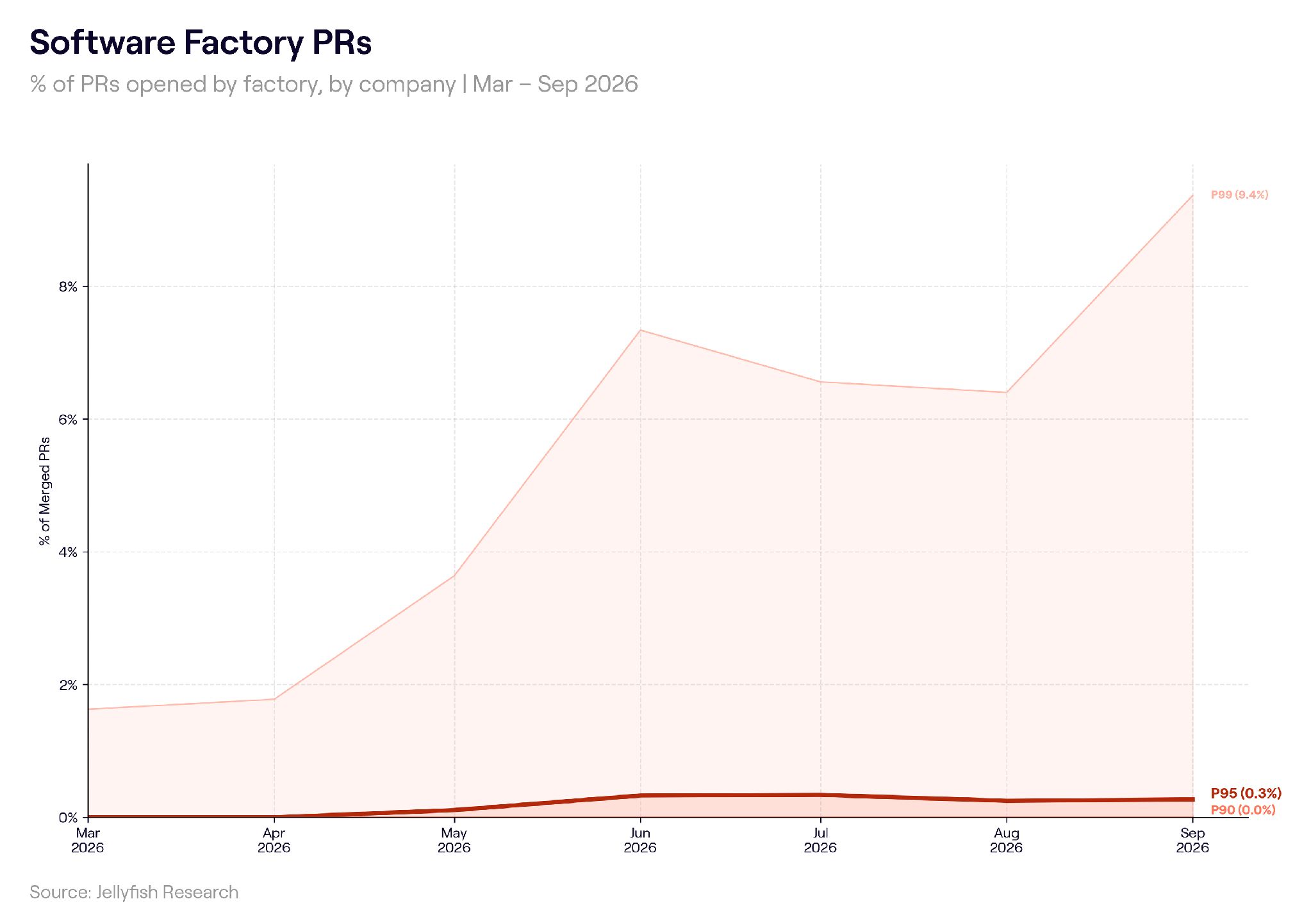
At the 99th-percentile company, software factories opened 9.4% of pull requests in September, up from about 1.7% in March. At the 90th percentile, the share rounded to 0.0%. Credit: Jellyfish Research
Scaling that autonomy takes investment in the systems around the agents, Ferrari said. “You have to build confidence and trust in the system.” Teams need enough context and controls to feel confident in what an agent produces, reviews and ships.
One part of that investment is maintaining context files, the instructions coding agents read about a project and how to work within it. In Jellyfish’s analysis, engineers who edited those files six or more times merged 2.3 more pull requests a week compared with no edits, controlling for AI usage. Each doubling of context-file investment was associated with 29% more merged pull requests.
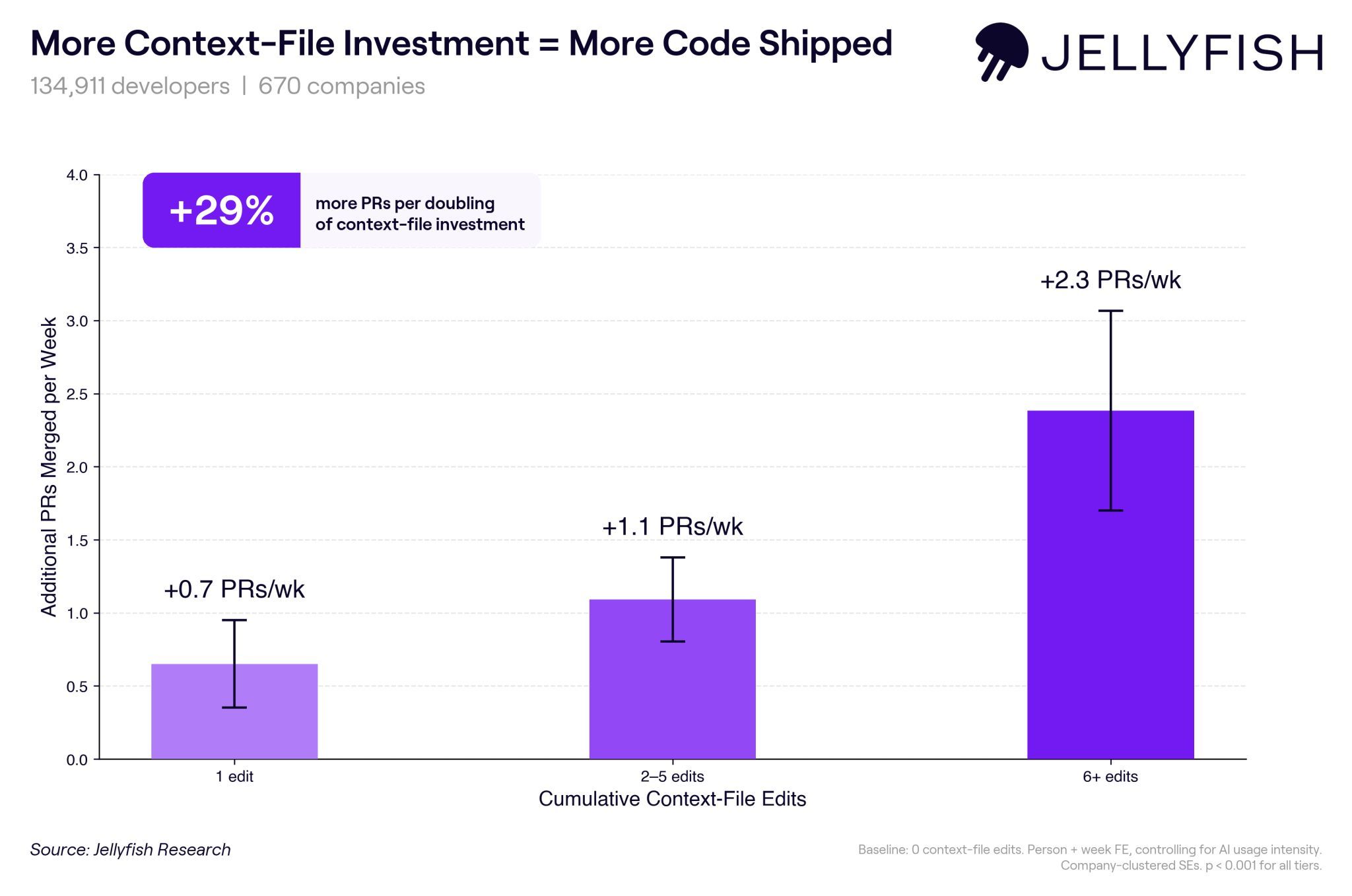
Engineers who edited agent context files six or more times merged 2.3 more pull requests a week than with no edits, controlling for AI usage. Credit: Jellyfish Research
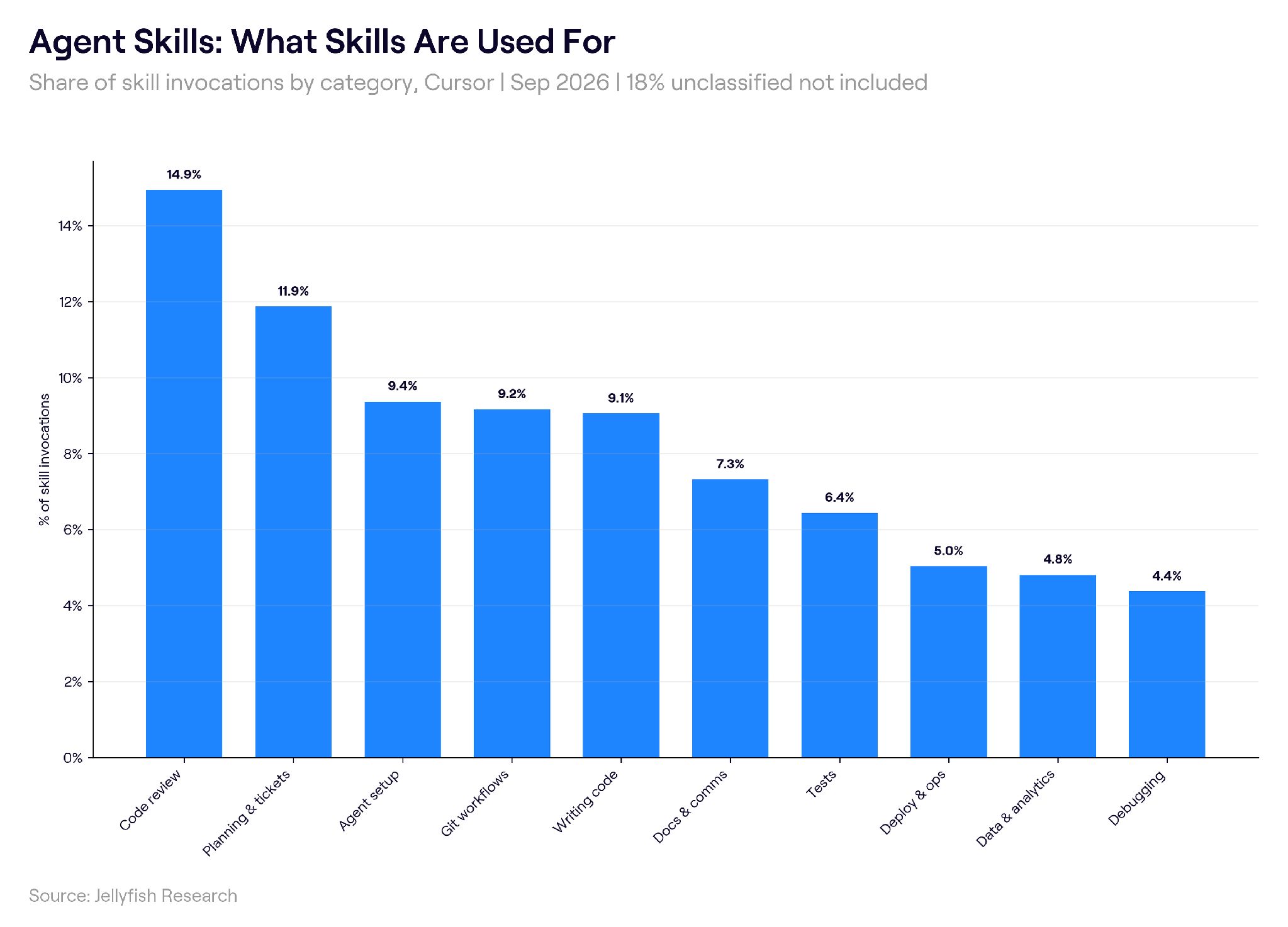
In Cursor, code review drew 14.9% of classified agent-skill invocations in September and planning and tickets drew 11.9%. Credit: Jellyfish Research
Future scaling hinges partly on governance
Developers’ confidence in AI now outpaces their confidence in their employers’ ability to manage it. In Jellyfish’s survey of 1,417 developers at 30 companies, conducted from January through September, 88% agreed that AI coding tools helped their work, while 62% agreed that their organization effectively managed the risks of AI-generated code.
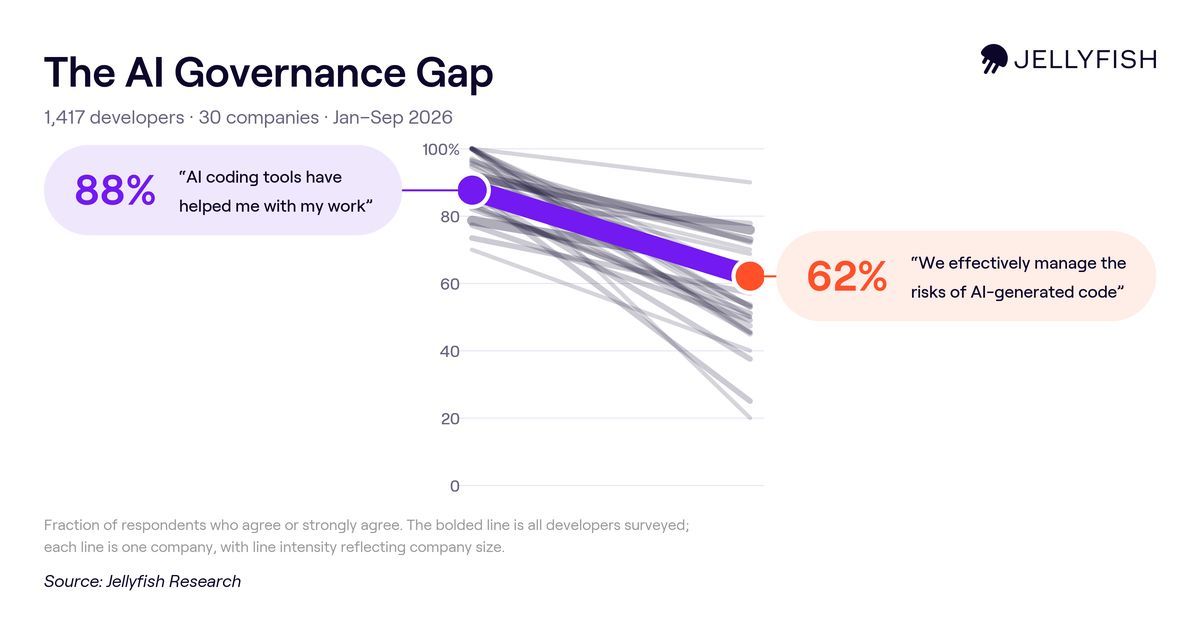
In a survey of 1,417 developers at 30 companies, 88% agreed AI coding tools helped their work and 62% agreed their organization effectively manages the risks of AI-generated code. Each gray line is one company. Credit: Jellyfish Research
Companies are making progress in pockets, Arcolano said. “Very few are figuring out how to scale it to everyone.” Bringing the rest of the organization along takes training and support that have struggled to keep pace with the tools.
“It’s moved so fast that the human change-management part, the training and support, is lagging,” he said.


Tell Us What You Think!
You must be logged in to post a comment.