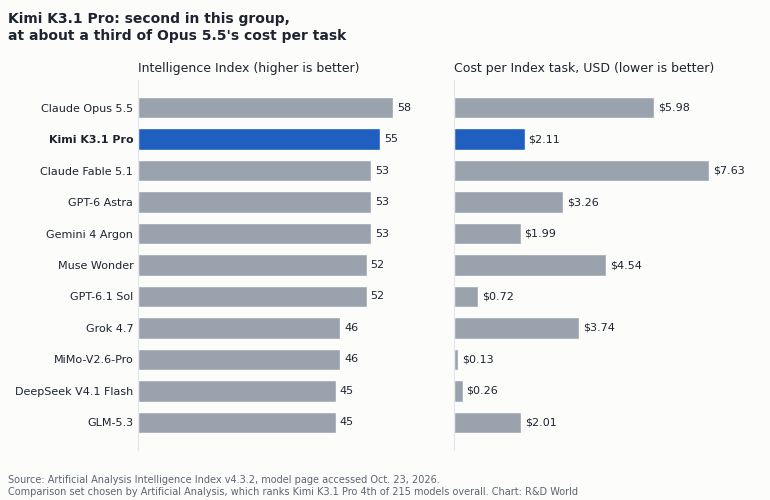
Credit: R&D World, from Artificial Analysis data
Research groups that want a near-frontier AI model on their own hardware, for data they would rather keep off a vendor’s servers, may have a stronger option soon. Moonshot AI, the Chinese company behind the Kimi models, released Kimi K3.1 Pro on Oct. 23 and says it will publish the full model weights by Nov. 4.
Independent scores put K3.1 Pro near the top of a field refreshed by several recent launches. Artificial Analysis gives it a 55 on its Intelligence Index, fourth among 215 models. Anthropic’s Claude Opus 5.5, released Sept. 22, leads at 58, followed by Claude Sonnet 5.5, released Sept. 28, at 56.
Also scoring 56 is Meta’s Muse Wonder Full, one of two Muse Wonder models introduced Oct. 12 for AI agents that carry out personal and professional tasks. Meta describes the pair as its most capable models to date, with capabilities spanning coding, finance, law and health. Claude Fable 5.1, OpenAI’s GPT-6 Astra and Google’s Gemini 4 Argon each score 53. Google unveiled its overdue Argon Sept. 30, claiming frontier-level performance on various benchmarks, but Artificial Analysis places it behind models like GPT-6 Astra and Opus 5.5.
While Chinese models once had a reputation for undercutting Western models by a large margin, Kimi’s latest releases illustrate how pricing for leading Chinese and U.S. models now overlaps. Moonshot charges $2 per million input tokens and $10 per million output tokens, down from $3 and $15 for Kimi K3, which launched in July. Those rates match GPT-6.1 Sol and are half the price of Opus 5.5, as software developer and AI blogger Simon Willison noted. Moonshot also offers a Highspeed variant that it says runs two to three times faster. At $4 per million input tokens and $20 per million output tokens. That faster version matches Opus 5.5 and costs twice as much per token as GPT-6.1 Sol, a lower-cost, near-frontier model OpenAI launched Sept. 29. Cached input rates remain unchanged for the Highspeed variant from Kimi.
The independent benchmarker Artificial Analysis counted 150 million output tokens from K3.1 Pro to complete its index, against a median of 87 million, and measured an output speed of 77 tokens per second. Based on token usage and API prices, it calculated a weighted average cost of $2.11 per Intelligence Index task for K3.1 Pro, compared with $5.98 for Opus 5.5, $7.63 for Fable 5.1 and $3.26 for GPT-6 Astra. Gemini 4 Argon, which scores 53, cost $1.99 per task, and GPT-6.1 Sol, at 52, cost $0.72.
While the pricing is converging, the performance of models near the frontier often is as well, but Peter Gostev, AI capability lead at Arena, the AI evaluation company formerly known as LMArena, found K3.1 Pro to still lag Western rivals in his testing, which involved tasks related to creating 3D scenes, animations and websites in a video posted Oct. 23. He rated its work above GPT-5.6 Sol’s and below GPT-6.1 Sol’s. “At least in these tests, I don’t think it’s quite there,” he said of its standing against the frontier.
Moonshot’s benchmark claims
Moonshot’s benchmark sheet has the K3.1 Pro model near the frontier in several benchmarks, comparing with Opus 5.5, Fable 5.1, GPT-6 Astra, DeepSeek V4.1 Flash and Zhipu’s GLM-5.3 on 14 tests. K3.1 Pro posts the top score on six, including SWE Marathon, a long-horizon software engineering test (51.7 versus 46.3 for Opus 5.5), Humanity’s Last Exam with tools (70.0 versus 67.7) and OfficeQA Pro v2, a financial-document analysis test (64.4 versus 62.2). On Terminal-Bench 4.0, which tests coding agents on terminal tasks, it scores 65.7, behind Opus 5.5 at 66.4 and ahead of GPT-6 Astra at 58.2.
Mixed signals in science
The weakest result for research readers comes on Terminal-Bench Science 0.1, which tests agents on scientific research workflows in a terminal. K3.1 Pro scores 38.1 there, against 68.1 for GPT-6 Astra, 63.3 for Opus 5.5 and 40.0 for Fable 5.1.
An August preprint introducing BenchBench-Protocol, a test of 149 modifications scientists made to published wet-lab protocols, found Kimi K3 and GPT-5.6 Sol statistically indistinguishable on single attempts; over 10 attempts, Kimi K3 scored higher. Claude Opus 5 led the nine models tested, at 59.2%.
Moonshot’s clearest research-oriented demonstration began with a simulated human that collapsed within seconds. In an internal test, K3.1 Pro built a walking simulator around human-atlas, an open-source anatomical model, then worked through repeated experiments to improve its movement. When adjustments to the training rewards failed to improve arm motion, the model investigated the simulator itself. According to Moonshot’s technical account, it found and corrected 36 errors in calculations governing how shoulder muscles rotate the joints, then retrained the walking controller. The simulated human eventually managed alternating strides for 11.2 seconds.
Methodology note: Moonshot ran K3.1 Pro at maximum reasoning effort (temperature 1.0, top-p 0.95), mostly on the Claude Code harness. Rival scores on its sheet mix Moonshot’s own runs, vendor system cards and blogs, and public leaderboards, and Moonshot notes that Claude results may include fallbacks and GPT results may include cyber safeguards.
Kimi Code Bench 3.0 and Kimi Hallu Bench are internal Moonshot benchmarks, and the DeepSeek score on Terminal-Bench Science comes from an older DeepSeek version (Moonshot’s own run of the current one scored 9.3). GDPval-AA scores are Elo ratings cited from Artificial Analysis. Artificial Analysis lists K3.1 Pro as proprietary until the weights ship.



Tell Us What You Think!
You must be logged in to post a comment.