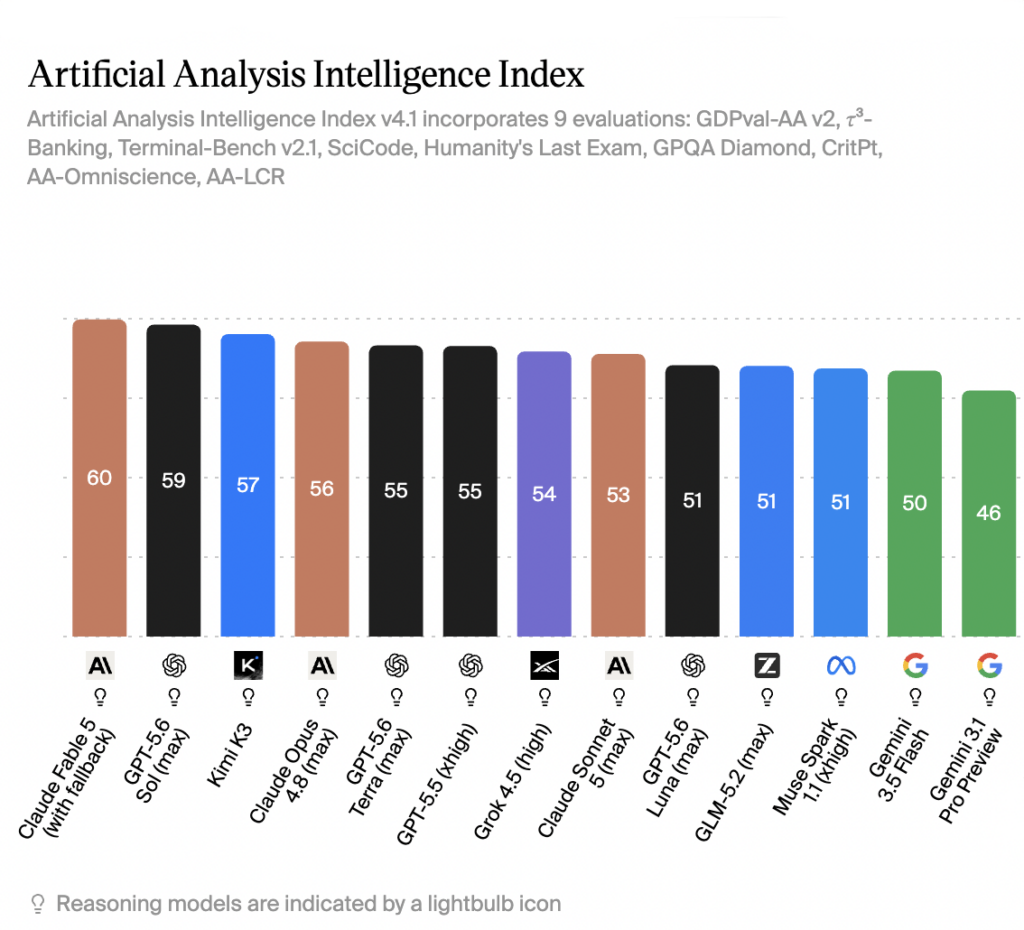
How Kimi K3 stacks up against the frontier. Image from Artificial Analysis.
China has done it again. They have launched a new AI model that comes close to the frontier roughly a year and a half after Hangzhou, China–based Deepseek launched R1, a model that was roughly tied with OpenAI’s then frontier model o1.
Now, Moonshot AI’s Kimi K3, released yesterday, follows a similar template while matching or edging past Anthropic’s Claude Fable 5 on several coding and agentic benchmarks (including Terminal-Bench 2.1 and SWE-Marathon) while undercutting Fable 5’s API price by roughly two-thirds ($3/$15 per million tokens versus $10/$50). Still, the performance comes at a premium, and is the most expensive model released by a Chinese AI lab, as AI blogger Simon Willison has noted.
K3’s strongest independent result may be front-end design, a field Anthropic previously led. On July 16, K3 ranked first on Arena’s human-voted WebDev leaderboard with a score of 1679, ahead of Claude Fable 5 at 1631 and GPT-5.6 Sol at 1618. Fable had occupied the top position earlier in July. K3’s ranking remains preliminary, though its current lead margin is significant.
Kimi K3 may be relatively inexpensive by the token, although its real workload economics look closer to other frontier models. Moonshot says K3 has 2.8 trillion parameters, about 4.2 times the 671 billion in the architecture underpinning DeepSeek R1, which launched in January 2025. For context, pundits have estimated Anthropic’s Fable to have several trillion parameters.
Moonshot reduces K3’s footprint by storing the model’s weights in MXFP4, a four-bit floating-point format that shares scaling information across small blocks of values. In plain terms, it compresses the numerical values inside the model while preserving enough range for inference. Even at four bits per parameter, K3’s raw weights would occupy roughly 1.4 terabytes before accounting for scaling data, activations, context caches and other runtime overhead.
Operating K3 requires considerable data center infrastructure. Moonshot recommends a “supernode,” a tightly networked cluster of at least 64 high-end accelerators. The chips within those accelerators must be able to move data among themselves quickly because K3 is a mixture-of-experts model, spreading work across many specialized sub-networks, and those sub-networks constantly need to exchange information.
Developer and YouTuber Theo Browne, who spent a day building with K3, titled his review “Kimi K3 is the best model ever made (sometimes).” Testing it on real front-end work, he judged its UI output slightly behind Claude’s but ahead of OpenAI’s, and called its 3D and visual coding the most capable he had seen from an open-weight model.
R&D World also encountered signs of constrained serving capacity while testing K3 on a scientific-analysis task. We accessed the model through OpenRouter, a unified API gateway for AI models. During the run, OpenRouter relayed that K3 was temporarily rate-limited.
| Model | Input | Cached input | Output |
|---|---|---|---|
| Kimi K3 | $3 | $0.30 | $15 |
| GPT-5.6 Sol | $5 | $0.50 | $30 |
| Claude Fable 5 | $10 | $1 | $50 |