Research & Development World

  • R&D World Home
  • Topics
    • Aerospace
    • Automotive
    • Biotech
    • Careers
    • Chemistry
    • Environment
    • Energy
    • Life Science
    • Material Science
    • R&D Management
    • Physics
  • Technology
    • 3D Printing
    • A.I./Robotics
    • Software
    • Battery Technology
    • Controlled Environments
      • Cleanrooms
      • Graphene
      • Lasers
      • Regulations/Standards
      • Sensors
    • Imaging
    • Nanotechnology
    • Scientific Computing
      • Big Data
      • HPC/Supercomputing
      • Informatics
      • Security
    • Semiconductors
  • R&D Market Pulse
  • R&D 100
    • 2026 R&D 100 Award Winners
    • 2026 Professional Award Winners
    • 2026 Special Recognition Winners
    • R&D 100 Awards Event
    • R&D 100 Submissions
    • Winner Archive
  • Resources
    • Research Reports
    • Digital Issues
    • Educational Assets
    • Subscribe
    • Video
    • Webinars
    • PharmSci360
    • Content submission guidelines for R&D World
  • Global Funding Forecast
  • Top Labs
  • Advertise
  • SUBSCRIBE

Inside the Genesis Mission’s first cohort: Sandia is automating Bayesian reasoning for science 

By Julia Rock-Torcivia | September 1, 2026

Sandia National Laboratories’ Agent Bayes project faces a nine-month test that asks whether AI can help scientists perform Bayesian reasoning, a process that often requires a subject matter expert and a statistician working together.
[Image courtesy of DOE]

The project is part of the first cohort selected for the Genesis mission, a Trump administration effort to “transform American science and innovation through the power of artificial intelligence,” according to the Department of Energy (DOE), which is leading the mission.

Performing Bayesian reasoning for science currently “requires both the subject matter expertise and a statistician to help them in developing data analysis methods and approaches that can quantify uncertainties in many high consequence situations,” Tommie Catanach, a lead investigator on the Agent Bayes project, said. “What Agent Bayes is supposed to do is automate a lot of that kind of reasoning and help a subject matter expert reason through decisions.”

When asked how AI could change Bayesian statistics workflows in the long term, Catanach said part of her goal is to make advanced statistic techniques more approachable for scientists that aren’t statisticians.

“Lots of what we’ve already done is trying to automate many of these methods that we have developed… There’s a whole field in something called probabilistic programming, which tries to do this already. However, they still require a lot of expertise to use. So really, this is trying to be a level above that, so that people like me can focus on the things that we really like,” she said.

Catanach and her colleagues designed the Agent Bayes project with the Genesis mission in mind.

“I do a lot of work in Bayesian methods development in general and have been looking to integrate AI… but we haven’t really had a method to directly pursue that and think about it more holistically, which is what the Genesis Mission provides,” she said. “A lot of [the project] was developed based on what the call asked for and also what resources are available through the Genesis platform.”

In addition to resources, the Genesis mission also changes how Catanach thinks about her work, she said. One change is thinking about delivering something that will be a tool other people can use and fit within their own ecosystem, she added.

The team is also thinking about how Agent Bayes will fit within other developments from Genesis mission projects. Catanach said the project is less about deeply theoretical, foundational work on the algorithms and methods and more about researching how AI can fit within existing lab workflows, broadening the impact beyond what they could do with a traditional grant.

The team intends to plug Agent Bayes into the broader ecosystem of the Genesis Mission, which the mission website describes as “an integrated platform that connects the world’s best supercomputers, experimental facilities, AI systems and unique datasets across every major scientific domain to double the productivity and impact of American research and innovation.”

The first Genesis mission cohort, including Agent Bayes, is moving into the first phase of the mission, for which they will receive funding of $500,000 to $750,000, depending on negotiations with the DOE, for nine months of work. Teams can then apply for Phase II, which will provide between $6 million and $15 million.

To advance to the second phase, teams will need to identify how their model provides an advantage over available models, Catanach said.

“For us, that means what the AI we are developing through Agent Bayes can do better than a naive AI implementation of the system or a default implementation of one of the probabilistic programming languages,” she said.

Proving Agent Bayes can be better than existing approaches in nine months is going to be challenging, she admitted.

“I’m really used to working on these three-year timelines… It is very different. We have a bigger team than we normally work with on something like this… and we tried to scope our project within those needs, but it’s definitely a different type of environment.”
 

Tell Us What You Think! Cancel reply

You must be logged in to post a comment.

Related Articles Read More >

Claude Mythos by Anthropic mobile logo app on a screen smartphone. Claude is a family of large language models developed by Anthropic. Batumi, Georgia - March 26, 2026
Anthropic doubles a science benchmark score with Fable 5.1 while OpenAI says its Astra models crosses critical cyber threshold
How Lantern Med Digital is helping build the digital layer of Costa Rica’s medtech boom
Anthropic wants Claude to run life sciences R&D. Now it is wiring AI agents into the lab.
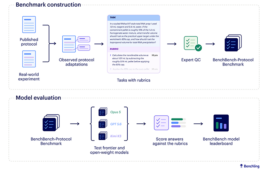
BenchBench-Protocol turns published methods and real-world protocol adaptations into expert-reviewed, rubric-scored tasks used to compare frontier and open-weight models. (Image: Benchling)
Benchling envisions vibe coding cutting R&D app development time from months to minutes
rd newsletter
EXPAND YOUR KNOWLEDGE AND STAY CONNECTED
Get the latest info on technologies, trends, and strategies in Research & Development.

R&D World Digital Issues

Fall 2025 issue

Browse the most current issue of R&D World and back issues in an easy to use high quality format. Clip, share and download with the leading R&D magazine today.

R&D 100 Awards
Research & Development World
  • Subscribe to R&D World Magazine
  • Sign up for R&D World’s newsletter
  • Contact Us
  • About Us
  • Drug Discovery & Development
  • Pharmaceutical Processing
  • Global Funding Forecast

Copyright © 2026 Arrowfly LLC. All Rights Reserved. The material on this site may not be reproduced, distributed, transmitted, cached or otherwise used, except with the prior written permission of Arrowfly
Privacy Policy | Advertising | About Us

Search R&D World

  • R&D World Home
  • Topics
    • Aerospace
    • Automotive
    • Biotech
    • Careers
    • Chemistry
    • Environment
    • Energy
    • Life Science
    • Material Science
    • R&D Management
    • Physics
  • Technology
    • 3D Printing
    • A.I./Robotics
    • Software
    • Battery Technology
    • Controlled Environments
      • Cleanrooms
      • Graphene
      • Lasers
      • Regulations/Standards
      • Sensors
    • Imaging
    • Nanotechnology
    • Scientific Computing
      • Big Data
      • HPC/Supercomputing
      • Informatics
      • Security
    • Semiconductors
  • R&D Market Pulse
  • R&D 100
    • 2026 R&D 100 Award Winners
    • 2026 Professional Award Winners
    • 2026 Special Recognition Winners
    • R&D 100 Awards Event
    • R&D 100 Submissions
    • Winner Archive
  • Resources
    • Research Reports
    • Digital Issues
    • Educational Assets
    • Subscribe
    • Video
    • Webinars
    • PharmSci360
    • Content submission guidelines for R&D World
  • Global Funding Forecast
  • Top Labs
  • Advertise
  • SUBSCRIBE