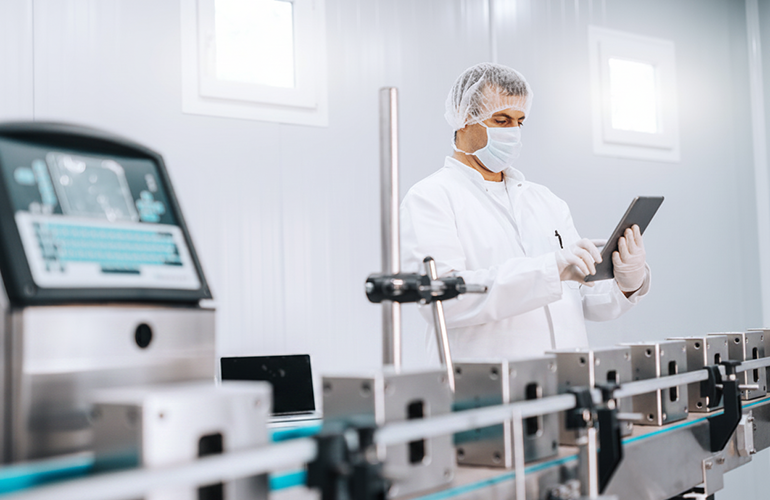
A technician reviews production data beside a manufacturing line. (Image credit: Adobe Stock.)Costa Rica, the land of pura vida, stunning national parks and biodiversity, has transformed itself from an agriculture-focused exporter into a high-tech manufacturing hub over the years. “Medical devices are now our biggest export,” said Keiner Morales, chief technology officer at Lantern Med Digital.
The country has transformed considerably since the 1980s. “Back then, we were a coffee-and-banana country,” Morales said. Both the medical device and semiconductor industries have made significant investments. The medical device firm Baxter set up shop in 1987. Intel followed with a landmark $300-million-plus semiconductor assembly-and-test plant investment announced in late 1996 and begun in 1997. Over the next two decades the medical-device cluster continued to grow with Boston Scientific opening a plant there in 2004, followed by Medtronic, Abbott, Hologic, Philips, and numerous other multinationals from medtech and beyond.
“Through education and government policy, we were able to shift toward manufacturing. Medical devices are now the country’s most important export, while coffee is approximately fifth,” he continued. As of 2024, medical devices accounted for 44% of Costa Rica’s goods exports, according to the country’s trade and investment promotion agency, PROCOMER. A study from the same agency released in December 2025 valued the country’s medical-device exports at $8.675 billion for 2024. More recently, the U.S. International Trade Administration’s Costa Rica healthcare-sector guide estimated that the Costa Rica-U.S. medical-device trade relationship produces $582.1 million in imports into the U.S. “We became an important medical device hub,” Morales said.
Bringing a technology lens to medtech
Morales has observed Costa Rica’s changing technology sector from two vantage points. After more than a decade at Intel, he co-founded Lantern Technologies in 2015, which has operations in Costa Rica and Colombia, as well as in Dallas, Texas. The company later concentrated on medical-device work and adopted the Lantern Med Digital name.

Keiner Morales
At LMD, Morales applies a semiconductor manufacturing mindset to making production visible at the level of each unit, with a pronounced focus on efficiency. “Semiconductor manufacturing is highly automated,” he said. “They invest a lot in every single unit, with cameras all over the place, unit-level data gathering and so on.”
Published case studies illustrate the work. In a PTC partner case involving Establishment Labs, Lantern centralized the control and monitoring of pharmaceutical ovens used to cure and dry silicone implants. Meanwhile, a separate 2024 case published by LMD describes a manual production station where a step had to last for a specified minimum time for an unnamed client. Lantern built a pedal-operated controller that timed the step, counted completed and rejected units, displayed the result to the operator and sent the data through an IoT gateway for cloud reporting.
Using technology to build technology
That experience also informs his view of medical-device production. “Medical device manufacturing is normally highly manual, and manufacturers have many technology needs,” Morales said. “The compliance requirements demand a lot of technology, and we saw an opportunity there.”
The rise of genAI, along with continued advances in machine vision and IoT, continues to transform medical device development. “We’re seeing AI create tools that were unavailable two years ago,” Morales said. “We’re using AI to build AI.” Morales said AI tools now assist with both image classification and coding.
“Two years ago, everything had to be done manually. Training, image classification and much of that work were entirely manual. Now they have AI tools that can help them execute it faster,” he said. “Even coding has changed and is evolving quickly compared with hardware.”
The engineer still defines the manufacturing problem, selects the technology and checks the output. Morales compares that role to driving. “They have to follow the engineering process: visit the customer, understand the problem, identify the technology that fits the problem-solving path, and use AI to keep development on track and make it faster,” he said. “We need the driver to keep control of the results.”
Working, fast and slow
Traditionally, the medical device sector has moved at a different pace from that of consumer technology, given its elevated regulatory demands and the practical limits on adopting emerging, unproven technologies. For software changes to an existing device, FDA guidance says a change that could significantly affect safety or effectiveness may require a new 510(k) submission. The manufacturer must assess the change’s intended and unintended consequences and perform the necessary verification or validation.
That tendency to move cautiously also extends to many factory operations. Morales pointed to a recent factory visit in Latin America where operators were assembling tubing and applying glue by hand. “These processes will most likely remain manual because, in our countries, it’s much less expensive to hire people than to build a machine,” he said. In those plants, semi-automation can mean using machine vision to flag deviations from a defined process and replacing some paper-based traceability with digital records.
Still, the gulf between the medical device sector and consumer tech has grown narrower as consumer-technology giants have stepped up their healthcare ambitions. Apple, for instance, has expanded its regulated Apple Watch health features, including an ECG app granted FDA De Novo classification in 2018 and FDA-cleared hypertension notifications. Google received FDA clearance in February 2025 for Loss of Pulse Detection on Pixel Watch 3, which joined irregular-heart-rhythm notifications and an ECG app. Samsung’s Galaxy Watch platform likewise offers an FDA-cleared irregular-heart-rhythm notification, paired with its ECG function, and FDA-authorized sleep apnea detection.
Despite that convergence, medical-device development still moves slowly. “You have to thoroughly justify every change, especially with the FDA,” Morales said. For factory systems, FDA’s February 2026 computer-software-assurance guidance calls for a risk-based approach and objective evidence that production or quality-system software performs as intended. Replacing a camera, revising an inspection model or updating the software can therefore require another documented assessment.
“Once everything is validated, they don’t want to invest in changing the technology,” Morales said. “You can sell one technology to a factory, and the same technology can still be there in five or 20 years.”

Tell Us What You Think!
You must be logged in to post a comment.