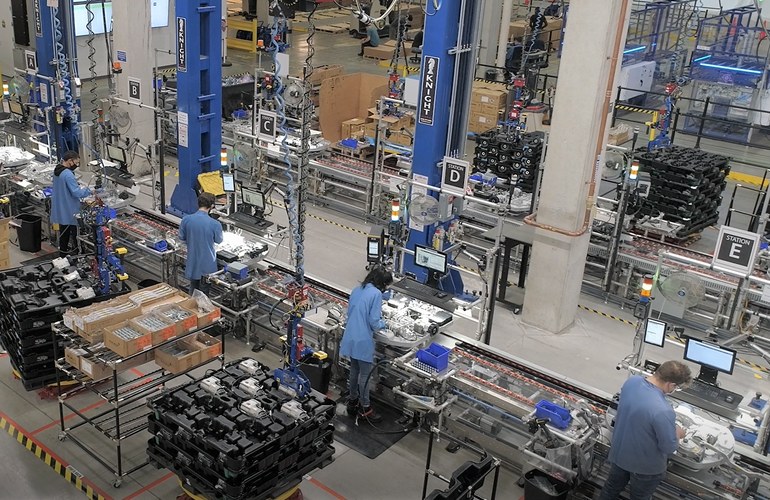
An Amazon robotics manufacturing line. Credit: Amazon
Amazon’s planned 1.2-million-square-foot robotics plant joins a growing cluster of physical robotics builders in Central Texas, including Tesla’s Optimus humanoid factory on its Gigafactory Texas campus, Austin-based humanoid developer Apptronik, and the robotics program at the University of Texas at Austin.
“It makes sense that you would see robotics from Tesla, robotics from Amazon,” said Stacy Schmitt, chief operating officer of Opportunity Austin. “There’s several other companies that are looking at Austin as an opportunity as well because of that ecosystem that’s building.”
For Amazon, the draw combined local talent with a rare piece of real estate. “The physical land, that doesn’t exist in a lot of places, to have that amount of acreage in such close proximity to a thriving urban downtown,” said Jessica Breaux, Amazon’s senior manager for economic development.
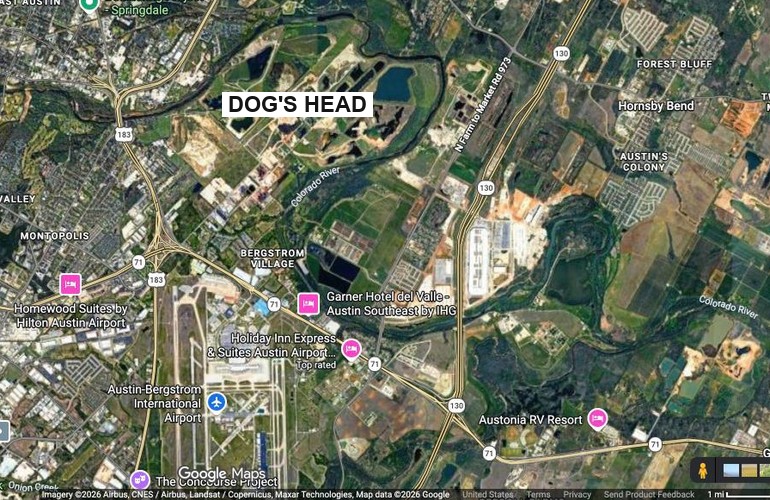
Dog’s Head sits in a bend of the Colorado River between US 183 and SH 130, just north of Austin-Bergstrom International Airport. Credit: Google Maps (imagery ©2026 Airbus, CNES / Airbus, Landsat / Copernicus, Maxar Technologies; map data ©2026 Google)
Amazon’s plant anchors Dog’s Head, a roughly 2,614-acre tract near Austin’s airport that sat outside city limits until Austin annexed it in May. The former industrial and quarrying site still needs roads and utilities before much of it can be built out.
Amazon’s plant and the district around it are paid for differently. “Amazon did not seek any incentives as part of this project, so we are fully paying our own way,” Breaux said, referring to construction and the infrastructure serving the facility. Austin Mayor Kirk Watson made the same point in Amazon’s August announcement.
Public infrastructure across the wider district is financed through Tax Increment Reinvestment Zone No. 21, which the Austin City Council approved in July. The zone sets aside a share of future tax growth inside its boundaries for roads, utilities and other public infrastructure. Developer Endeavor Real Estate Group pays for eligible projects upfront and is reimbursed for part of the cost, and only from new tax revenue the district generates. “If there is no development that were to happen at Dog’s Head, there’s nothing to reimburse them with,” Breaux said.

Jessica Breaux
Work on the plant is already underway. A Texas Department of Licensing and Regulation filing lists Nov. 16 as the start date for core-and-shell construction and July 13, 2027, as the completion date, though the timing of the first robot off the line remains open. “We’re still focused on just making sure that we have suppliers lined up,” Breaux said. “We’re in very early stages of construction, so no confirmed start date at this point.”
At 1.2 million square feet, the Austin factory is roughly twice the size of the 585,000-square-foot plant Amazon announced in September for Greenwood, Indiana, and more than three times its manufacturing site in Westborough, Massachusetts. Amazon centers its robotics innovation in Massachusetts, at an innovation hub in North Reading and its Westborough factory. “We’re still certainly committed to the facility that we have in Massachusetts,” Breaux said, adding that Amazon is growing its presence there as well. In Austin, the 300 to 500 projected roles will span entry-level production workers to what Breaux called “engineering design talent that’s helping us innovate the product.” According to the announcement, the plant will produce robotics systems that work alongside Amazon employees on repetitive tasks and heavy lifting.
Amazon is counting on the Austin area, where it already employs about 17,000 people, to supply much of that workforce. “I don’t want you to have the impression that our intention is to move a bunch of people to Austin,” Breaux said. “Part of what was attractive about that community is that the innovation ecosystem, the talent, the partnerships already exist.”

Stacy Schmitt
How the new factory will connect to university research is still taking shape. Amazon and the University of Texas at Austin have operated a joint Science Hub since 2023. “We’re still exploring that, and still, I would say, in the early stages of how we are able to partner with the university,” Breaux said. For hands-on technical training, Amazon is looking to build on its existing Career Choice tuition program with Austin Community College and has begun talks with the Austin Infrastructure Academy, a City of Austin training program run with Workforce Solutions Capital Area and Austin Community College that prepares residents for construction, skilled-trades and other infrastructure jobs.
Amazon has also started working with K-12 schools, with formalized plans to support the FIRST Robotics team at nearby Del Valle High School in 2027. Texas treats robotics as an official University Interscholastic League contest alongside sports like football. “It’s not like that in every state, but it is in the state of Texas,” Schmitt said, noting that early competition helps build the regional talent pipeline.
Amazon is framing the plant as a long-term hiring project. “We’re really kind of approaching this new opportunity for us in Austin as, how do we not only make sure we have that immediate talent pipeline ready to go,” Breaux said, “but what are we doing in terms of partnership to make sure that pipeline is there for years to come?”


Tell Us What You Think!
You must be logged in to post a comment.