Credit: OpenAI
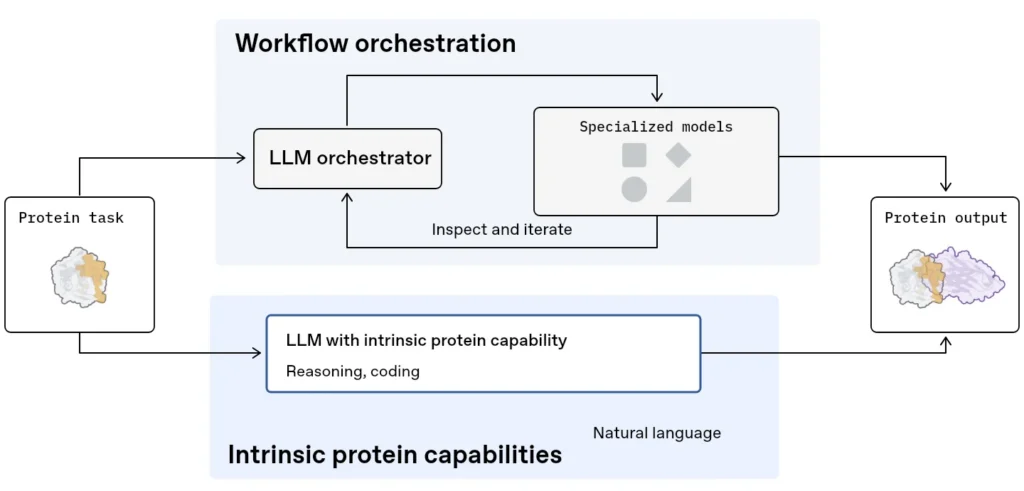
Of 322 small proteins that OpenAI’s research partner Onava tested, 35 showed evidence of binding to their intended targets. At least one candidate bound to each of the five targets, OpenAI reported Nov. 24. A prerelease version of GPT-6.2 designed the proteins’ three-dimensional backbones using general-purpose code. A specialized model, SolubleMPNN, supplied candidate amino acid sequences. Other models helped the researchers choose which proteins to make.
The protein-design preprint follows two AI-assisted results in mathematics. In September, OpenAI credited an internal model with a proof about the equations governing fluid flow, known as the Navier–Stokes equations. On Nov. 20, Anthropic mathematician Levent Alpöge announced that he and Claude had found a proof of the Riemann hypothesis, a conjecture about the distribution of prime numbers.
The protein study gave Onava a physical test of the model’s predictions. The 10.9% binding rate covered selected candidates across PD-L1, IL-7Rα, TrkA, VEGF-A and IL-17A. A second experiment reversed the assignment. Researchers supplied the shapes of known binders and asked GPT-6.2 to design sequences that would fit them. In initial screens, 75 of 88 designs for MDM2 showed binding (85%), as did 26 of 42 for VEGF-A (62%) and eight of 59 for PD-1 (14%).
For three unpublished shapes GPT-6.2 had designed earlier, 14 of 107 new sequences (13.1%) produced proteins that screened positive. Two binders for the same PD-L1 structure differed from the original sequence at 52 and 58 of its 90 positions. The researchers cite those differences as evidence that GPT-6.2 could do more than reproduce a memorized sequence.
Credit: OpenAI
GPT-6.2 also redesigned the binding loops of six small antibodies. Of 182 designs with screening results, 128 (70%) showed binding to IL-4Rα. For five therapeutic antibodies, the researchers asked the model to change about half the amino acids in each of three heavy-chain binding loops. Of 272 redesigned fragments, 179 (66%) screened positive for binding to the original target, PD-1 or PD-L1.
Credit: OpenAI
On computational tests, researchers could specify how many helices or strands a protein should contain. In a separate docking task, they could identify a known bond and ask how the rest of the molecule would fit. On MotifBench, 43.7% of a separate internal research model’s designs passed structural checks, compared with 27.8% for RFdiffusion. On the PoseBusters blind docking test, the internal model placed a molecule within 2 angstroms of its observed pose in 96% of scored predictions. GPT-6.2 did so in 93% and DiffDock-L in 50%. Both OpenAI models ranked the effects of mutations more accurately on average than ESM2-650M on each of four public datasets.
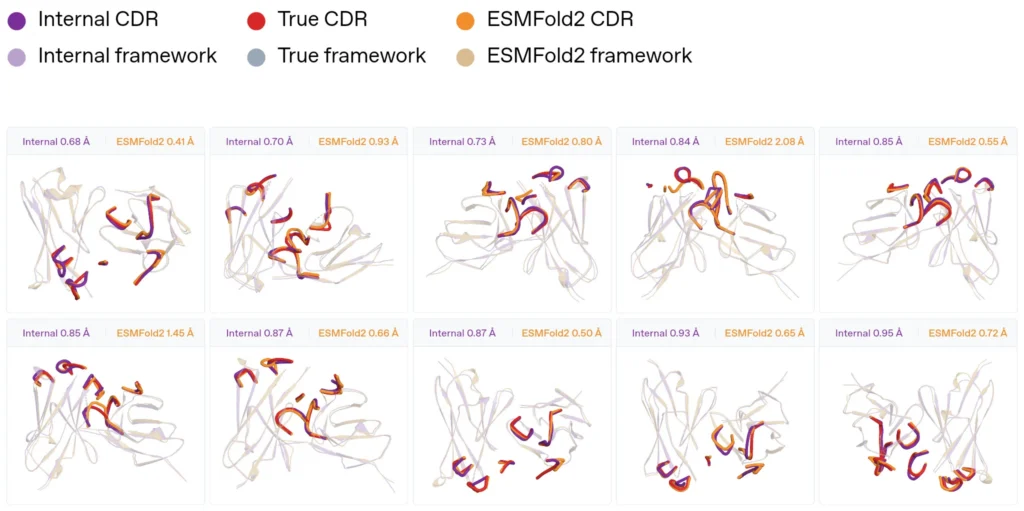
Predicting a whole protein’s shape from its sequence proved harder. On experimentally measured structures, GPT-6.2 averaged 0.26 on the TM-score scale, the internal model averaged 0.38 and ESMFold2, a specialized folding model, averaged 0.93. A score of 1 indicates a perfect match. Scores above 0.5 generally mean the prediction captured the overall fold. The researchers used ESMFold2 and other structure predictors, including Boltz-2 and OpenDDE, to filter candidates for lab testing.
Credit: OpenAI
OpenAI wrote that “binding is only one step toward a useful research tool or medicine.” The company wants to test what the proteins do after they bind, how selectively they recognize their targets and whether they are practical to manufacture. It also aims to extend the work to RNA and small molecules, including protein degraders called PROTACs.
Tell Us What You Think!
You must be logged in to post a comment.