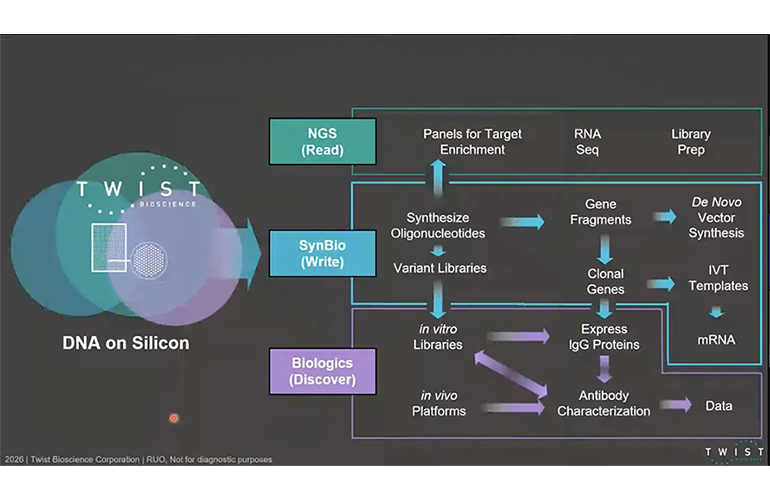
Twist’s silicon-based DNA synthesis feeds three product lines: NGS tools for reading DNA, synthetic biology for writing it and biologics for antibody discovery. Credit: Twist Bioscience
South San Francisco-headquartered Twist Bioscience sees potential for another year of triple-digit growth in AI drug discovery orders, even though its initial fiscal 2027 guidance assumes revenue from that work grows about 69%. The synthetic DNA maker is building on a fiscal fourth quarter that pushed it to positive adjusted EBITDA. In fiscal 2026, AI drug discovery orders more than doubled and revenue jumped 175% to roughly $59.1 million, part of $459.4 million in total sales. The fiscal 2027 guidance assumes about $100 million from AI drug discovery out of $550 million to $560 million in total revenue. Twist is also guiding for positive adjusted EBITDA for the full fiscal year.
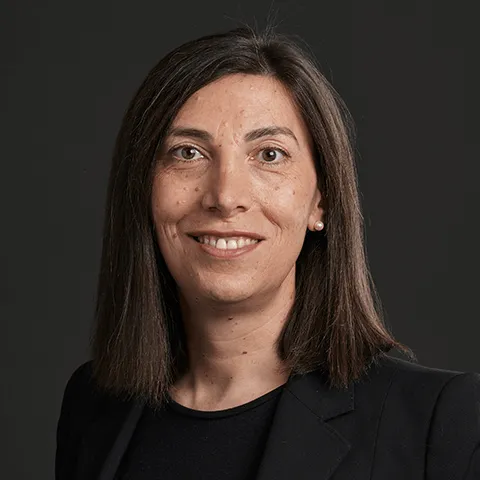
Emily Leproust
“We remain confident in the potential for triple-digit percentage order growth in fiscal 2027,” CEO and founder Emily Leproust wrote in responses to R&D World. “The $100 million in AI drug discovery revenue included in our initial guidance reflects the programs and delivery timing we can forecast with high confidence today.”
Expanding existing customer programs and signing new ones offer upside beyond that baseline, Leproust said, noting that Twist is “adding capacity and expanding workflows to serve that demand and convert additional orders into revenue within the year.”
Twist’s capacity push builds on a yearslong effort to make fuller use of its silicon-based DNA synthesis platform. Its roughly 212,000-square-foot facility in Wilsonville, Oregon, is the company’s primary manufacturing site for DNA synthesis and protein solutions, and its fiscal 2027 guidance includes about $75 million in capital expenditures as part of a two-year investment plan. During a tour of Twist’s South San Francisco facility earlier this year, Leproust likened each DNA writer to a plane and the roughly 1 million synthesis sites on each silicon chip, which is the size of a standard 96-well plate, to seats. Twist already pays to fly the plane, she said, so filling empty seats can bring in more revenue at little extra cost. The company reported $2.2 million in adjusted EBITDA for its fiscal fourth quarter, up from a $7.8 million loss a year earlier.
AI drug discovery has become one of the company’s fastest-growing engines. AI programs can generate thousands of candidate sequences that still need to be built and tested in the wet lab. Several providers can handle an order of roughly 100 antibodies, but at 1,000 or 10,000 candidates, Leproust argued in July, Twist’s integrated workflow of DNA synthesis, antibody expression, purification and characterization narrows the field. That scale turns Twist’s high-throughput platform into a bridge from digital predictions to the wet lab.
Turning that wet-lab output into better AI models requires more than raw volume, Leproust said. If a customer trains a model on data generated today, they need to test its predictions in a later experiment and trust that differences “reflect biology rather than variability in the assay,” she wrote. Meeting that standard depends on consistent performance across runs, biological and technical replicates, standardized controls and validation points wherever possible.
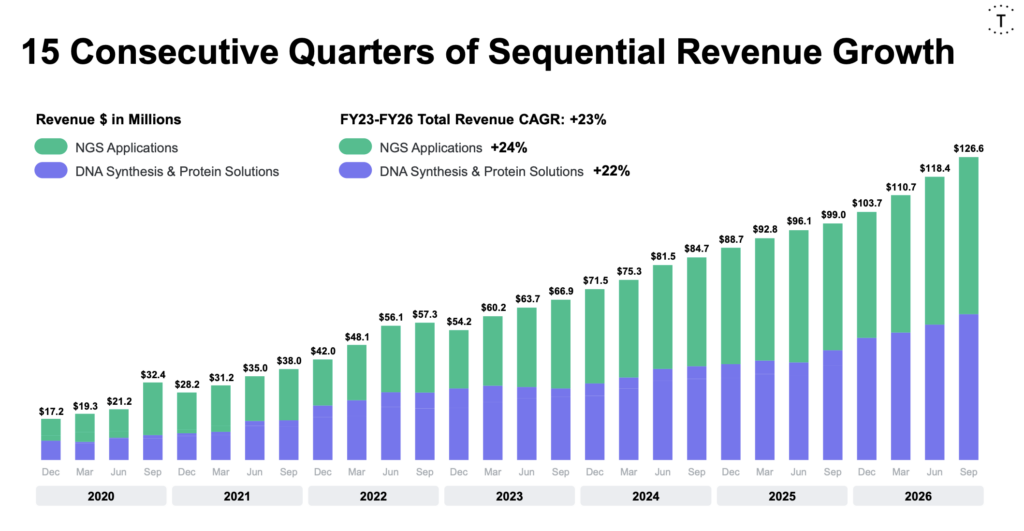
A recent slide from Twist’s earnings showed the cumulative growth over 15 consecutive quarters. Credit: Twist Bioscience.
Negative results are valuable, Leproust noted, but the most informative datasets also capture what happens between a clear positive and a clear negative. Assays with a wide dynamic range, paired with samples that span that range, provide more information for training and evaluating models. Twist also works with customers on project design, helping plan experiments and review conclusions so the resulting data supports better predictions and experimental testing.
The data Twist generates belongs to its customers, Leproust said, and characterization orders often arrive with both a customer’s target and its sequences. “That’s their IP for what could become future therapeutics and deciding where to send that information should not be taken lightly,” she wrote.
Twist counts AI drug discovery revenue conservatively, Leproust said, including only sales it can clearly tie to customer orders or a customer’s stated focus on AI drug discovery. Large drugmakers complicate that count: they run many labs across multiple sites, and one lab may pursue AI drug discovery while another sticks with traditional methods.
“As more pharma and biotech customers incorporate AI alongside traditional approaches, that distinction becomes harder to make,” she wrote.


Tell Us What You Think!
You must be logged in to post a comment.