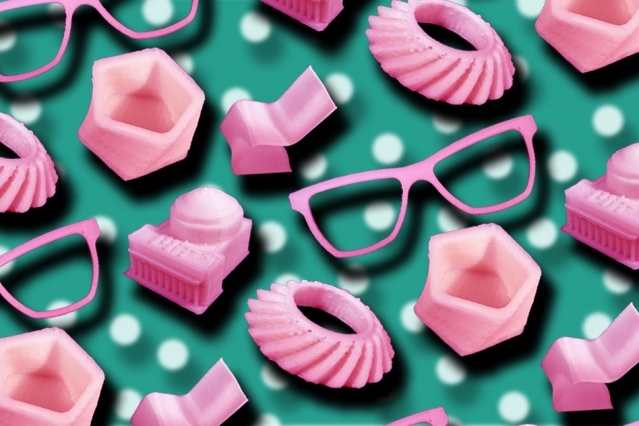
Collection of objects and test samples printed on the new 3-D printer, including a miniature chair, simplified model of Building 10 at MIT, eyeglasses frames, a spiral cup, and a helical bevel gear. Image: Chelsea Turner (using images provided by the researchers)
A new desktop 3D printer boasts speeds up to 10 times faster than existing commercial printers.
Researchers from the Massachusetts Institute of Technology (MIT) designed a new printer that incorporates a screw mechanism that feeds polymer material through a nozzle at high force and a laser—built into the printer’s compact printhead—that rapidly heats and melts the material, enabling it to flow faster through the nozzle.
To demonstrate the printer’s capabilities, the researchers printed various detailed, handheld 3D objects within minutes including small eyeglass frames, a bevel gear and a miniature replica of the MIT dome.
“If I can get a prototype part, maybe a bracket or a gear, in five to 10 minutes rather than an hour, or a bigger part over my lunch break rather than the next day, I can engineer, build, and test faster,” Anastasios John Hart, an associate professor of mechanical engineering at MIT, said in a statement. “If I’m a repair technician and I could have a fast 3D printer in my vehicle, I could 3D-print a repair part on-demand after I figure out what’s broken.
“I don’t have to go to a warehouse and take it out of inventory,” he added.
According to Hart, the new printer could be used in emergency medicine and for a variety of needs in remote locations.
The researchers previously determined that commercial desktop extrusion 3D printers on average print at a rate of about 20 cubic centimeters per hour. They were able to discover that how fast a printer can move its printhead, how much force a printhead can apply to a material to push it through the nozzle and how quickly the printhead can transfer heat to melt a material and make it flow were the main factors that determined the speed of the printer.
“Then, given our understanding of what limits those three variables, we asked how do we design a new printer ourselves that can improve all three in one system,” Hart said. “And now we’ve built it, and it works quite well.”
In desktop 3D printers, plastic is fed through a nozzle through a pinch-wheel mechanism, where two small wheels within the printhead rotate and push the plastic or filament forward. This works well at slower speeds, but if more force were applied to speed up the process, at a certain point the wheels would lose their grip on the material—which limits how fast the printhead can push material through.
The researchers replaced the pinchwheel design with a screw mechanism that turns within the printhead. They then fed a textured plastic filament onto the screw and as the screw turned, it gripped onto the filament’s textured surface and was able to feed the filament through the nozzle at higher forces and speeds.
“Using this screw mechanism, we have a lot more contact area with the threaded texture on the filament,” Hart said. “Therefore we can get a much higher driving force, easily 10 times greater force.”
The researchers also added a laser downstream of the screw mechanism that heats and melts the filament before it passes through the nozzle. They also have the ability to control the amount of heat delivered to the plastic by adjusting the laser’s power and turning it quickly on and off.
The final change included devising a high-speed gantry mechanism—an H-shaped frame powered by two motors, connected to a motion stage that holds the printhead.