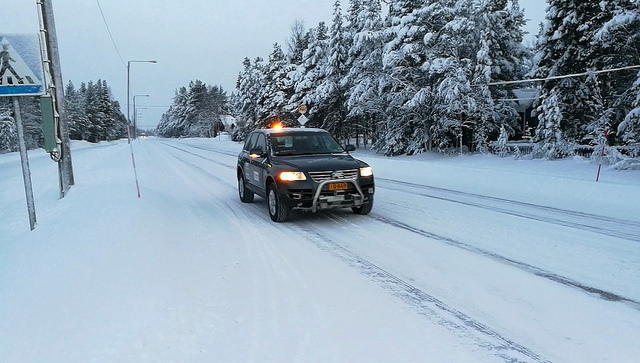
Martti, the robot car developed by VTT Technical Research Centre of Finland, is the first automated car to have driven fully autonomously on a real snow-covered road. On top of that, it also succeeded in making a new speed record of 40 km/h on the Aurora E8 intelligent road in Muonio, probably setting a new unofficial world record as well. Credit: VTT Technical Research Centre of Finland
While self-driving cars are smooth sailing on dry land with no traffic, snow and ice have always proved to be a hurdle for autonomous vehicles.
Researchers from the VTT Technical Research Center in Finland have developed Martti—a self-driving vehicle with a system that is designed to maneuver rough and icy conditions.
“We have developed special filtering technology for processing environment perception data and improve performance of LiDARs snowy conditions,” project manager Matti Kutila from VTT’s RobotCar Crew said in an interview with R&D Magazine. “In addition, the control strategy of driving this car has special features for controlling the vehicle when friction due to snow or ice makes driving conditions challenging.”
Martti, which includes cameras, antennas, sensors and laser scanners, was developed on the chassis of a Volkswagen Touareg.
The autonomous car contains three laser scanners that sense the environment only in front of the car.
Autonomous cars require different sensors and strategies depending on the situation. Plain, optical cameras, which work well under ideal conditions, do not perform as well on snowy roads. LiDAR is also less effective.
However, to combat the difficulties, Martti will rely more on radar.
The system uses positioning based on GPS with correction signaling and an inertia unit to align the vehicle in the road.
“Furthermore, the trajectory planning is fine-tuned with LiDARr data to be between road border even if lane markings are not visible,” Kutila said. “The vehicle has been connected via ITS G5 communication device to the smart road signs too.
“Finally, the vehicle steering and cruise commands are provided according to environment constrains,” he added.
To test the abilities of their new car, the researchers drive Martti autonomously on a real snow-covered road in Muonio, Finland. During the test, they hit 25 miles per hour, clearing a major hurdle for the advent of autonomous cars in rough conditions.
Kutila explained that it has been a challenge to develop a car that could handle inclement weather.
“This of course depends on markets. Scandinavia, Finland, Russia and Canada are not maybe the biggest markets compared to China, etc,” he said. “Fog and rain is everywhere and automotive and sensor industry is investing to tackle those conditions first.
“However, people needs help automated safety functions especially in harsh weather conditions,” he added. “Future mobility cannot stop due to challenging weather.”
Kutila said ultimately, there is more that needs to be done to fine tune the technology before it is commercially viable.
“Technology is evolving daily bases and we can see lot of things happening today with LiDARs, radars, computing and artificial intelligence,” he said. “However, maturity of the technology is still young and not widely experimented.
“Some of the Martti type of functions will be in markets in 3-5 years and some will take more than 10 years,” he added.
The next step for VTT’s autonomous cars will be changing the wavelengths of the optical components, increasing the resolution of the radar, and building more intelligence into the software monitoring the capabilities of the sensors. These are intended to enhance the vehicle’s functioning capacity on slippery road surfaces, where concealed edge of the road or fog may obstruct visibility.
Martti was created to go along with Marilyn, a partner vehicle that was developed at VTT and designed for more ordinary urban drives.