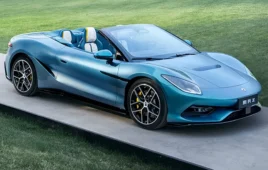
Changan Automobile and Contemporary Amperex Technology (CATL) have developed a mass-production passenger vehicle equipped with sodium-ion batteries (SIBs), the companies announced last month. The vehicle is set to reach the market in mid-2026, marking a shift towards a dual-chemistry ecosystem in which sodium-ion and lithium-ion batteries complement each other.
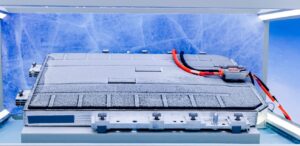
CATL’s Naxtra sodium-ion battery. Credit: CATL
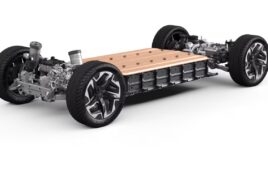
CATL’s Naxtra sodium-ion battery has an energy density of up to 175 Wh/kg. Its Cell-to-Pack system and BMS enable an electric range exceeding 400 km. The company anticipates reaching 500 km to 600 km for pure-electric range variants as its sodium-ion supply chain advances.
Could this battery solve EVs’ cold-weather problems?
The battery can operate in extreme cold, delivering nearly three times the discharge power of equivalent LFP batteries at –30 °C, while maintaining over 90% capacity retention at –40 °C and stable power delivery at temperatures as low as –50 °C, the company said. These batteries could address one of the biggest drawbacks of EVs: diminished range and slower charging in colder conditions.
Most EVs are powered by lithium-ion batteries (LIBs), which generally offer higher energy density than current sodium-ion batteries, but experience a reduction in performance in the cold. Sodium ions form weaker bonds with the battery’s electrolyte, allowing them to move more easily than lithium ions, even when the electrolyte becomes thicker in the cold.
Charging lithium batteries in the cold is not only slow and difficult, but it can also damage the battery. In the cold, the lithium ions cannot enter the anode fast enough, causing them to plate onto the surface.
How CATL scaled sodium-ion batteries to mass production
The cell construction of SIBs is similar to that of commercial LIBs, with sodium serving as the charge carrier instead of lithium. The same four main components make up these batteries: a cathode, an anode, an electrolyte and a separator.
During the charge process, sodium ions are extracted from the cathodes and inserted into the anodes while the current travels through an external circuit in the opposite direction. When discharging, the sodium ions leave the anode and return to the cathode in a process called the “rocking-chair principle”. This is also how LIBs work. These similarities allow for existing manufacturing infrastructure to be employed for the production of SIBs with minor modifications.
Additionally, SIBs can be made with a cheaper collector material. LIBs require copper foil for the anode because lithium alloys with aluminum at low voltages. Sodium does not alloy with aluminum, so SIBs can be made with aluminum foil for the cathode and the anode, which reduces the weight of the battery and lowers the collector cost by 70%.
CATL isn’t just swapping LIBs for SIBs; it is mixing the two technologies to capitalize on the advantages of each. CATL’s battery management system (BMS) controls the two different chemistries, allowing the vehicle to leverage the high energy density of lithium as well as the superior cold weather performance of sodium.
By leveraging the rocking-chair principle within existing manufacturing frameworks and replacing costly copper with aluminum, CATL and Changan have bypassed the “valley of death” that new chemistries often fall victim to. The Naxtra series demonstrates that energy density no longer needs to be sacrificed for thermal resilience; instead, the two can coexist through sophisticated BMS arbitration and Cell-to-Pack integration.