
Scientists at Rice and Duke universities have identified a set of genes they say make sarcoma cells less aggressive. They hope to turn the discovery into new therapeutic approaches to fight metastatic cancers. The work by members of Rice’s Center for Theoretical Biological Physics led by co-director and biophysicist Herbert Levine and scientists at Duke…
Graphene Nanoribbons Show Promise for Healing Spinal Injuries

The combination of graphene nanoribbons made with a process developed at Rice University and a common polymer could someday be of critical importance to healing damaged spinal cords in people, according to Rice chemist James Tour. The Tour lab has spent a decade working with graphene nanoribbons, starting with the discovery of a chemical process to…
Improved Microendoscope Brings Cervical Cancer into Focus
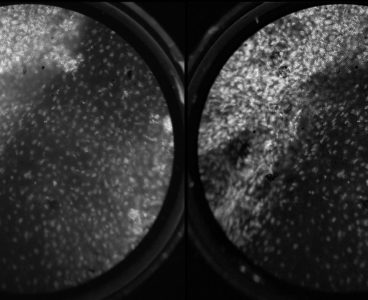
Rice University researchers have added a clever spin—a rotating grating that removes out-of-focus light—to a cutting-edge, minimally invasive fiber-optic microscope that lets oncologists and surgeons zoom in on cancer tumors prior to surgery. The research is published online this week in the Early Edition of the Proceedings of the National Academy of Sciences. Rice’s high-resolution microendoscope,…
3D Graphene Has Promise for Bio Applications

Flakes of graphene welded together into solid materials may be suitable for bone implants, according to a study led by Rice University scientists. The Rice lab of materials scientist Pulickel Ajayan and colleagues in Texas, Brazil and India used spark plasma sintering to weld flakes of graphene oxide into porous solids that compare favorably with the mechanical properties and…
Map Helps Maximize Carbon-Capture Material
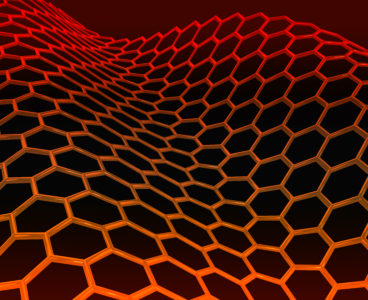
Nanoribbons in Solutions Mimic Nature
Nothing — And Something — Give Concrete Strength, Toughness
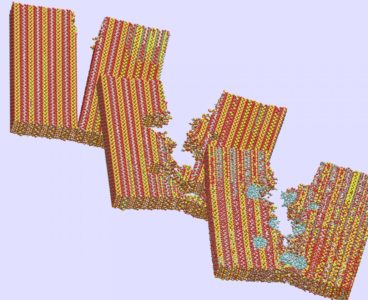
What does one need to strengthen or toughen concrete? A lot of nothing. Or something. The “nothing” is in the form of microscopic voids and the “something” consists of particular particles embedded in the most common construction material on Earth. Rice University materials scientist Rouzbeh Shahsavari and postdoctoral researcher Ning Zhang analyzed more than 600…
Ultra-flat Circuits Will Have Unique Properties

The old rules don’t necessarily apply when building electronic components out of two-dimensional materials, according to scientists at Rice University. The Rice lab of theoretical physicist Boris Yakobson analyzed hybrids that put 2-D materials like graphene and boron nitride side by side to see what happens at the border. They found that the electronic characteristics…
Scientists Detect Thermal Boundary that Hinders Ultracold Experiments

Spiders Spin Unique Phononic Material
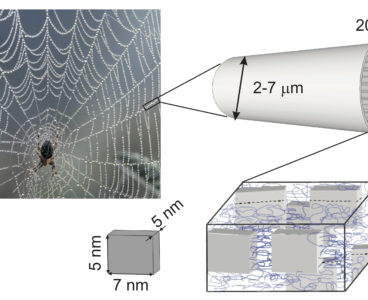
New discoveries about spider silk could inspire novel materials to manipulate sound and heat in the same way semiconducting circuits manipulate electrons, according to scientists at Rice University, in Europe and in Singapore. A paper in Nature Materials today looks at the microscopic structure of spider silk and reveals unique characteristics in the way it transmits phonons,…
Likely New Planet Might Be in Slow-Death Spiral

Astronomers searching for the galaxy’s youngest planets have found compelling evidence for one unlike any other, a newborn “hot Jupiter” whose outer layers are being torn away by the star it orbits every 11 hours. “A handful of known planets are in similarly small orbits, but because this star is only 2 million years old…