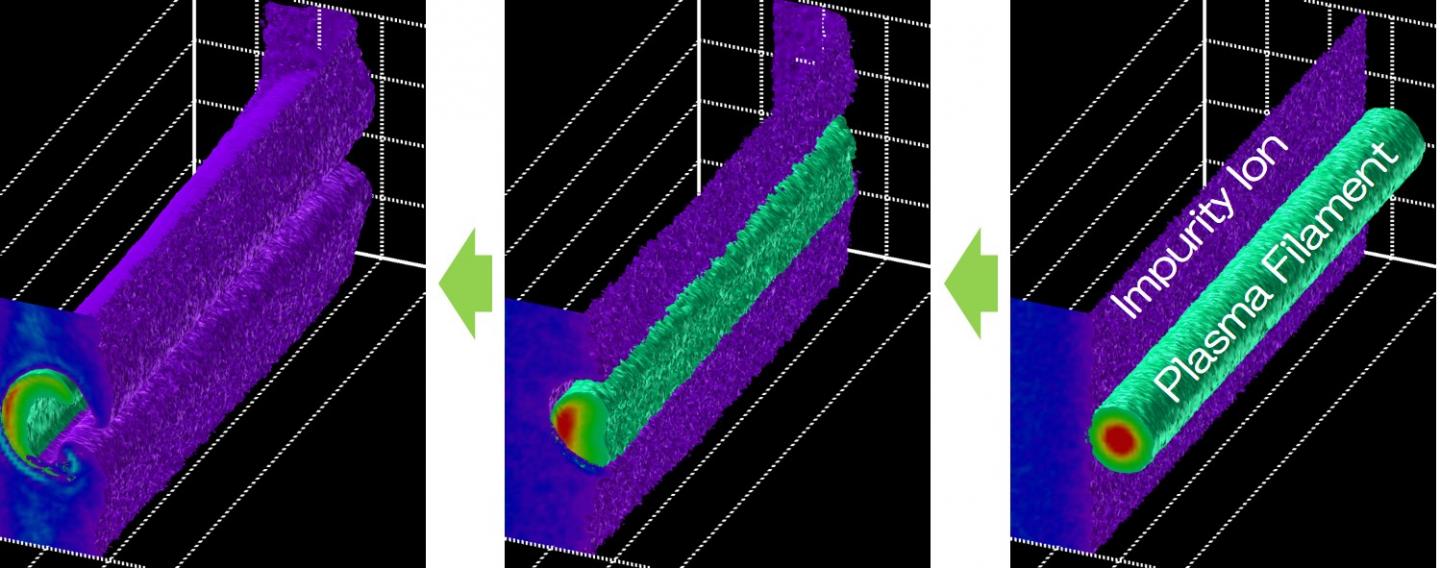
Time is passing from right to left. The tube in green is the surface of the plasma blob. Areas where impurities are great are in blue and areas where impurities are few are in purple, and both colors appear. When a plasma blob invades an area where impurities are many, the impurities are carried in the right-hand side direction. Source: Dr. Hiroki Hasegawa
The generation of fusion energy utilizes the fusion reaction that occurs inside a high-temperature plasma. In order to achieve the generation of fusion energy, we confine plasma in the magnetic field with a doughnut configuration. Together with raising the temperature and the density in the plasma’s core region, it also is necessary to control the plasma in the edge region which surrounds the plasma. In the edge region of the confined plasma appears the plasma blob. Because this plasma blob moves in the direction of the confinement vessel’s wall, there thus is concern that the plasma will come into contact with the wall and the plasma temperature will fall (see Figure 1). In order to control this type of plasma blob, precisely understanding and predicting the blob’s movement is one of the important topics in the future achievement of fusion energy. In order to investigate in detail the complicated movements of a plasma blob, computational simulations are necessary. There are several methods for performing simulations of the gathering of particles (ions and electrons) that bear electricity. The most accurate method is that which calculates the movement of each particle that composes the plasma and calculates the electrical field thus produced. In order to accurately understand the behavior of a plasma blob, a simulation from the micro-level (particle level) is required. However, it was extremely difficult to perform such a simulation because an immense amount of calculation is required.
Research Results
Dr. Hiroki Hasegawa and Dr. Seiji Ishiguro, at the National Institute of Fusion Science, using the NIFS Plasma Simulator supercomputer succeeded for the first time in the world in conducting a micro-level simulation of a plasma blob in the “edge region” of the plasma. The Plasma Simulator has the greatest capacity in the world as a supercomputer dedicated to plasma and fusion science use. Here, in addition to newly developing a calculation program by utilizing the Plasma Simulator’s capacity, they also were able to calculate the movements of one billion particles. When calculating plasmas of the same size, the number of calculations exceeded 10,000 in comparison with the method used heretofore for calculating the blob’s particles as if they were a unit.
According to this simulation, finely detailed analyses that incorporated the influence mutually provided by the movement of particles and the electrical field, which had not been possible in methods used to date, became possible. Further, at the same time as we pursue the movements of a string-like plasma blob from the particle level, we were able to clarify the micro-level internal structure of particle movements inside the plasma and the temperature distribution (see Figure 2). By understanding this type of internal structure, it became possible to investigate the influence of that internal structure upon the movement of a plasma blob. Moreover, we clarified the condition in which a plasma blob carries impurities (see Figure 3).
These research results, together with greatly advancing understanding of the behavior of a plasma blob, have greatly improved prediction accuracy. These research results were reported at the 26th International Atomic Energy Association (IAEA) Fusion Energy Conference held in Kyoto, Japan from October 17-22, 2016. The results have also been highly evaluated, and later were presented as an invited lecture at the thirty-third annual meeting of The Japan Society of Plasma and Nuclear Fusion Research in Sendai, Japan, held from November 29 to December 2, 2016, where the research results also garnered much attention.