Research & Development World

  • R&D World Home
  • Topics
    • Aerospace
    • Automotive
    • Biotech
    • Careers
    • Chemistry
    • Environment
    • Energy
    • Life Science
    • Material Science
    • R&D Management
    • Physics
  • Technology
    • 3D Printing
    • A.I./Robotics
    • Software
    • Battery Technology
    • Controlled Environments
      • Cleanrooms
      • Graphene
      • Lasers
      • Regulations/Standards
      • Sensors
    • Imaging
    • Nanotechnology
    • Scientific Computing
      • Big Data
      • HPC/Supercomputing
      • Informatics
      • Security
    • Semiconductors
  • R&D Market Pulse
  • R&D 100
    • 2025 R&D 100 Award Winners
    • 2025 Professional Award Winners
    • 2025 Special Recognition Winners
    • R&D 100 Awards Event
    • R&D 100 Submissions
    • Winner Archive
  • Resources
    • Research Reports
    • Digital Issues
    • Educational Assets
    • Subscribe
    • Video
    • Webinars
    • PharmSci360
    • Content submission guidelines for R&D World
  • Global Funding Forecast
  • Top Labs
  • Advertise
  • SUBSCRIBE

Cellular Barcoding Helps Scientists Understand the Behavior of Stem Cells

By NIH/National Heart, Lung and Blood Institute | January 3, 2018

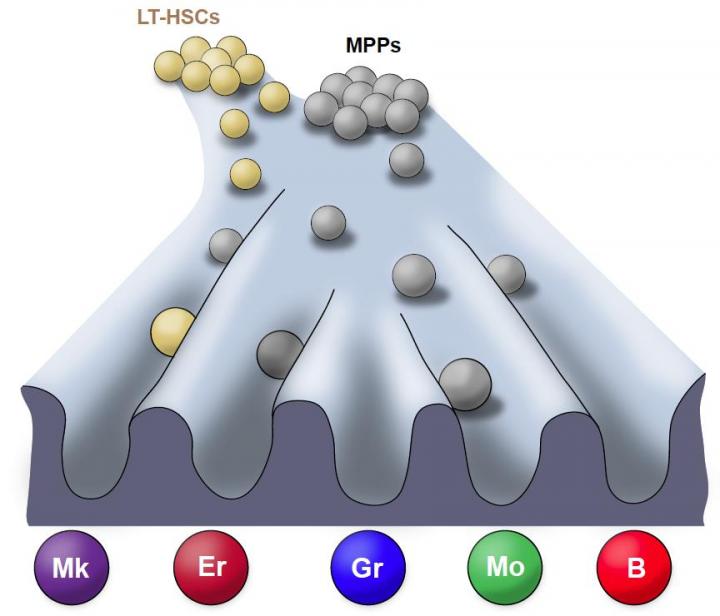
Landscape of the lineage fate (natural environment) of unperturbed haematopoiesis (the process of mature blood and immune cell production).

By tagging bone marrow cells of mice with a genetic label, or barcode, researchers were able to track and describe the family tree of individual blood cells as they form in their natural environment. The scientists discovered that these cells regenerate differently than their counterparts do after a blood cell transplant, according to a study published Jan. 3 in Nature and funded by the National Heart, Lung and Blood Institute (NHLBI), part of the National Institutes of Health.

“The findings of this research, if applicable to humans, will have implications for blood cell transplantation, and for clinical and research methods using blood cells, such as gene therapy or gene editing,” said John W. Thomas, Ph.D., Stem Cell and Cell-based Therapy Coordinator at NHLBI.

This study moves research a step further towards the development of blood regeneration therapies, but the researchers believe it is also applicable to a variety of cells and will yield insights about regenerating diseased or damaged tissues.

“Our results show that stem cells and their less pluripotent descendants, blood progenitors, behave somewhat differently when studied without removing them from their native environment versus when studied in a laboratory or in transplantation; leading to differences in the type of blood lineages they make,” said study’s first author Alejo Rodriguez Fraticelli, Ph.D., from Harvard Stem Cell Institute, at the Boston Children’s Hospital.

Due to the lack of appropriate tools to study how blood forms in the natural environment of the body, the majority of studies about where individual blood cells come from have been done after a transplant. In that context, the transplanted cells would have been “perturbed,” or removed from their natural environment. According to the researchers, the current models are more likely to represent a roadmap of lineage potential for the blood cells’ natural offspring.

For Rodriguez Fraticelli, this highlights the importance of studying blood regeneration in its native context. “Moving forward, we need to come up with methods to better predict what types of cells will be the most optimal for therapy, for instance in reprogramming cells, and editing,” he said.

In the study, researchers tagged cells using a transposon, a piece of genetic code that can jump to a random point in DNA when exposed to an enzyme called transposase, to track blood progenitors and adult stem cells during the natural, unperturbed process of blood regeneration.

The research provides evidence for a substantially revised roadmap for normal blood regeneration or blood production in the natural environment; and highlights how in those conditions blood stem cells and progenitor cells manifest unique properties.
Related Articles Read More >

Norstella launches Atlas, a biopharma agentic platform that can ‘train you’
How a Duke-led HPC method brought cell-scale cancer simulation to a single cloud node 
As AI floods drug discovery with designs, Twist uses DNA chips to tackle the wet-lab bottleneck
Purple Glowing Spiral Fractal Background Image, Illustration - Vortex repeating spiral patterns, Symmetrical repeating geometric patterns. Abstract design, black background
Recursion says its Norstella-backed real-time simulation can expand trial eligibility by up to 40%
rd newsletter
EXPAND YOUR KNOWLEDGE AND STAY CONNECTED
Get the latest info on technologies, trends, and strategies in Research & Development.

R&D World Digital Issues

Fall 2025 issue

Browse the most current issue of R&D World and back issues in an easy to use high quality format. Clip, share and download with the leading R&D magazine today.

R&D 100 Awards
Research & Development World
  • Subscribe to R&D World Magazine
  • Sign up for R&D World’s newsletter
  • Contact Us
  • About Us
  • Drug Discovery & Development
  • Pharmaceutical Processing
  • Global Funding Forecast

Copyright © 2026 Arrowfly LLC. All Rights Reserved. The material on this site may not be reproduced, distributed, transmitted, cached or otherwise used, except with the prior written permission of Arrowfly
Privacy Policy | Advertising | About Us

Search R&D World

  • R&D World Home
  • Topics
    • Aerospace
    • Automotive
    • Biotech
    • Careers
    • Chemistry
    • Environment
    • Energy
    • Life Science
    • Material Science
    • R&D Management
    • Physics
  • Technology
    • 3D Printing
    • A.I./Robotics
    • Software
    • Battery Technology
    • Controlled Environments
      • Cleanrooms
      • Graphene
      • Lasers
      • Regulations/Standards
      • Sensors
    • Imaging
    • Nanotechnology
    • Scientific Computing
      • Big Data
      • HPC/Supercomputing
      • Informatics
      • Security
    • Semiconductors
  • R&D Market Pulse
  • R&D 100
    • 2025 R&D 100 Award Winners
    • 2025 Professional Award Winners
    • 2025 Special Recognition Winners
    • R&D 100 Awards Event
    • R&D 100 Submissions
    • Winner Archive
  • Resources
    • Research Reports
    • Digital Issues
    • Educational Assets
    • Subscribe
    • Video
    • Webinars
    • PharmSci360
    • Content submission guidelines for R&D World
  • Global Funding Forecast
  • Top Labs
  • Advertise
  • SUBSCRIBE