A tangible expression of Insilico’s strategy to be “super productive.” The company’s bipedal robot operates within its automated Suzhou lab, physically connecting its AI design platform to real-world data generation. Image: Insilico Medicine / YouTube
Years after the pandemic, parts of biopharma remain in a slump: scarce capital, steady layoffs, and surplus lab space in key hubs. Among the outliers is Insilico Medicine, which closed an oversubscribed $123 million Series E in June 2025 and is advancing an AI-built fibrosis drug; its pipeline includes more than 30 assets. Over the years, the company has built out a still-burgeoning toolkit of AI tools, which it continues to periodically refresh. Pharma.ai, Insilico’s end-to-end drug-R&D platform spans PandaOmics for target discovery, Chemistry42 for generative molecule design (with ADMET/retrosynthesis), and inClinico for predicting clinical-trial outcomes, built to run as one stack rather than as point tools. To turn digital proposals into data, that software is tied to “Life Star,” an automated lab the company operates in Suzhou’s BioBAY; independent coverage has described the facility and its integration with Insilico’s agentic workflows (including a bipedal ‘AI scientist’ used to operate human-oriented equipment).
Compete, don’t complain
For CEO Alex Zhavoronkov, recently named #85 on the Observer’s 2025 AI Power Index alongside leaders from Nvidia, OpenAI and Google, this biotech market downturn is a test of competitiveness, not a time for excuses. The company is doubling down on a strategy centered on concrete metrics, aiming to advance more programs toward clinical candidacy, faster.
“I think that this industry needs a little bit of a shake up.” —Zhavoronkov
It says something that Insilico, which is now headquartered in Boston but has operations in several sites across the globe, cut its teeth in Asia, where preclinical and early clinical work is executed against hard benchmarks—even “nine months to a developmental candidate,” Zhavoronkov said, thanks to a unique mix of goal-oriented workflows, deep CRO capacity and faster IND timelines.
“Right now, everybody is trying to blame China for something, especially for biotech efficiency,” Zhavoronkov said. Such an approach is “very unfair, because of what they had to go through to reach this point.” Some organizations in legacy biopharma firms by extension are “protective,” he said. “But instead of being protective, you actually need to go in and compete.” Zhavoronkov said that was Insilico’s approach. ” What I did… we went there, researched all of the companies that were doing business there, understood how they’re doing things, and tried to do better. My job was to go in, out-compete, outperform, get to the very top position, and then bring it back. That’s what we did. And I think that if you are not competing there, you don’t even have a clue.”

Alex Zhavoronkov, Ph.D.
Zhavoronkov draws a parallel with the strategic lesson at the heart of the iPhone’s success: Foxconn redefined electronics production through scale, process optimization and relentless efficiency. That reality, he argues, forces a stark choice on every competitor. “You don’t want to be assembling iPhones, you need to figure out how to develop the next iPhone if you’ve got China assembling iPhones very efficiently.”
Insilico’s global footprint reflects this strategic approach. Instead of building a single, monolithic headquarters, the company has distributed its functions to the global hubs best suited for each task. “We consolidate our foundational AI research in Montreal and Abu Dhabi, while validation—synthesis, testing, preclinical, and early clinical — we do in Asia, just because it’s super efficient,”

On AI, scale and measuring success
For Insilico, success in AI drug discovery means “cheaper, faster, or higher quality drugs, better probability of success, and hopefully higher novelty,” though Zhavoronkov notes that “pharma doesn’t like novel targets. They like established targets. So just make sure that your molecule is differentiated…and pharma will buy.”
While some AI companies active in drug discovery sometimes post about their data, compute, research prestige and board members, “nothing matters if you don’t have benchmarks,” he said.
“Where are the drugs, right? In biotech, your job is to produce drugs. When you are an AI company, you’re expected to produce many. Because if you produce just one, you are not an AI company. What’s the point? It’s like developing a driverless infrastructure to produce one car.” —Zhavoronkov
Aging as North Star, disease as path
This full-stack approach is a reflection of Zhavoronkov’s own non-linear path. His background bridges computer science and finance from Queen’s University, a Ph.D. in physics from Moscow State University, and a Master’s in biotechnology from Johns Hopkins. Insilico itself aims at a single, complex problem: aging. “Aging pulls everything together,” he says. He traces it back early: “I’ve been interested in aging since my early childhood.” He treats its tech stack as a way to test dual-purpose biology at scale: “My model is that I try to identify therapeutic targets that have a dual purpose, so they are implicated in aging and disease at the same time.”
“I realized that aging research is such a multi-faceted, multi-disciplinary, multi-factorial problem…the solution is not going to come from just one area,” Zhavoronkov said. The near-term play is to win in disease first: “If you are to go and get a drug approved for aging, you’re going to fail 100%.” Hence the two-track plan: win approvals in disease today and bank aging optionality for tomorrow via what he calls a “longevity vault” that he says holds “more than 80 very promising targets” for when the science and regulators allow broader use.
On the current state of longevity interventions, Zhavoronkov is measured: “Currently, there is no drug that tangibly works on aging. We now know that GLP-1s may have a chance to be the first very weak longevity drugs.” He adds: “I actually think beta-blockers can give you significant torque late in life.”
But progress in combatting aging has been slow. His assessment of progress to date is sobering: “Imagine, $6 trillion spent over the past 30 years, and we got maybe one quality-adjusted life year in the U.S.,” he said. “We have not made a significant difference in maximum lifespan.”
Still, he sees the tide potentially turning: “I think that maybe in the next couple of years, I’m going to pull the trigger on a few of our 100% focused-on-longevity targets.”
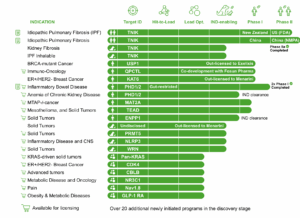
A pipeline snapshot as shown on Insilico’s website in 2025
Playing the long game
Insilico’s portfolio logic traces to Zhavoronkov’s early conclusion that the grant-driven path was structurally mismatched to aging. “If you do a Bachelor’s and Master’s and PhD in biology or chemistry, the probability that you are going to have enough resources to focus on a very broad spectrum problem, or a set of problems, is very low, because you will need to focus on one specific small thing,” he said.
After years in computer science and finance, plus organizing dozens of scientific conferences, he came away convinced that the problem demands breadth and cross-checks, not a single doctrine. “Aging research is multi-faceted,” he says, and any credible effort has to test ideas across organ systems and disease models, with benchmarks that show what moves and what doesn’t.
The pipeline is built to do exactly that: a set of disease programs that probe biology and chemistry from multiple angles to build the knowledge base required to go after aging “in a big way.” It is a hedge against false certainty and a way to keep score the same way every time, by throughput and evidence.
“If you set your mindset on just one scheme, the probability that you’re going to fail there is very, very high.”—Zhavoronkov
This long-term, foundational work has stocked what Zhavoronkov calls a “longevity vault,” a repository now holding more than 80 promising targets implicated in aging. But the company’s early fibrosis program taught a crucial lesson in patience: not every promising target, he stresses, “is ready for prime time.” Before committing to a full clinical program for a novel aging target, you must “explore the biology around those targets and ensure that you are 100% confident that it is going to work clinically in order to push the button.”
And when that button is pushed, Insilico must be prepared to go it alone. For these kinds of truly novel programs, he argues, you must be ready to “go full-stack, because Pharma is not going to give you significant upfronts to partner with you on longevity targets. It just doesn’t happen.” After years of building the platform and the pipeline to de-risk this moment, Zhavoronkov sees the time for that calculated shot on goal approaching. He says he expects to “pull the trigger on a few of our 100% focused-on-longevity targets” within the next couple of years.