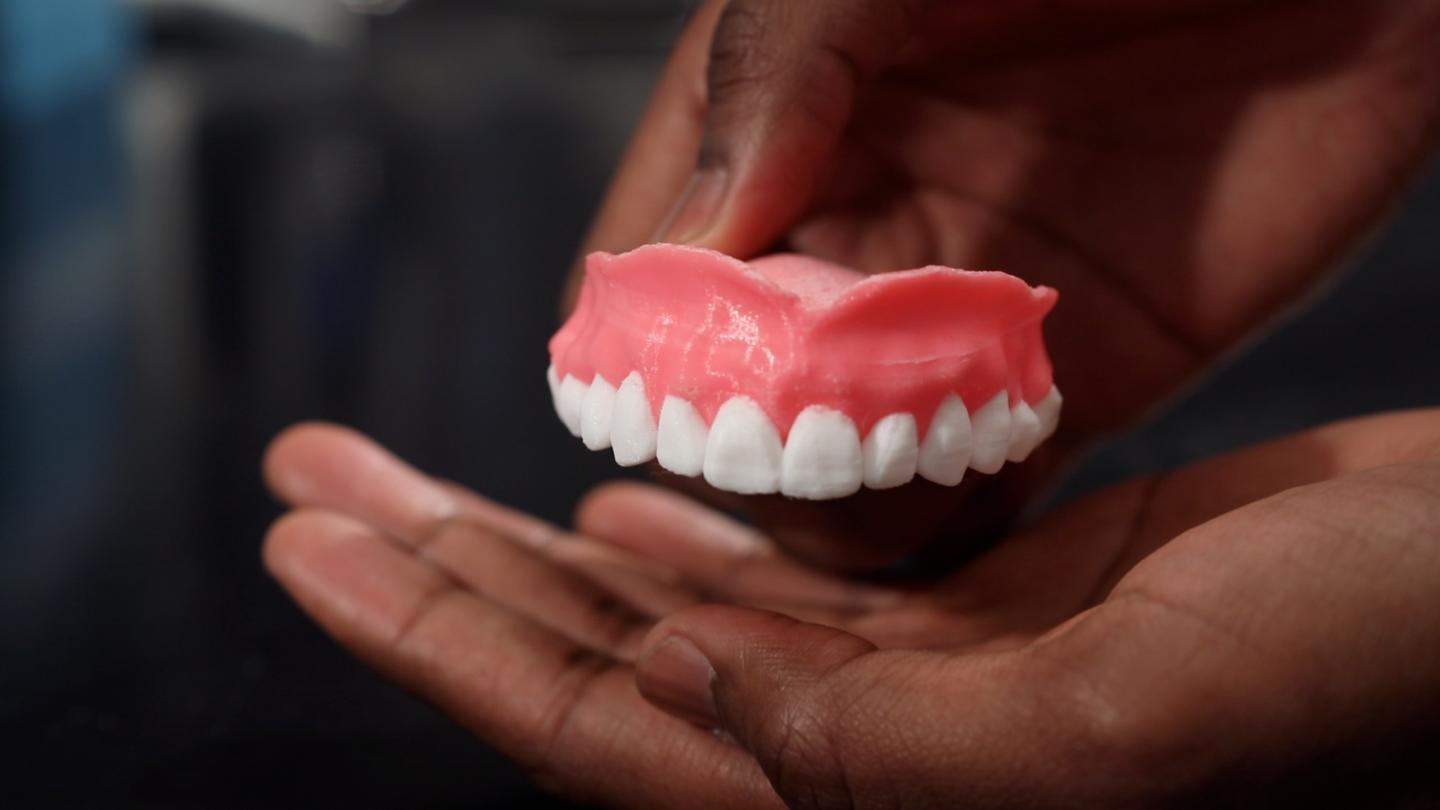
The dentures are printed using acrylamide, the current go-to material for denture fabrication. Credit: Douglas Levere, University at Buffalo
Nearly two-thirds of the U.S. denture-wearing population suffer frequent fungal infections that cause inflammation, redness and swelling in the mouth.
To better treat these infections, called denture-related stomatitis, University at Buffalo researchers have turned to 3-D printers, using the machines to build dentures filled with microscopic capsules that periodically release Amphotericin B, an antifungal medication.
A study describing the work, recently published in Materials Today Communications, found that the drug-filled dentures can reduce fungal growth. Unlike current treatment options, such as antiseptic mouthwashes, baking soda and microwave disinfection, the new development can also help prevent infection while the dentures are in use.
“The major impact of this innovative 3-D printing system is its potential impact on saving cost and time,” says Praveen Arany, DDS, PhD, the study’s senior author and an assistant professor in the Department of Oral Biology in the UB School of Dental Medicine.
The technology allows clinicians to rapidly create customized dentures chair-side, a vast improvement over conventional manufacturing that can vary from a few days to weeks, says Arany, who also has an appointment in UB’s Department of Biomedical Engineering, a joint program in the Jacobs School of Medicine and Biomedical Sciences at UB and the School of Engineering and Applied Sciences.
Applications from this research, says Arany, could be applied to various other clinical therapies, including splints, stents, casts and prosthesis.
“The antifungal application could prove invaluable among those highly susceptible to infection, such as the elderly, hospitalized or disabled patients,” he says.
The dental biomaterials market – worth more than $66 billion in 2015 – is expected to grow 14 percent by 2020. A large part of the industry is focused on dental polymers, particularly the fabrication of dentures.
UB researchers printed their dentures with acrylamide, the current go-to material for denture fabrication. The study sought to determine if these dentures maintained the strength of conventional dentures and if the material could effectively release antifungal medication.
To test the strength of the teeth, researchers used a flexural strength testing machine to bend the dentures and discover their breaking points. A conventional lab-fabricated denture was used as a control. Although the flexural strength of the 3-D printed dentures was 35 percent less than that of the conventional pair, the printed teeth never fractured.
To examine the release of medication in the printed dentures, the team filled the antifungal agent into biodegradable, permeable microspheres. The microspheres protect the drug during the heat printing process, and allow the release of medication as they gradually degrade.
The investigation involved the development of an innovative form of acrylamide designed to carry antifungal payloads, and a novel syringe pump system to combine the dental polymer and microspheres during the printing process.
The dentures were tested with one, five and 10 layers of material to learn if additional layers would allow the dentures to hold more medication. The researchers found the sets with five and 10 layers were impermeable and were not effective at dispensing the medication. Release was not hindered in the more porous single layer, and fungal growth was successfully reduced.
Future research aims to reinforce the mechanical strength of 3-D printed dentures with glass fibers and carbon nanotubes, and focus on denture relining. – the readjustment of dentures to maintain proper fit.