Research & Development World

  • R&D World Home
  • Topics
    • Aerospace
    • Automotive
    • Biotech
    • Careers
    • Chemistry
    • Environment
    • Energy
    • Life Science
    • Material Science
    • R&D Management
    • Physics
  • Technology
    • 3D Printing
    • A.I./Robotics
    • Software
    • Battery Technology
    • Controlled Environments
      • Cleanrooms
      • Graphene
      • Lasers
      • Regulations/Standards
      • Sensors
    • Imaging
    • Nanotechnology
    • Scientific Computing
      • Big Data
      • HPC/Supercomputing
      • Informatics
      • Security
    • Semiconductors
  • R&D Market Pulse
  • R&D 100
    • 2025 R&D 100 Award Winners
    • 2025 Professional Award Winners
    • 2025 Special Recognition Winners
    • R&D 100 Awards Event
    • R&D 100 Submissions
    • Winner Archive
  • Resources
    • Research Reports
    • Digital Issues
    • Educational Assets
    • R&D Index
    • Subscribe
    • Video
    • Webinars
    • Content submission guidelines for R&D World
  • Global Funding Forecast
  • Top Labs
  • Advertise
  • SUBSCRIBE

Experiment Tests “Smart” Antibacterial Surfaces in Outer Space

By CEA Leti | November 15, 2016

The Matiss experiment will test the anti-bacterial properties of materials in space. France’s space agency CNES has selected five advanced materials that should stop bacteria from settling and growing on the surface.

Leti, an institute of CEA Tech, and three French partners are collaborating in a “house-cleaning” project aboard the International Space Station that will investigate antibacterial properties of new materials in a zero-gravity environment to see if they can improve and simplify cleaning inside spacecraft.

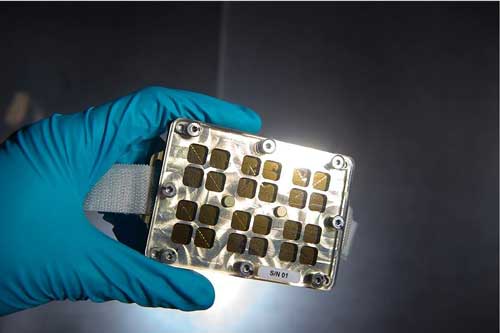
The Matiss experiment, as part of the Proxima Mission sponsored by France’s CNES space agency, is based on four identical plaques that European Space Agency (ESA) astronaut Thomas Pesquet, the 10th French citizen to go into space, will take with him and install when he joins the space station in November for a six-month mission. The plaques will be in the European Columbus laboratory in the space station for at least three months, and Pesquet will bring them back to earth for analysis at the conclusion of his mission.

Leti, in collaboration with the ENS de Lyon, CNRS, the French company Saint Gobain, and CNES, selected five advanced materials that could stop bacteria from settling and growing on “smart” surfaces. A sixth material, made of glass, will be used as control material.

The experiment will test the new smart surfaces in a gravity-free, enclosed environment. These surfaces are called “smart” because of their ability to provide an appropriate response to a given stimulus. For example, they may repel bacteria, prevent them from growing on the surface, or create their own biofilms that protect them from the bacteria.

The materials are a mix of advanced technology — from self-assembly monolayers and green polymers to ceramic polymers and water-repellent hybrid silica. By responding protectively to air-borne bacteria they become easier to clean and more hygienic. The experiment will determine which one is most effective and could lead to antibacterial surfaces on elevator buttons and bars in mass-transit cars, for example.

“Leveraging its unique chemistry platform, Leti has been developing gas, liquid, and supercritical-phase-collective processes of surface functionalization for more than 10 years,” says Guillaume Nonglaton, Leti’s project manager for surface chemistry for biology and health-care applications. “Three Leti-developed surfaces will be part of the space-station experiment: a fluorinated thin layer, an organic silica and a biocompatible polymer. They were chosen for their hydrophobicity, or lack of attraction properties, their level of reproducibility and their rapid integration within Pesquet’s six-month mission.”

Source: CEA Leti
Related Articles Read More >

Researchers discover new form of water
Buildings on Mars could be made of ice
Schmidt Sciences funds orbiting observatory larger than Hubble telescope
NASA rover detected “lightning” on Mars
rd newsletter
EXPAND YOUR KNOWLEDGE AND STAY CONNECTED
Get the latest info on technologies, trends, and strategies in Research & Development.
RD 25 Power Index

R&D World Digital Issues

Fall 2025 issue

Browse the most current issue of R&D World and back issues in an easy to use high quality format. Clip, share and download with the leading R&D magazine today.

R&D 100 Awards
Research & Development World
  • Subscribe to R&D World Magazine
  • Sign up for R&D World’s newsletter
  • Contact Us
  • About Us
  • Drug Discovery & Development
  • Pharmaceutical Processing
  • Global Funding Forecast

Copyright © 2026 WTWH Media LLC. All Rights Reserved. The material on this site may not be reproduced, distributed, transmitted, cached or otherwise used, except with the prior written permission of WTWH Media
Privacy Policy | Advertising | About Us

Search R&D World

  • R&D World Home
  • Topics
    • Aerospace
    • Automotive
    • Biotech
    • Careers
    • Chemistry
    • Environment
    • Energy
    • Life Science
    • Material Science
    • R&D Management
    • Physics
  • Technology
    • 3D Printing
    • A.I./Robotics
    • Software
    • Battery Technology
    • Controlled Environments
      • Cleanrooms
      • Graphene
      • Lasers
      • Regulations/Standards
      • Sensors
    • Imaging
    • Nanotechnology
    • Scientific Computing
      • Big Data
      • HPC/Supercomputing
      • Informatics
      • Security
    • Semiconductors
  • R&D Market Pulse
  • R&D 100
    • 2025 R&D 100 Award Winners
    • 2025 Professional Award Winners
    • 2025 Special Recognition Winners
    • R&D 100 Awards Event
    • R&D 100 Submissions
    • Winner Archive
  • Resources
    • Research Reports
    • Digital Issues
    • Educational Assets
    • R&D Index
    • Subscribe
    • Video
    • Webinars
    • Content submission guidelines for R&D World
  • Global Funding Forecast
  • Top Labs
  • Advertise
  • SUBSCRIBE