
[Image from Adobe Stock]
Google Research posted a 54-page paper to GitHub on Nov. 25 claiming an AI system has closed a 34-year-old theoretical gap in integer factorization, the math problem that underpins RSA encryption. The paper does not break modern encryption, and no outside mathematician has verified it yet.
According to Google, its multi-agent system Cogentic, built on Gemini 4, produced the proof from a single prompt with no further human help. If it holds up, the result matches the speed scaling of the fastest factoring method used in practice without relying on the unproven assumptions cryptographers have leaned on since the early 1990s.
The Google paper describes a randomized algorithm that checks every prime factor deterministically so it never returns a wrong answer, completely factoring any integer N in expected time LN[1⁄3, 105]. In that standard factoring notation, the exponent 1⁄3 matches the number field sieve’s growth rate, improving on the 1⁄2 that Hendrik Lenstra and Carl Pomerance proved in 1992, while 105 is a constant inside an exponential.
The sieve’s own constant, under its heuristic analysis, is about 1.92. The paper’s algorithm also hands every number up to 210,000 to plain trial division, a cutoff far above the 2,048- to 4,096-bit keys RSA commonly uses.
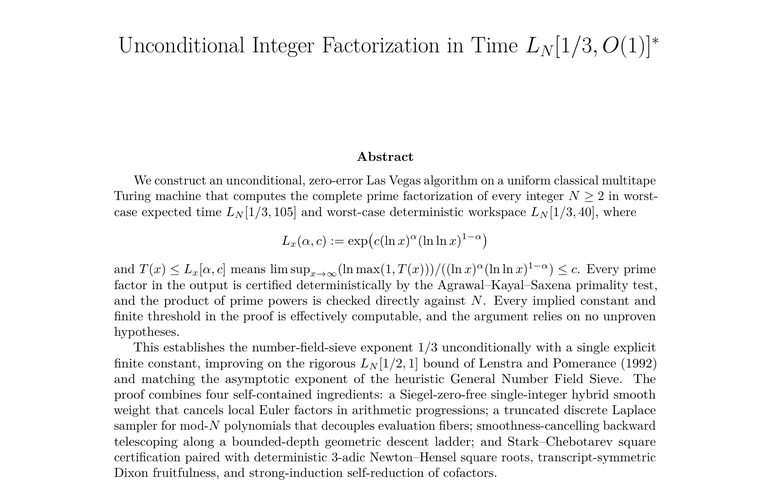
Title and abstract of the Cogentic factoring paper Google Research posted Nov. 25. Credit: Google Research, CC BY 4.0
A second paper in the same Nov. 25 commit drops randomness altogether, targeting deterministic factoring. The paper says every deterministic factoring algorithm proved before it, down to a 2021 bound from University of New South Wales mathematician David Harvey at roughly the fifth root of N (N1/5), scales exponentially with the number of digits. Cogentic’s second paper claims a subexponential worst-case bound of LN[3⁄4], growing slower than any fixed root of N without random coin flips or unproven assumptions.
An earlier subexponential claim exists. In late October, Isaac Rudich and Louis-Martin Rousseau of Polytechnique Montréal posted a note and Lean code claiming that a deterministic machine finds the smallest prime factor of N in subexponential time. The proof came from Anthropic’s Claude, and the two wrote that they audited the formal statement and left the proof to Lean’s checker. Harvey, who flagged the earlier work in an email, said Google’s new results “appear to be a better complexity bound.”
The two factoring preprints arrived inside a six-paper batch that also covers discrete logarithms, approximate Nash equilibria in two-player games, communication complexity and graph reconstruction. That release shifts away from Google’s Sept. 30 preprint introducing Cogentic, which said domain experts independently verified early results produced with Gemini 3.1 Pro and an early version of Gemini 4 Argon. Four Cogentic papers in game theory and learning theory followed between Oct. 30 and Nov. 23, before the Nov. 25 batch claimed single-prompt proofs paired with automated checking. Releasing batches of AI-generated proofs ahead of outside review has already led to quick retractions. After OpenAI released 722 AI-generated math manuscripts on Oct. 6, it withdrew three the next day when a sign error broke one proof and two papers built on it, as R&D World reported.
Google’s new papers await outside review. By midday Nov. 25, as the release passed 300 points on Hacker News, the repository held only PDFs and READMEs. Each README says Cogentic completed a proof in Lean 4, software that checks mathematical steps line by line, using only Mathlib, the community-built Lean math library. The commit says Google will release all six Lean formalizations in a companion submission, allowing outside researchers to run the proof checker and compare the formal statements with the papers’ theorems. Later on Nov. 25, Google revised the batch’s Nash equilibrium paper to cite earlier work, writing that no algorithmic or proof content changed. That afternoon the repository still held only PDFs and READMEs.
Editor’s note: This story was updated Nov. 25 with an earlier deterministic factoring claim, a comment from David Harvey and details from the two factoring papers.


Tell Us What You Think!
You must be logged in to post a comment.