Research & Development World

  • R&D World Home
  • Topics
    • Aerospace
    • Automotive
    • Biotech
    • Careers
    • Chemistry
    • Environment
    • Energy
    • Life Science
    • Material Science
    • R&D Management
    • Physics
  • Technology
    • 3D Printing
    • A.I./Robotics
    • Software
    • Battery Technology
    • Controlled Environments
      • Cleanrooms
      • Graphene
      • Lasers
      • Regulations/Standards
      • Sensors
    • Imaging
    • Nanotechnology
    • Scientific Computing
      • Big Data
      • HPC/Supercomputing
      • Informatics
      • Security
    • Semiconductors
  • R&D Market Pulse
  • R&D 100
    • 2025 R&D 100 Award Winners
    • 2025 Professional Award Winners
    • 2025 Special Recognition Winners
    • R&D 100 Awards Event
    • R&D 100 Submissions
    • Winner Archive
  • Resources
    • Research Reports
    • Digital Issues
    • Educational Assets
    • Subscribe
    • Video
    • Webinars
    • PharmSci360
    • Content submission guidelines for R&D World
  • Global Funding Forecast
  • Top Labs
  • Advertise
  • SUBSCRIBE

Individual Impurity Atoms Found in Graphene Ribbons

By University of Basel | April 16, 2018

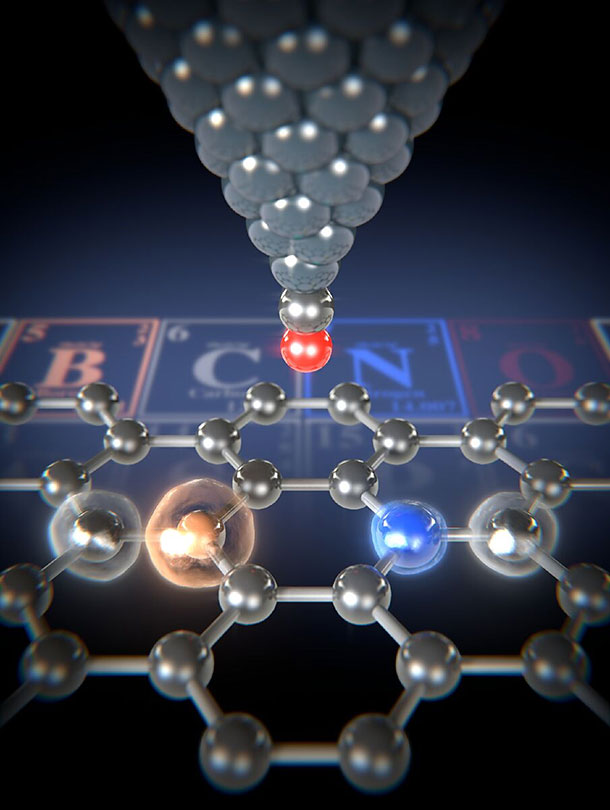
Using the atomic force microscope’s carbon monoxide functionalized tip (red/silver), the forces between the tip and the various atoms in the graphene ribbon can be measured. The smallest forces are measured between the tip and the boron atom (light brown). The carbon atoms (silver) and the nitrogen atoms (blue) can also be clearly identified in the graphene’s hexagonal lattice. Image: University of Basel, Department of Physics

A team including physicists from the University of Basel has succeeded in using atomic force microscopy to clearly obtain images of individual impurity atoms in graphene ribbons. Thanks to the forces measured in the graphene’s two-dimensional carbon lattice, they were able to identify boron and nitrogen for the first time, as the researchers report in the journal Science Advances.

Graphene is made of a two-dimensional layer of carbon atoms arranged in a hexagonal lattice. The strong bonds between the carbon atoms make graphene extremely stable yet flexible. It is also an excellent electrical conductor through which electricity can flow with almost no loss.

Graphene’s distinctive properties can be further expanded by incorporating impurity atoms in a process known as “doping”. The impurity atoms cause local changes of the conduction that, for example, allow graphene to be used as a tiny transistor and enable the construction of circuits.

In a collaboration between scientists from the University of Basel and the National Institute for Material Science in Tsukuba in Japan, Kanazawa University and Kwansei Gakuin University in Japan, and Aalto University in Finland, the researchers specifically created and examined graphene ribbons containing impurity atoms.

They replaced particular carbon atoms in the hexagonal lattice with boron and nitrogen atoms using surface chemistry, by placing suitable organic precursor compounds on a gold surface. Under heat exposure up to 400 degrees C, tiny graphene ribbons formed on the gold surface from the precursors, including impurity atoms at specific sites.

Scientists from the team led by Professor Ernst Meyer from the Swiss Nanoscience Institute and the University of Basel’s Department of Physics examined these graphene ribbons using atomic force microscopy (AFM). They used a carbon monoxide functionalized tip and measured the tiny forces that act between the tip and the individual atoms.

This method allows even the smallest differences in forces to be detected. By looking at the different forces, the researchers were able to map and identify the different atoms. “The forces measured for nitrogen atoms are greater than for a carbon atom,” explains Dr. Shigeki Kawai, lead author of the study and former postdoc in Meyer’s team. “We measured the smallest forces for the boron atoms.” The different forces can be explained by the different proportion of repulsive forces, which is due to the different atomic radii.

Computer simulations confirmed the readings, proving that AFM technology is well-suited to conducting chemical analyses of impurity atoms in the promising two-dimensional carbon compounds.

Source: University of Basel
Related Articles Read More >

The emerging materials shaping next-generation semiconductor electronics
24 R&D trends that redefined 2024
Graphene-based flowmeter sensor measures nano-rate fluid flows, Part 3: The sensor
Graphene-based flowmeter sensor measures nano-rate fluid flows, Part 2: The graphene context
rd newsletter
EXPAND YOUR KNOWLEDGE AND STAY CONNECTED
Get the latest info on technologies, trends, and strategies in Research & Development.

R&D World Digital Issues

Fall 2025 issue

Browse the most current issue of R&D World and back issues in an easy to use high quality format. Clip, share and download with the leading R&D magazine today.

R&D 100 Awards
Research & Development World
  • Subscribe to R&D World Magazine
  • Sign up for R&D World’s newsletter
  • Contact Us
  • About Us
  • Drug Discovery & Development
  • Pharmaceutical Processing
  • Global Funding Forecast

Copyright © 2026 Arrowfly LLC. All Rights Reserved. The material on this site may not be reproduced, distributed, transmitted, cached or otherwise used, except with the prior written permission of Arrowfly
Privacy Policy | Advertising | About Us

Search R&D World

  • R&D World Home
  • Topics
    • Aerospace
    • Automotive
    • Biotech
    • Careers
    • Chemistry
    • Environment
    • Energy
    • Life Science
    • Material Science
    • R&D Management
    • Physics
  • Technology
    • 3D Printing
    • A.I./Robotics
    • Software
    • Battery Technology
    • Controlled Environments
      • Cleanrooms
      • Graphene
      • Lasers
      • Regulations/Standards
      • Sensors
    • Imaging
    • Nanotechnology
    • Scientific Computing
      • Big Data
      • HPC/Supercomputing
      • Informatics
      • Security
    • Semiconductors
  • R&D Market Pulse
  • R&D 100
    • 2025 R&D 100 Award Winners
    • 2025 Professional Award Winners
    • 2025 Special Recognition Winners
    • R&D 100 Awards Event
    • R&D 100 Submissions
    • Winner Archive
  • Resources
    • Research Reports
    • Digital Issues
    • Educational Assets
    • Subscribe
    • Video
    • Webinars
    • PharmSci360
    • Content submission guidelines for R&D World
  • Global Funding Forecast
  • Top Labs
  • Advertise
  • SUBSCRIBE