Idaho National Laboratory (INL) is collaborating with Argonne, Oak Ridge and Sandia National Laboratories, as well as four universities and more than 20 industry partners, on a three-year project to bring agentic AI to nuclear engineering. The principal investigator said the project, called Prometheus, will aim to compress the time to get a nuclear power plant up and running. In the short term, the consortium will focus on getting iterative feedback.
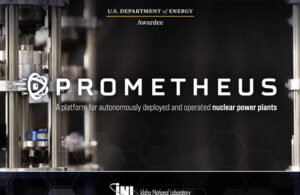
INL’s Prometheus project was selected for the Genesis Mission. [Image courtesy of INL]
INL announced the project as an INL-Nvidia partnership in February, and the Department of Energy (DOE) selected it for a Genesis Mission second-phase award in July after nine months as a kickstart seed team under the mission. The project will receive $60 million in funding for a three-year execution window, subject to appropriations.
“Using these AI technologies, leveraging our partners, we hope to reduce the time it takes to deploy a power plant to about half of what it takes today, and then reduce the operating costs of a plant by about half in the future,” Suyderhoud said.
Industry partners on the project include Nvidia and AWS as well as reactor developers including X-energy and TerraPower.
The first step is to determine, “Where does an agent make sense, and, on the flip side, where do we think an agent may actually complicate things? Because that could very well be the case. We don’t have that definitive evidence,” Suyderhoud said.
Every AI advantage claim will be measured against a documented non-AI baseline established before any AI-assisted workflow runs, according to the project page on INL’s website. The investigators will also publish baseline datasets and evaluation protocols through the Genesis Mission Platform at each milestone.
The platform will be composed of agents that encode logic and behavior mimicking how people perform nuclear engineering tasks today, along with the software tools engineers already use, Suyderhoud said. He used Excel as an example. “We click buttons, we use shortcuts and we perform work directly in that tool,” he said. “Instead, the agent takes over that job at the instruction of the user.”
After building and testing the program in the first year, the project will use years two and three to extend workflows and scale the platform, he said. The project is aiming for initial deployment on the Genesis Mission Platform by March 2027, according to INL’s website.
In addition to nuclear, Suyderhoud said the platform could be applied to other domains, such as fusion and geothermal energy.
“We didn’t invent AI for nuclear in the last five or six months. We’ve been building the blocks within the laboratory complex over the past five, ten years. The Genesis Mission provides that convenient opportunity to scale it,” Suyderhoud said.


Tell Us What You Think!
You must be logged in to post a comment.