Research & Development World

  • R&D World Home
  • Topics
    • Aerospace
    • Automotive
    • Biotech
    • Careers
    • Chemistry
    • Environment
    • Energy
    • Life Science
    • Material Science
    • R&D Management
    • Physics
  • Technology
    • 3D Printing
    • A.I./Robotics
    • Software
    • Battery Technology
    • Controlled Environments
      • Cleanrooms
      • Graphene
      • Lasers
      • Regulations/Standards
      • Sensors
    • Imaging
    • Nanotechnology
    • Scientific Computing
      • Big Data
      • HPC/Supercomputing
      • Informatics
      • Security
    • Semiconductors
  • R&D Market Pulse
  • R&D 100
    • 2025 R&D 100 Award Winners
    • 2025 Professional Award Winners
    • 2025 Special Recognition Winners
    • R&D 100 Awards Event
    • R&D 100 Submissions
    • Winner Archive
  • Resources
    • Research Reports
    • Digital Issues
    • Educational Assets
    • R&D Index
    • Subscribe
    • Video
    • Webinars
    • Content submission guidelines for R&D World
  • Global Funding Forecast
  • Top Labs
  • Advertise
  • SUBSCRIBE

Large-Scale and Sustainable 3D Printing With the Most Ubiquitous Natural Material

By Singapore University of Technology and Design | June 6, 2018

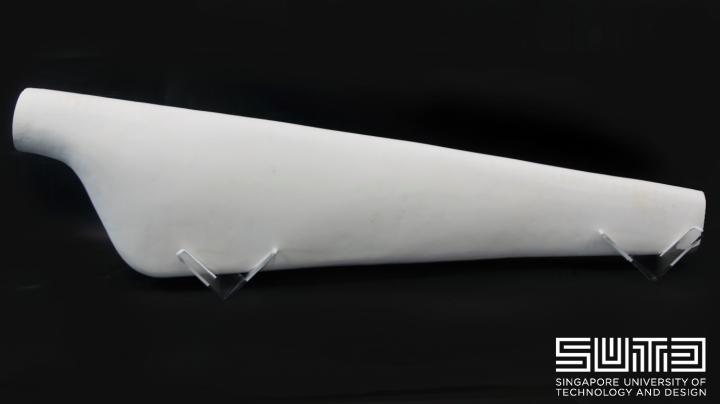
1.2m, 5.2kg turbine blade fabricated entirely with cellulose and chitosan, the most ubiquitous biopolymers on earth and produced in large amounts in almost every ecosystem. Both ingredients are obtained from by-products of the industry, resulting in production with negative ecological footprint. Credit: SUTD

Cellulose is one of the most abundant and broadly distributed organic compound and industrial by-product on Earth. Yet, despite decades of extensive research, the bottom-up use of cellulose to fabricate 3D objects is still plagued with problems that restrict its practical applications: derivatives with vast polluting effects, used in combination with plastics, lack of scalability and high production cost.

However, researchers from the Singapore University of Technology and Design (SUTD) have recently demonstrated the use of cellulose to sustainably manufacture/fabricate large 3D objects. Their approach diverges from the common association of cellulose with green plants and is inspired by the wall of the fungus-like oomycetes, which is reproduced introducing small amounts of chitin between cellulose fibers. The resulting fungal-like adhesive material(s) (FLAM) are strong, lightweight and inexpensive, and can be molded or processed using woodworking techniques.

This material is completely ecologically sustainable as no organic solvents or synthetic plastics were used to manufacture it. It is scalable and can be reproduced anywhere without specialised facilities. FLAM is also fully biodegradable in natural conditions and outside composting facilities. The cost of FLAM is in the range of commodity plastics and 10 times lower than the cost of common filaments for 3D printing, such as PLA (polylactic acid) and ABS (Acrylonitrile Butadiene Styrene), making it not only more sustainable but also a more cost-effective substitute. The researchers have furthermore developed an additive manufacturing technique specific for the material.

Co-lead of this research, SUTD Assistant Prof Javier Gomez Fernandez, also known for the development of Shrilk said: “We believe this first large-scale additive manufacturing process with the most ubiquitous biological polymers on earth will be the catalyst for the transition to environmentally benign and circular manufacturing models, where materials are produced, used, and degraded in closed regional systems. This reproduction and manufacturing with the material composition found in the oomycete wall, namely unmodified cellulose, small amounts of chitosan –the second most abundant organic molecule on earth — and low concentrated acetic acid, is probably one of the most successful technological achievements in the field of bioinspired materials.”

Co-lead SUTD Assistant Prof Stylianos Dritsas, added: “We believe the results reported here represent a turning point for global manufacturing with broader impact on multiple areas ranging from material science, environmental engineering, automation and the economy. So far we have been focusing on fundamental technology development, and little time has been invested in specific target applications. We are now at the stage of seeking industrial collaborators to bring this technology from the laboratory to the world.”

With the increase in waste and pollution, the urgency for more sustainable manufacturing processes is growing. The establishment of a technology based on unmodified compostable polymers of great abundance that does not require cropland or forest resources, will foster the transition to environmentally benign manufacturing and a sustainable society.

This research was published in the 5th June edition of the journal Scientific Reports.
Related Articles Read More >

R&D 100 winner LLNL achieves 1,000x speed boost in 3D nanofabrication
Caltech team 3D-prints drug depots deep inside living tissue
What could make MXene a key to ultra-precise, additive-free 3D microprinting?
Industry 4.0 Modern Factory: Facility Operator Controls Workshop Production Line, Uses Computer with Screens Showing Complex UI of Machine Operation Processes, Controllers, Machinery Blueprints
Building the thinking factory: An additive exec on AI, automation, and the skills crisis
rd newsletter
EXPAND YOUR KNOWLEDGE AND STAY CONNECTED
Get the latest info on technologies, trends, and strategies in Research & Development.
RD 25 Power Index

R&D World Digital Issues

Fall 2025 issue

Browse the most current issue of R&D World and back issues in an easy to use high quality format. Clip, share and download with the leading R&D magazine today.

R&D 100 Awards
Research & Development World
  • Subscribe to R&D World Magazine
  • Sign up for R&D World’s newsletter
  • Contact Us
  • About Us
  • Drug Discovery & Development
  • Pharmaceutical Processing
  • Global Funding Forecast

Copyright © 2026 WTWH Media LLC. All Rights Reserved. The material on this site may not be reproduced, distributed, transmitted, cached or otherwise used, except with the prior written permission of WTWH Media
Privacy Policy | Advertising | About Us

Search R&D World

  • R&D World Home
  • Topics
    • Aerospace
    • Automotive
    • Biotech
    • Careers
    • Chemistry
    • Environment
    • Energy
    • Life Science
    • Material Science
    • R&D Management
    • Physics
  • Technology
    • 3D Printing
    • A.I./Robotics
    • Software
    • Battery Technology
    • Controlled Environments
      • Cleanrooms
      • Graphene
      • Lasers
      • Regulations/Standards
      • Sensors
    • Imaging
    • Nanotechnology
    • Scientific Computing
      • Big Data
      • HPC/Supercomputing
      • Informatics
      • Security
    • Semiconductors
  • R&D Market Pulse
  • R&D 100
    • 2025 R&D 100 Award Winners
    • 2025 Professional Award Winners
    • 2025 Special Recognition Winners
    • R&D 100 Awards Event
    • R&D 100 Submissions
    • Winner Archive
  • Resources
    • Research Reports
    • Digital Issues
    • Educational Assets
    • R&D Index
    • Subscribe
    • Video
    • Webinars
    • Content submission guidelines for R&D World
  • Global Funding Forecast
  • Top Labs
  • Advertise
  • SUBSCRIBE