The Faraday Cage Effect is well known. Examples of it include the blocking of radio signals by the Sydney Harbour Bridge, as well as the metal shielding that surrounds MRI machines in hospitals, used to reduce interference from microwave signals.
Scientists hard pressed to find a way to switch off forces that keep molecules stuck to 2D materials at the nanoscale say they have understood how it is possible, paving the way for the development of better filters that could be used to remove toxins from the air or store hydrogen and greenhouse gases.
The research published in Proceedings of the National Academy of Sciences points to a reassessment of how van der Waals forces function, with potentially significant implications for nanotechnology and nanomedicine.
The collaboration between Griffith University, Shanghai University, and the University of Technology Sydney (UTS) used the concept of a Faraday Cage to theoretically model switching off the van der Waals forces that exist between molecules that, although considered weak, act as a “glue” keeping things stuck to them.
However, functionality is limited. So things stick, but stay stuck. What is needed is a way to release them on demand.
Co-author Emeritus Professor John Dobson from Griffith University says van der Waals force is usually thought of as being cumulative like gravity, “the more mass that comes together, the greater the force.”
“The insights revealed here have come following 20 years of research into the van der Waals force, showing that it is not always cumulative, unlike gravity. It is possible to switch it on and off and to amplify it, one just needs the right nanostructures,” he says.
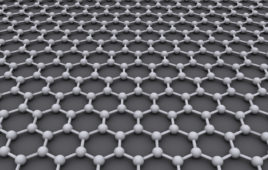
PhD student Musen Li from Shanghai University, who conducted the research, took two silica bilayers, mimicking 2D materials of possible use in filters and other devices, and inserted in between them a sheet of graphene.
“First-principles quantum mechanical calculations using Dr. Tim Gould’s code then showed how the quantum van der Waals force could be switched off by the graphene acting as a classical Faraday Cage,” he says.
“To make this work in practice now presents an engineering challenge. We need a way of inserting graphene between one 2D material to which the desired molecules have stuck, and a backing large material that provide the van der Waals force for the sticking.”
Lead researcher Gould, from Griffith University’s Queensland Micro- and Nanotechnology Centre, developed the methods used to model switching-off the van der Waals forces, bridging Dobson’s higher theory with practical calculations.
“The fact that we know you can model it means that the engineers will someday find a way of doing it,” he says. “In particular, if you could switch this effect on and off you would have a way of storing stuff on a surface then releasing it in a controllable way.
“The next question is well what can we do with this. And the obvious one is we can control filtration — we can create systems where we can make things stick and then unstick, or we can make better glues, increase friction or reduce friction.
“There’s no evidence that you can switch off gravity, and previously people thought you couldn’t switch off van der Waals forces — we now have understood how you can. This opens up a wide range of new nanotechnologies that could exploit this effect. Rather than having to rely on mechanical release or by heating things up, processes that cost a lot of energy, you might be able to rely on the intrinsic properties of the materials you’ve got.”
Professor Jeffrey Reimers from Shanghai University and University of Technology Sydney, a co-lead on the study, first proposed the research during his national lecture tour, after receiving the Australian Academy of Science’s David Craig Medal for Chemical Research in 2016.
“The Faraday Cage Effect is well known. Examples of it include the blocking of radio signals by the Sydney Harbour Bridge, as well as the metal shielding that surrounds MRI machines in hospitals, used to reduce interference from microwave signals” he says.
“If we could replicate this at the nanoscale, using 2D materials such as graphene, then we could capture and ‘unstick’ molecules we want to remove on demand, making 2D filtering technologies feasible in principle.”
Dobson says that, for more than a century, thinking about the van der Waals force as being cumulative, like gravity, has led to a great wealth of understanding concerning chemical, biochemical, and materials function.
“It is more subtle than that though, and we are just beginning to understand its potential as a control element in nanotechnology and nanomedicine,” he says.
Source: Griffith University