Ground controllers at NASA’s Ames Research Center in Moffett Field, Calif., have confirmed that NASA’s Lunar Atmosphere and Dust Environment Explorer (LADEE) spacecraft impacted the surface of the moon, as planned, between 9:30 and 10:22 p.m. PDT on April 17.
LADEE lacked fuel to maintain a long-term lunar orbit or continue science operations and was intentionally sent into the lunar surface. The spacecraft’s orbit naturally decayed following the mission’s final low-altitude science phase.
During impact, engineers believe the LADEE spacecraft, the size of a vending machine, broke apart, with most of the spacecraft’s material heating up several hundred degrees – or even vaporizing – at the surface. Any material that remained is likely buried in shallow craters.
“At the time of impact, LADEE was traveling at a speed of 3,600 miles per hour – about three times the speed of a high-powered rifle bullet,” says Rick Elphic, LADEE project scientist at Ames. “There’s nothing gentle about impact at these speeds – it’s just a question of whether LADEE made a localized craterlet on a hillside or scattered debris across a flat area. It will be interesting to see what kind of feature LADEE has created.”
In early April, the spacecraft was commanded to carry out maneuvers that would lower its closest approach to the lunar surface. The new orbit brought LADEE to altitudes below one mile above the lunar surface. This is lower than most commercial airliners fly above Earth, enabling scientists to gather unprecedented science measurements.
On April 11, LADEE performed a final maneuver to ensure a trajectory that caused the spacecraft to impact the far side of the moon, which is not in view of Earth or near any previous lunar mission landings. LADEE also survived the total lunar eclipse on April 14 to 15. This demonstrated the spacecraft’s ability to endure low temperatures and a drain on batteries as it, and the moon, passed through Earth’s deep shadow.
In the coming months, mission controllers will determine the exact time and location of LADEE’s impact and work with the agency’s Lunar Reconnaissance Orbiter (LRO) team to possibly capture an image of the impact site. Launched in June 2009, LRO provides data and detailed images of the lunar surface.
“It’s bittersweet knowing we have received the final transmission from the LADEE spacecraft after spending years building it in-house at Ames, and then being in constant contact as it circled the moon for the last several months,” says Butler Hine, LADEE project manager at Ames.
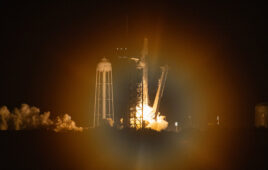
Launched in September 2013 from NASA’s Wallops Flight Facility in Virginia, LADEE began orbiting the moon Oct. 6 and gathering science data Nov. 10. The spacecraft entered its science orbit around the moon’s equator on Nov. 20, and in March 2014, LADEE extended its mission operations following a highly successful 100-day primary science phase.
LADEE also hosted NASA’s first dedicated system for two-way communication using laser instead of radio waves. The Lunar Laser Communication Demonstration made history using a pulsed laser beam to transmit data over the 239,000 miles from the moon to the Earth at a record-breaking download rate of 622 megabits-per-second. In addition, an error-free data upload rate of 20 Mbps was transmitted from the primary ground station in New Mexico to the Laser Communications Space Terminal aboard LADEE.
LADEE gathered detailed information about the structure and composition of the thin lunar atmosphere. In addition, scientists hope to use the data to address a long-standing question: Was lunar dust, electrically charged by sunlight, responsible for the pre-sunrise glow seen above the lunar horizon during several Apollo missions?
“LADEE was a mission of firsts, achieving yet another first by successfully flying more than 100 orbits at extremely low altitudes,” says Joan Salute, LADEE program executive, at NASA Headquarters in Washington. “Although a risky decision, we’re already seeing evidence that the risk was worth taking.”
A thorough understanding of the characteristics of our nearest celestial neighbor will help researchers understand other bodies in the solar system, such as large asteroids, Mercury and the moons of outer planets.
NASA also included the public in the final chapter of the LADEE story. A “Take the Plunge” contest provided an opportunity for the public to guess the date and time of the spacecraft’s impact via the internet. Thousands submitted predictions. NASA will provide winners a digital congratulatory certificate.
NASA’s Science Mission Directorate in Washington funds the LADEE mission. Ames was responsible for spacecraft design, development, testing and mission operations, in addition to managing the overall mission. To ensure the spacecraft was uncontaminated before it was launched into space, all testing was performed in cleanroom conditions at NASA’s Ames Research Center at Moffett Field, Calif., and National Technical Systems’ Santa Clarita, Calif. facility. Ames is responsible for managing the mission, building the spacecraft, and performing mission operations.
NASA’s Goddard Space Flight Center in Greenbelt, Md., managed the science instruments, technology demonstration payload and science operations center, and provided mission support. Goddard also manages the LRO mission. Wallops was responsible for launch vehicle integration, launch services and operations. NASA’s Marshall Space Flight Center in Huntsville, Ala., managed LADEE within the Lunar Quest Program Office.
Release Date: April 18, 2014
Source: NASA